 Add to Chrome
 Add to Firefox
 Add to Edge
Diagnosing Aerial-View Object Detectors with Foundational Image Generative Models
Jul 02, 2026
Recent advances in large-scale image generative models enable photorealistic scene synthesis with controllable attributes. Beyond data augmentation, their potential as diagnostic tools for trained vision systems remains unexplored in the aerial and remote sensing domains. We introduce a synthetic diagnostic framework for aerial-view vehicle detection that combines text-guided generation, attribute-controlled editing, and automated attribute verification to construct a controllable synthetic testbed. This enables fine-grained evaluation of pretrained detectors under diverse scene types and environmental conditions that are difficult to isolate in real datasets. Across three detection architectures and three real aerial datasets, synthetic scene-wise performance trends closely match real-world weaknesses. Guided by these diagnostics, targeted supplementation with small real datasets from the identified weak categories yields improvements of up to 13% AP50 while requiring substantially fewer additional samples than non-targeted augmentation. Our results show that controlled synthetic probing can predict real-domain performance gaps and guide efficient data collection. The proposed diagnostic framework is modular and can incorporate alternative generative or vision-language models as capabilities evolve. Our code and datasets are available here: https://humansensinglab.github.io/AVODDiag/

GraphIP-Bench: How Hard Is It to Steal a Graph Neural Network, and Can We Stop It?
May 12, 2026Graph neural networks (GNNs) deployed as cloud services can be \emph{stolen} through \emph{model-extraction attacks}, which train a surrogate from query responses to reproduce the target's behaviour, and a growing line of ownership defenses tries to prevent or trace such theft. The title of this paper asks two questions: \emph{how hard is it to steal a GNN?}, and \emph{can we stop it?} Prior work cannot answer either, because experiments use inconsistent datasets, threat models, and metrics. We introduce \emph{GraphIP-Bench}, a unified benchmark which evaluates both sides under a single black-box protocol. It integrates twelve extraction attacks, twelve defenses spanning watermarking, output-perturbation, and query-pattern-detection families, ten public graphs covering homophilic, heterophilic, and large-scale regimes, three GNN backbones, and three graph-learning tasks, and it reports fidelity, task utility, ownership verification, and computational cost on shared splits, queries, and budgets. We further add a joint attack-and-defense track which runs every attack on every defended target and measures watermark verification on the resulting surrogate, which exposes the protection that a defense retains after extraction. The empirical picture is short: stealing a GNN is easy at medium query budgets and most defenses do not change this; several watermarks verify reliably on the protected model but lose most of their verification signal on the extracted surrogate, which exposes a gap that single-model evaluations miss; and heterophilic graphs are systematically harder to steal, while a cross-architecture mismatch between target and surrogate reduces but does not prevent extraction. Code: \href{https://github.com/LabRAI/GraphIP-Bench}{LabRAI/GraphIP-Bench}.
An Analysis of Active Learning Algorithms using Real-World Crowd-sourced Text Annotations
Apr 25, 2026Active learning algorithms automatically identify the most informative samples from large amounts of unlabeled data and tremendously reduce human annotation effort in inducing a machine learning model. In a conventional active learning setup, the labeling oracles are assumed to be infallible, that is, they always provide correct answers (in terms of class labels) to the queried unlabeled instances, which cannot be guaranteed in real-world applications. To this end, a body of research has focused on the development of active learning algorithms in the presence of imperfect / noisy oracles. Existing research on active learning with noisy oracles typically simulate the oracles using machine learning models; however, real-world situations are much more challenging, and using ML models to simulate the annotation patterns may not appropriately capture the nuances of real-world annotation challenges. In this research, we first collect annotations of text samples (from 3 benchmark text classification datasets) from crowd-sourced workers through a crowd-sourcing platform. We then conduct extensive empirical studies of 8 commonly used active learning techniques (in conjunction with deep neural networks) using the obtained annotations. Our analyses sheds light on the performance of these techniques under real-world challenges, where annotators can provide incorrect labels, and can also refuse to provide labels. We hope this research will provide valuable insights that will be useful for the deployment of deep active learning systems in real-world applications. The obtained annotations can be accessed at https://github.com/varuntotakura/al_rcta/.
* The proposed dataset can be accessed at https://github.com/varuntotakura/al_rcta/. To appear in Proceedings of the IEEE International Joint Conference on Neural Networks (IJCNN 2026)
MetaErr: Towards Predicting Error Patterns in Deep Neural Networks
Apr 25, 2026Due to the unprecedented success of deep learning, it has become an integral component in several multimedia computing applications in todays world. Unfortunately, deep learning systems are not perfect and can fail, sometimes abruptly, without prior warning or explanation. While reducing the error rate of deep neural networks has been the primary focus of the multimedia community, the problem of predicting when a deep learning system is going to fail has received significantly less research attention. In this paper, we propose a simple yet effective framework, MetaErr, to address this under-explored problem in deep learning research. We train a meta-model whose goal is to predict whether a base deep neural network will succeed or fail in predicting a particular data sample, by observing the base models performance on a given learning task. The meta-model is completely agnostic of the architecture and training parameters of the base model. Such an error prediction system can be immensely useful in a variety of smart multimedia applications. Our empirical studies corroborate the promise and potential of our framework against competing baselines. We further demonstrate the usefulness of our framework to improve the performance of pseudo-labeling-based semi-supervised learning, and show that MetaErr outperforms several strong baselines on three benchmark computer vision datasets.
* Accepted and presented at the IEEE International Conference on SMART MULTIMEDIA (ICSM 2025)
In-the-Wild Camouflage Attack on Vehicle Detectors through Controllable Image Editing
Mar 19, 2026Deep neural networks (DNNs) have achieved remarkable success in computer vision but remain highly vulnerable to adversarial attacks. Among them, camouflage attacks manipulate an object's visible appearance to deceive detectors while remaining stealthy to humans. In this paper, we propose a new framework that formulates vehicle camouflage attacks as a conditional image-editing problem. Specifically, we explore both image-level and scene-level camouflage generation strategies, and fine-tune a ControlNet to synthesize camouflaged vehicles directly on real images. We design a unified objective that jointly enforces vehicle structural fidelity, style consistency, and adversarial effectiveness. Extensive experiments on the COCO and LINZ datasets show that our method achieves significantly stronger attack effectiveness, leading to more than 38% AP50 decrease, while better preserving vehicle structure and improving human-perceived stealthiness compared to existing approaches. Furthermore, our framework generalizes effectively to unseen black-box detectors and exhibits promising transferability to the physical world. Project page is available at https://humansensinglab.github.io/CtrlCamo
CITED: A Decision Boundary-Aware Signature for GNNs Towards Model Extraction Defense
Feb 23, 2026Graph neural networks (GNNs) have demonstrated superior performance in various applications, such as recommendation systems and financial risk management. However, deploying large-scale GNN models locally is particularly challenging for users, as it requires significant computational resources and extensive property data. Consequently, Machine Learning as a Service (MLaaS) has become increasingly popular, offering a convenient way to deploy and access various models, including GNNs. However, an emerging threat known as Model Extraction Attacks (MEAs) presents significant risks, as adversaries can readily obtain surrogate GNN models exhibiting similar functionality. Specifically, attackers repeatedly query the target model using subgraph inputs to collect corresponding responses. These input-output pairs are subsequently utilized to train their own surrogate models at minimal cost. Many techniques have been proposed to defend against MEAs, but most are limited to specific output levels (e.g., embedding or label) and suffer from inherent technical drawbacks. To address these limitations, we propose a novel ownership verification framework CITED which is a first-of-its-kind method to achieve ownership verification on both embedding and label levels. Moreover, CITED is a novel signature-based method that neither harms downstream performance nor introduces auxiliary models that reduce efficiency, while still outperforming all watermarking and fingerprinting approaches. Extensive experiments demonstrate the effectiveness and robustness of our CITED framework. Code is available at: https://github.com/LabRAI/CITED.
ACIL: Active Class Incremental Learning for Image Classification
Feb 04, 2026Continual learning (or class incremental learning) is a realistic learning scenario for computer vision systems, where deep neural networks are trained on episodic data, and the data from previous episodes are generally inaccessible to the model. Existing research in this domain has primarily focused on avoiding catastrophic forgetting, which occurs due to the continuously changing class distributions in each episode and the inaccessibility of the data from previous episodes. However, these methods assume that all the training samples in every episode are annotated; this not only incurs a huge annotation cost, but also results in a wastage of annotation effort, since most of the samples in a given episode will not be accessible to the model in subsequent episodes. Active learning algorithms identify the salient and informative samples from large amounts of unlabeled data and are instrumental in reducing the human annotation effort in inducing a deep neural network. In this paper, we propose ACIL, a novel active learning framework for class incremental learning settings. We exploit a criterion based on uncertainty and diversity to identify the exemplar samples that need to be annotated in each episode, and will be appended to the data in the next episode. Such a framework can drastically reduce annotation cost and can also avoid catastrophic forgetting. Our extensive empirical analyses on several vision datasets corroborate the promise and potential of our framework against relevant baselines.
Adapting Vehicle Detectors for Aerial Imagery to Unseen Domains with Weak Supervision
Jul 28, 2025Detecting vehicles in aerial imagery is a critical task with applications in traffic monitoring, urban planning, and defense intelligence. Deep learning methods have provided state-of-the-art (SOTA) results for this application. However, a significant challenge arises when models trained on data from one geographic region fail to generalize effectively to other areas. Variability in factors such as environmental conditions, urban layouts, road networks, vehicle types, and image acquisition parameters (e.g., resolution, lighting, and angle) leads to domain shifts that degrade model performance. This paper proposes a novel method that uses generative AI to synthesize high-quality aerial images and their labels, improving detector training through data augmentation. Our key contribution is the development of a multi-stage, multi-modal knowledge transfer framework utilizing fine-tuned latent diffusion models (LDMs) to mitigate the distribution gap between the source and target environments. Extensive experiments across diverse aerial imagery domains show consistent performance improvements in AP50 over supervised learning on source domain data, weakly supervised adaptation methods, unsupervised domain adaptation methods, and open-set object detectors by 4-23%, 6-10%, 7-40%, and more than 50%, respectively. Furthermore, we introduce two newly annotated aerial datasets from New Zealand and Utah to support further research in this field. Project page is available at: https://humansensinglab.github.io/AGenDA
FedAR: Addressing Client Unavailability in Federated Learning with Local Update Approximation and Rectification
Jul 26, 2024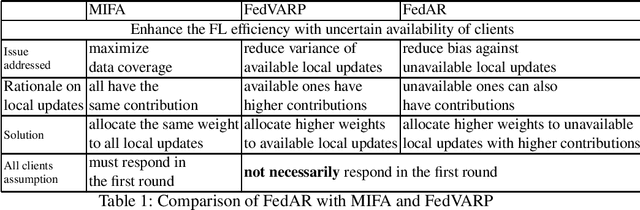
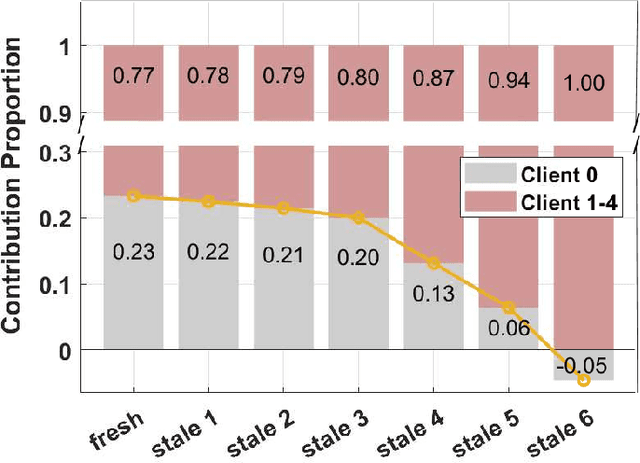
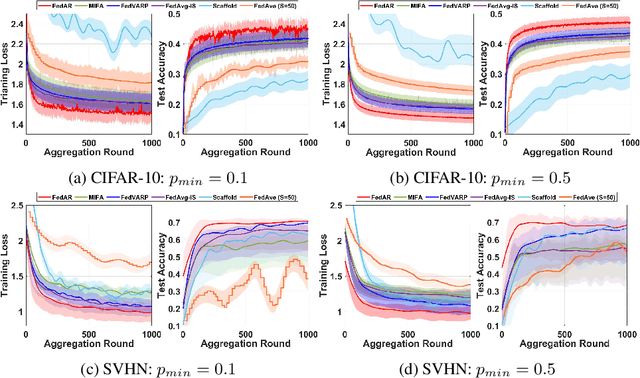
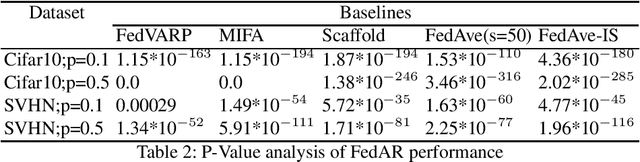
Federated learning (FL) enables clients to collaboratively train machine learning models under the coordination of a server in a privacy-preserving manner. One of the main challenges in FL is that the server may not receive local updates from each client in each round due to client resource limitations and intermittent network connectivity. The existence of unavailable clients severely deteriorates the overall FL performance. In this paper, we propose , a novel client update Approximation and Rectification algorithm for FL to address the client unavailability issue. FedAR can get all clients involved in the global model update to achieve a high-quality global model on the server, which also furnishes accurate predictions for each client. To this end, the server uses the latest update from each client as a surrogate for its current update. It then assigns a different weight to each client's surrogate update to derive the global model, in order to guarantee contributions from both available and unavailable clients. Our theoretical analysis proves that FedAR achieves optimal convergence rates on non-IID datasets for both convex and non-convex smooth loss functions. Extensive empirical studies show that FedAR comprehensively outperforms state-of-the-art FL baselines including FedAvg, MIFA, FedVARP and Scaffold in terms of the training loss, test accuracy, and bias mitigation. Moreover, FedAR also depicts impressive performance in the presence of a large number of clients with severe client unavailability.
D3GU: Multi-Target Active Domain Adaptation via Enhancing Domain Alignment
Jan 10, 2024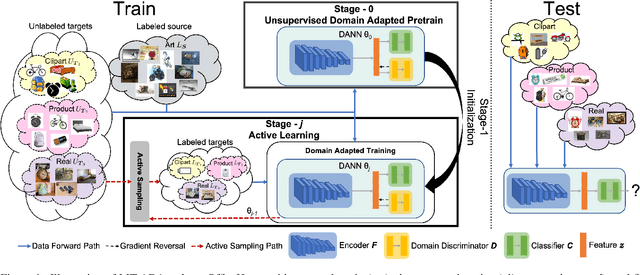
Unsupervised domain adaptation (UDA) for image classification has made remarkable progress in transferring classification knowledge from a labeled source domain to an unlabeled target domain, thanks to effective domain alignment techniques. Recently, in order to further improve performance on a target domain, many Single-Target Active Domain Adaptation (ST-ADA) methods have been proposed to identify and annotate the salient and exemplar target samples. However, it requires one model to be trained and deployed for each target domain and the domain label associated with each test sample. This largely restricts its application in the ubiquitous scenarios with multiple target domains. Therefore, we propose a Multi-Target Active Domain Adaptation (MT-ADA) framework for image classification, named D3GU, to simultaneously align different domains and actively select samples from them for annotation. This is the first research effort in this field to our best knowledge. D3GU applies Decomposed Domain Discrimination (D3) during training to achieve both source-target and target-target domain alignments. Then during active sampling, a Gradient Utility (GU) score is designed to weight every unlabeled target image by its contribution towards classification and domain alignment tasks, and is further combined with KMeans clustering to form GU-KMeans for diverse image sampling. Extensive experiments on three benchmark datasets, Office31, OfficeHome, and DomainNet, have been conducted to validate consistently superior performance of D3GU for MT-ADA.