 Add to Chrome
 Add to Firefox
 Add to Edge
Adam's Law: Textual Frequency Law on Large Language Models
Apr 02, 2026
While textual frequency has been validated as relevant to human cognition in reading speed, its relatedness to Large Language Models (LLMs) is seldom studied. We propose a novel research direction in terms of textual data frequency, which is an understudied topic, to the best of our knowledge. Our framework is composed of three units. First, this paper proposes Textual Frequency Law (TFL), which indicates that frequent textual data should be preferred for LLMs for both prompting and fine-tuning. Since many LLMs are closed-source in their training data, we propose using online resources to estimate the sentence-level frequency. We then utilize an input paraphraser to paraphrase the input into a more frequent textual expression. Next, we propose Textual Frequency Distillation (TFD) by querying LLMs to conduct story completion by further extending the sentences in the datasets, and the resulting corpora are used to adjust the initial estimation. Finally, we propose Curriculum Textual Frequency Training (CTFT) that fine-tunes LLMs in an increasing order of sentence-level frequency. Experiments are conducted on our curated dataset Textual Frequency Paired Dataset (TFPD) on math reasoning, machine translation, commonsense reasoning and agentic tool calling. Results show the effectiveness of our framework.

LLaSM: Large Language and Speech Model
Sep 16, 2023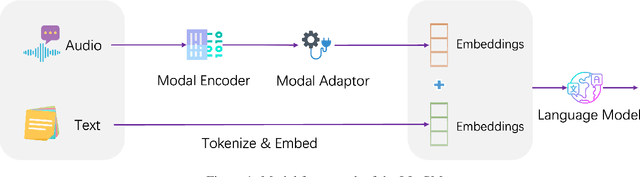

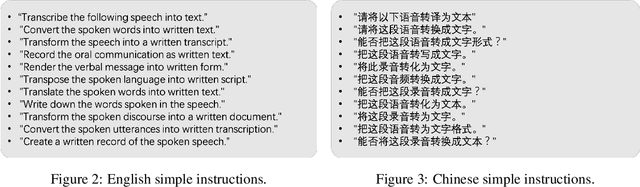
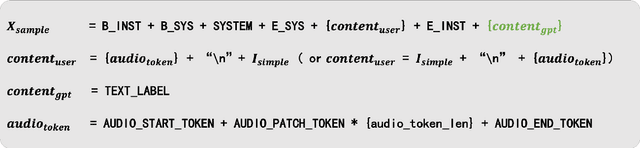
Multi-modal large language models have garnered significant interest recently. Though, most of the works focus on vision-language multi-modal models providing strong capabilities in following vision-and-language instructions. However, we claim that speech is also an important modality through which humans interact with the world. Hence, it is crucial for a general-purpose assistant to be able to follow multi-modal speech-and-language instructions. In this work, we propose Large Language and Speech Model (LLaSM). LLaSM is an end-to-end trained large multi-modal speech-language model with cross-modal conversational abilities, capable of following speech-and-language instructions. Our early experiments show that LLaSM demonstrates a more convenient and natural way for humans to interact with artificial intelligence. Specifically, we also release a large Speech Instruction Following dataset LLaSM-Audio-Instructions. Code and demo are available at https://github.com/LinkSoul-AI/LLaSM and https://huggingface.co/spaces/LinkSoul/LLaSM. The LLaSM-Audio-Instructions dataset is available at https://huggingface.co/datasets/LinkSoul/LLaSM-Audio-Instructions.