 Add to Chrome
 Add to Firefox
 Add to Edge
CulMind: Benchmarking Multimodal Understanding and Reasoning in Chinese Cultural Heritage
Jun 19, 2026
Evaluating Multimodal Large Language Models (MLLMs) in Chinese Cultural Heritage (CCH) requires fine-grained reasoning over visual, textual, stylistic, and historical clues. However, existing CCH benchmarks mainly emphasize final-answer accuracy, while the accuracy and completeness of reasoning processes remain underexplored. To address this gap, we introduce CulMind and CulMind-R: a high-quality benchmark for multimodal CCH covering 50 tasks from collections of more than 100 museums, and a 24-task reasoning subset that adaptively defines task-specific dimensions for reasoning process evaluation. To evaluate reasoning quality, we propose ReaScore, a task-adaptive metric that evaluates reasoning by automatically weighting task-relevant dimensions. Experiments on 14 leading MLLMs reveal a substantial gap between answers and reasoning, especially on challenging tasks. Further analysis shows that task-adaptive dimension selection and weighting better align evaluation results with expert judgments. Overall, our benchmark and metric support a more expert-aligned assessment of CCH understanding and offer a transferable reference for broader evaluations of cultural heritage. We publicly release the data, code, and evaluation scripts at https://github.com/ZevTsao/CulMind to facilitate reproducible research.

Debiased Multimodal Personality Understanding through Dual Causal Intervention
May 07, 2026Multimodalpersonalityunderstandingplaysacriticalroleinhuman centered artificial intelligence. Previous work mainly focus on learn-ing rich multimodal representations for video personality under standing. However, they often suffer from potential harm caused by subject bias (e.g., observable age and unobservable mental states), as subjects originate from diverse demographic backgrounds. Learn ing such spurious associations between multimodal features and traits may lead to unfair personality understanding. In this work, weconstruct aStructural Causal Model (SCM)toanalyze theimpact of these biases from a causal perspective, and propose a novel Dual Causal Adjustment Network (DCAN) to mitigate the interference of subject attributes on personality understanding. Specifically, we design a Back-door Adjustment Causal Learning (BACL) module to block spurious correlations from observable demographic factors via a prototype-based confounder dictionary, and subsequently ap ply a Front-door Adjustment Causal Learning (FACL) module to ad dress latent and unobservable biases throughalearnedmediatordic tionary intervention, thereby achieving causal disentanglement of representations for deconfounded reasoning. Importantly, we con struct a Demographic-annotated Multimodal Student Personality (DMSP) dataset to support the analysis and discussion of fairness related factors. Extensive experiments on the benchmark dataset CFI-V2 and our DMSPdataset demonstrate that DCAN consistently improves prediction accuracy, reaching 92.11% and 92.90%, respec tively. Meanwhile, the improvementsinthefairnessmetricsofequal opportunity and demographic parity are 6.57% and 7.97% on CFI-V2, and 15.38% and 20.06% on the DMSP dataset. Our code and DMSP dataset are available at https://github.com/Sabrina-han/DCAN
Adaptive Diffusion-based Augmentation for Recommendation
Jan 04, 2026Recommendation systems often rely on implicit feedback, where only positive user-item interactions can be observed. Negative sampling is therefore crucial to provide proper negative training signals. However, existing methods tend to mislabel potentially positive but unobserved items as negatives and lack precise control over negative sample selection. We aim to address these by generating controllable negative samples, rather than sampling from the existing item pool. In this context, we propose Adaptive Diffusion-based Augmentation for Recommendation (ADAR), a novel and model-agnostic module that leverages diffusion to synthesize informative negatives. Inspired by the progressive corruption process in diffusion, ADAR simulates a continuous transition from positive to negative, allowing for fine-grained control over sample hardness. To mine suitable negative samples, we theoretically identify the transition point at which a positive sample turns negative and derive a score-aware function to adaptively determine the optimal sampling timestep. By identifying this transition point, ADAR generates challenging negative samples that effectively refine the model's decision boundary. Experiments confirm that ADAR is broadly compatible and boosts the performance of existing recommendation models substantially, including collaborative filtering and sequential recommendation, without architectural modifications.
Eq.Bot: Enhance Robotic Manipulation Learning via Group Equivariant Canonicalization
Nov 19, 2025Robotic manipulation systems are increasingly deployed across diverse domains. Yet existing multi-modal learning frameworks lack inherent guarantees of geometric consistency, struggling to handle spatial transformations such as rotations and translations. While recent works attempt to introduce equivariance through bespoke architectural modifications, these methods suffer from high implementation complexity, computational cost, and poor portability. Inspired by human cognitive processes in spatial reasoning, we propose Eq.Bot, a universal canonicalization framework grounded in SE(2) group equivariant theory for robotic manipulation learning. Our framework transforms observations into a canonical space, applies an existing policy, and maps the resulting actions back to the original space. As a model-agnostic solution, Eq.Bot aims to endow models with spatial equivariance without requiring architectural modifications. Extensive experiments demonstrate the superiority of Eq.Bot under both CNN-based (e.g., CLIPort) and Transformer-based (e.g., OpenVLA-OFT) architectures over existing methods on various robotic manipulation tasks, where the most significant improvement can reach 50.0%.
AC-EVAL: Evaluating Ancient Chinese Language Understanding in Large Language Models
Mar 11, 2024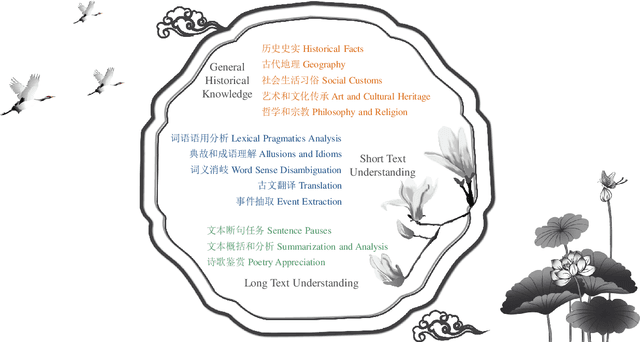

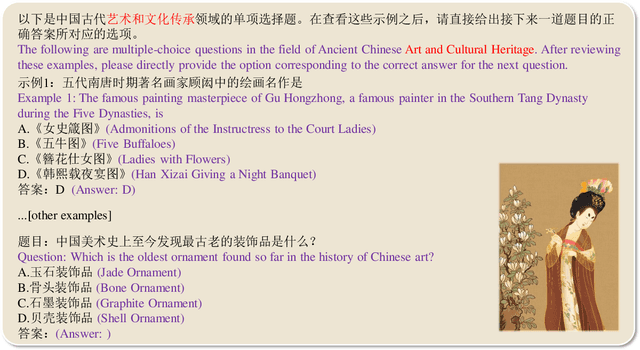

Given the importance of ancient Chinese in capturing the essence of rich historical and cultural heritage, the rapid advancements in Large Language Models (LLMs) necessitate benchmarks that can effectively evaluate their understanding of ancient contexts. To meet this need, we present AC-EVAL, an innovative benchmark designed to assess the advanced knowledge and reasoning capabilities of LLMs within the context of ancient Chinese. AC-EVAL is structured across three levels of difficulty reflecting different facets of language comprehension: general historical knowledge, short text understanding, and long text comprehension. The benchmark comprises 13 tasks, spanning historical facts, geography, social customs, art, philosophy, classical poetry and prose, providing a comprehensive assessment framework. Our extensive evaluation of top-performing LLMs, tailored for both English and Chinese, reveals a substantial potential for enhancing ancient text comprehension. By highlighting the strengths and weaknesses of LLMs, AC-EVAL aims to promote their development and application forward in the realms of ancient Chinese language education and scholarly research. The AC-EVAL data and evaluation code are available at https://github.com/yuting-wei/AC-EVAL.