 Add to Chrome
 Add to Firefox
 Add to Edge
Rate-Adaptive Generative Semantic Communication Using Conditional Diffusion Models
Sep 04, 2024
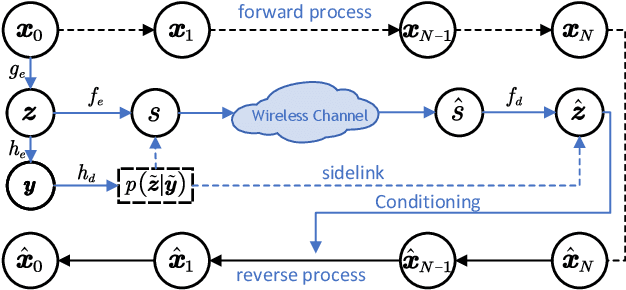
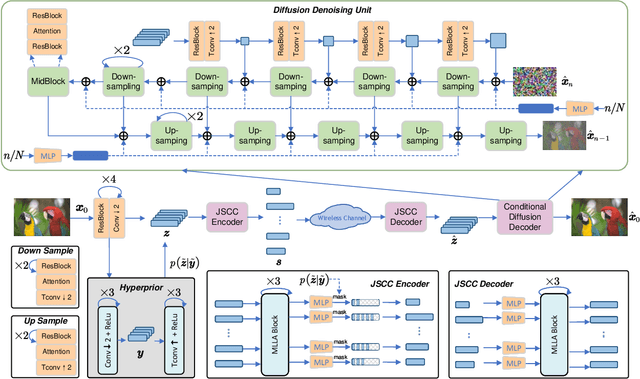
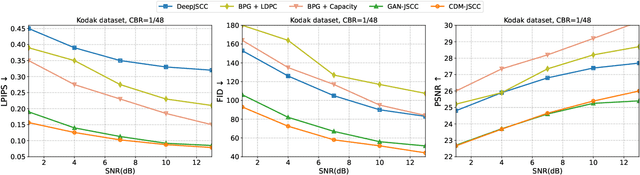
Recent advances in deep learning-based joint source-channel coding (DJSCC) have shown promise for end-to-end semantic image transmission. However, most existing schemes primarily focus on optimizing pixel-wise metrics, which often fail to align with human perception, leading to lower perceptual quality. In this letter, we propose a novel generative DJSCC approach using conditional diffusion models to enhance the perceptual quality of transmitted images. Specifically, by utilizing entropy models, we effectively manage transmission bandwidth based on the estimated entropy of transmitted sym-bols. These symbols are then used at the receiver as conditional information to guide a conditional diffusion decoder in image reconstruction. Our model is built upon the emerging advanced mamba-like linear attention (MLLA) skeleton, which excels in image processing tasks while also offering fast inference speed. Besides, we introduce a multi-stage training strategy to ensure the stability and improve the overall performance of the model. Simulation results demonstrate that our proposed method significantly outperforms existing approaches in terms of perceptual quality.

Two-Timescale Design for Movable Antenna Array-Enabled Multiuser Uplink Communications
Jul 25, 2024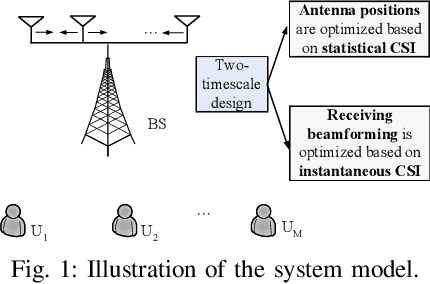
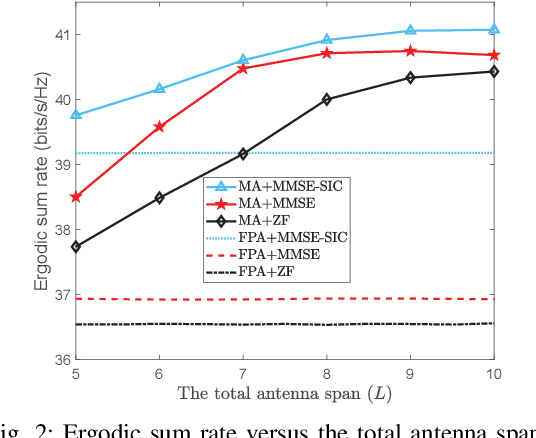
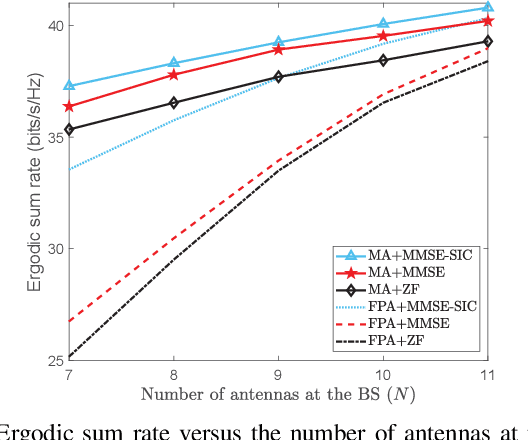
Movable antenna (MA) technology can flexibly reconfigure wireless channels by adjusting antenna positions in a local region, thus owing great potential for enhancing communication performance. This letter investigates MA technology enabled multiuser uplink communications over general Rician fading channels, which consist of a base station (BS) equipped with the MA array and multiple single-antenna users. Since it is practically challenging to collect all instantaneous channel state information (CSI) by traversing all possible antenna positions at the BS, we instead propose a two-timescale scheme for maximizing the ergodic sum rate. Specifically, antenna positions at the BS are first optimized using only the statistical CSI. Subsequently, the receiving beamforming at the BS (for which we consider the three typical zero-forcing (ZF), minimum mean-square error (MMSE) and MMSE with successive interference cancellation (MMSE-SIC) receivers) is designed based on the instantaneous CSI with optimized antenna positions, thus significantly reducing practical implementation complexities. The formulated problems are highly non-convex and we develop projected gradient ascent (PGA) algorithms to effectively handle them. Simulation results illustrate that compared to conventional fixed-position antenna (FPA) array, the MA array can achieve significant performance gains by reaping an additional spatial degree of freedom.
Automatic AI Model Selection for Wireless Systems: Online Learning via Digital Twinning
Jun 22, 2024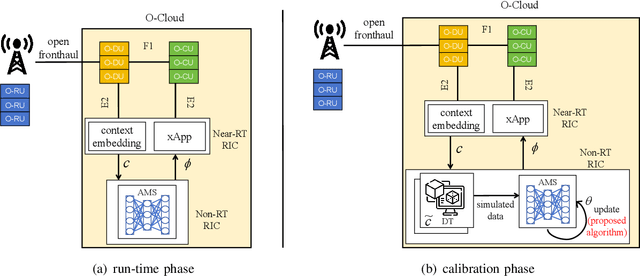
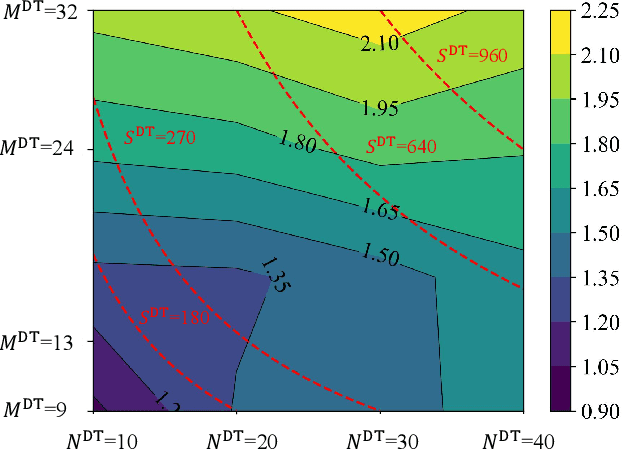
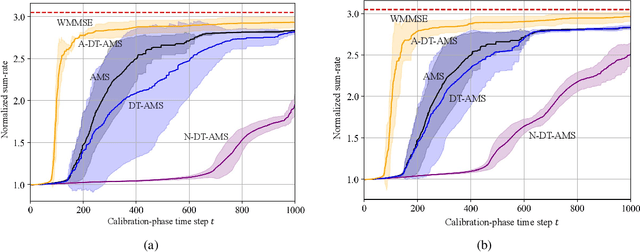

In modern wireless network architectures, such as O-RAN, artificial intelligence (AI)-based applications are deployed at intelligent controllers to carry out functionalities like scheduling or power control. The AI "apps" are selected on the basis of contextual information such as network conditions, topology, traffic statistics, and design goals. The mapping between context and AI model parameters is ideally done in a zero-shot fashion via an automatic model selection (AMS) mapping that leverages only contextual information without requiring any current data. This paper introduces a general methodology for the online optimization of AMS mappings. Optimizing an AMS mapping is challenging, as it requires exposure to data collected from many different contexts. Therefore, if carried out online, this initial optimization phase would be extremely time consuming. A possible solution is to leverage a digital twin of the physical system to generate synthetic data from multiple simulated contexts. However, given that the simulator at the digital twin is imperfect, a direct use of simulated data for the optimization of the AMS mapping would yield poor performance when tested in the real system. This paper proposes a novel method for the online optimization of AMS mapping that corrects for the bias of the simulator by means of limited real data collected from the physical system. Experimental results for a graph neural network-based power control app demonstrate the significant advantages of the proposed approach.
Digital Wireless Image Transmission via Distribution Matching
Jun 16, 2024Deep learning-based joint source-channel coding (JSCC) is emerging as a potential technology to meet the demand for effective data transmission, particularly for image transmission. Nevertheless, most existing advancements only consider analog transmission, where the channel symbols are continuous, making them incompatible with practical digital communication systems. In this work, we address this by involving the modulation process and consider mapping the continuous channel symbols into discrete space. Recognizing the non-uniform distribution of the output channel symbols in existing methods, we propose two effective methods to improve the performance. Firstly, we introduce a uniform modulation scheme, where the distance between two constellations is adjustable to match the non-uniform nature of the distribution. In addition, we further design a non-uniform modulation scheme according to the output distribution. To this end, we first generate the constellations by performing feature clustering on an analog image transmission system, then the generated constellations are employed to modulate the continuous channel symbols. For both schemes, we fine-tune the digital system to alleviate the performance loss caused by modulation. Here, the straight-through estimator (STE) is considered to overcome the non-differentiable nature. Our experimental results demonstrate that the proposed schemes significantly outperform existing digital image transmission systems.
From Analog to Digital: Multi-Order Digital Joint Coding-Modulation for Semantic Communication
Jun 08, 2024


Recent studies in joint source-channel coding (JSCC) have fostered a fresh paradigm in end-to-end semantic communication. Despite notable performance achievements, present initiatives in building semantic communication systems primarily hinge on the transmission of continuous channel symbols, thus presenting challenges in compatibility with established digital systems. In this paper, we introduce a novel approach to address this challenge by developing a multi-order digital joint coding-modulation (MDJCM) scheme for semantic communications. Initially, we construct a digital semantic communication system by integrating a multi-order modulation/demodulation module into a nonlinear transform source-channel coding (NTSCC) framework. Recognizing the non-differentiable nature of modulation/demodulation, we propose a novel substitution training strategy. Herein, we treat modulation/demodulation as a constrained quantization process and introduce scaling operations alongside manually crafted noise to approximate this process. As a result, employing this approximation in training semantic communication systems can be deployed in practical modulation/demodulation scenarios with superior performance. Additionally, we demonstrate the equivalence by analyzing the involved probability distribution. Moreover, to further upgrade the performance, we develop a hierarchical dimension-reduction strategy to provide a gradual information extraction process. Extensive experimental evaluations demonstrate the superiority of our proposed method over existing digital and non-digital JSCC techniques.
Next Generation Advanced Transceiver Technologies for 6G
Mar 25, 2024


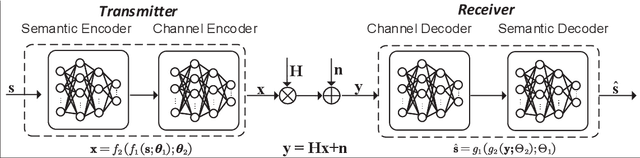
To accommodate new applications such as extended reality, fully autonomous vehicular networks and the metaverse, next generation wireless networks are going to be subject to much more stringent performance requirements than the fifth-generation (5G) in terms of data rates, reliability, latency, and connectivity. It is thus necessary to develop next generation advanced transceiver (NGAT) technologies for efficient signal transmission and reception. In this tutorial, we explore the evolution of NGAT from three different perspectives. Specifically, we first provide an overview of new-field NGAT technology, which shifts from conventional far-field channel models to new near-field channel models. Then, three new-form NGAT technologies and their design challenges are presented, including reconfigurable intelligent surfaces, flexible antennas, and holographic multi-input multi-output (MIMO) systems. Subsequently, we discuss recent advances in semantic-aware NGAT technologies, which can utilize new metrics for advanced transceiver designs. Finally, we point out other promising transceiver technologies for future research.
Feature Allocation for Semantic Communication with Space-Time Importance Awareness
Jan 26, 2024In the realm of semantic communication, the significance of encoded features can vary, while wireless channels are known to exhibit fluctuations across multiple subchannels in different domains. Consequently, critical features may traverse subchannels with poor states, resulting in performance degradation. To tackle this challenge, we introduce a framework called Feature Allocation for Semantic Transmission (FAST), which offers adaptability to channel fluctuations across both spatial and temporal domains. In particular, an importance evaluator is first developed to assess the importance of various features. In the temporal domain, channel prediction is utilized to estimate future channel state information (CSI). Subsequently, feature allocation is implemented by assigning suitable transmission time slots to different features. Furthermore, we extend FAST to the space-time domain, considering two common scenarios: precoding-free and precoding-based multiple-input multiple-output (MIMO) systems. An important attribute of FAST is its versatility, requiring no intricate fine-tuning. Simulation results demonstrate that this approach significantly enhances the performance of semantic communication systems in image transmission. It retains its superiority even when faced with substantial changes in system configuration.
Movable-Antenna Array Enabled Multiuser Uplink: A Low-Complexity Gradient Descent for Total Transmit Power Minimization
Dec 10, 2023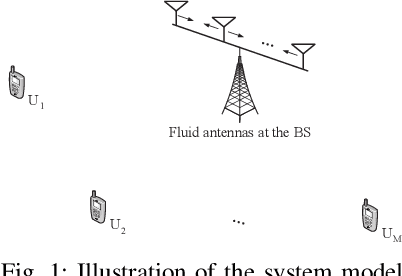
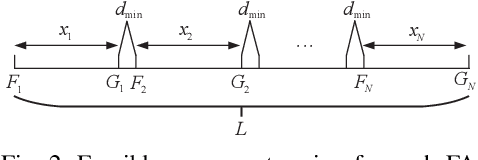
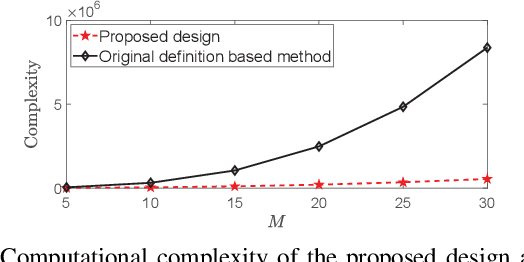
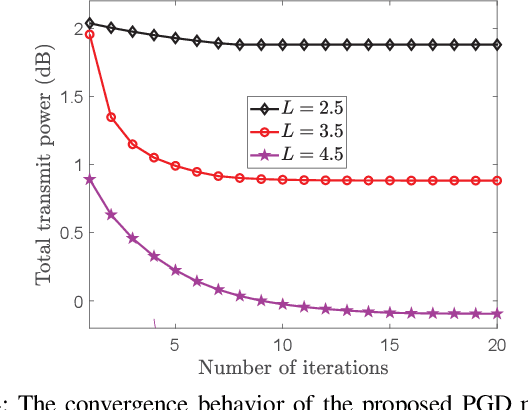
We investigate multiuser uplink communication from multiple single-antenna users to a base station (BS), which is equipped with a movable-antenna (MA) array and adopts zero-forcing receivers to decode multiple signals. We aim to optimize the MAs' positions at the BS, to minimize the total transmit power of all users subject to the minimum rate requirement. After applying transformations, we show that the problem is equivalent to minimizing the sum of each eigenvalue's reciprocal of a matrix, which is a function of all MAs' positions. Subsequently, the projected gradient descent (PGD) method is utilized to find a locally optimal solution. In particular, different from the latest related work, we exploit the eigenvalue decomposition to successfully derive a closed-form gradient for the PGD, which facilitates the practical implementation greatly. We demonstrate by simulations that via careful optimization for all MAs' positions in our proposed design, the total transmit power of all users can be decreased significantly as compared to competitive benchmarks.
Deep Refinement-Based Joint Source Channel Coding over Time-Varying Channels
Nov 26, 2023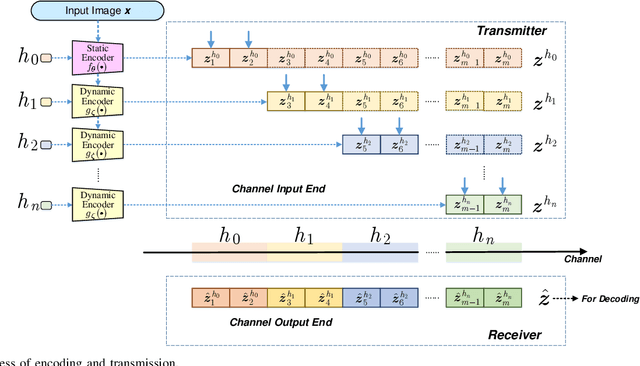
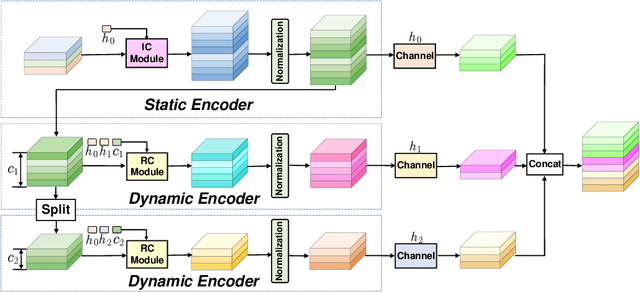


In recent developments, deep learning (DL)-based joint source-channel coding (JSCC) for wireless image transmission has made significant strides in performance enhancement. Nonetheless, the majority of existing DL-based JSCC methods are tailored for scenarios featuring stable channel conditions, notably a fixed signal-to-noise ratio (SNR). This specialization poses a limitation, as their performance tends to wane in practical scenarios marked by highly dynamic channels, given that a fixed SNR inadequately represents the dynamic nature of such channels. In response to this challenge, we introduce a novel solution, namely deep refinement-based JSCC (DRJSCC). This innovative method is designed to seamlessly adapt to channels exhibiting temporal variations. By leveraging instantaneous channel state information (CSI), we dynamically optimize the encoding strategy through re-encoding the channel symbols. This dynamic adjustment ensures that the encoding strategy consistently aligns with the varying channel conditions during the transmission process. Specifically, our approach begins with the division of encoded symbols into multiple blocks, which are transmitted progressively to the receiver. In the event of changing channel conditions, we propose a mechanism to re-encode the remaining blocks, allowing them to adapt to the current channel conditions. Experimental results show that the DRJSCC scheme achieves comparable performance to the other mainstream DL-based JSCC models in stable channel conditions, and also exhibits great robustness against time-varying channels.
Movable-Antenna Array-Enabled Wireless Communication with CoMP Reception
Nov 20, 2023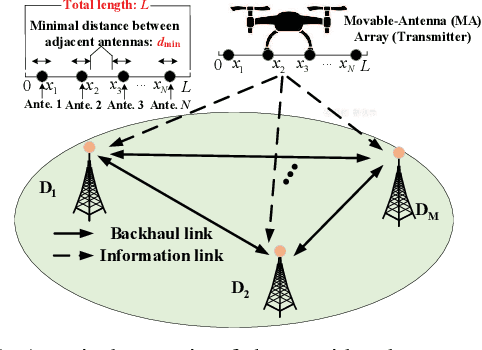
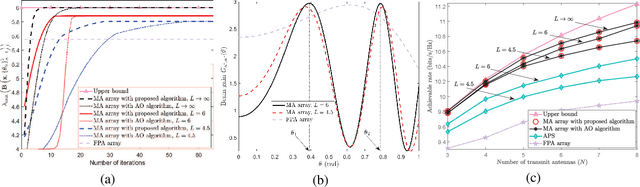
We consider the movable antenna (MA) array-enabled wireless communication with coordinate multi-point (CoMP) reception, where multiple destinations adopt the maximal ratio combination technique to jointly decode the common message sent from the transmitter equipped with the MA array. Our goal is to maximize the effective received signal-to-noise ratio, by jointly optimizing the transmit beamforming and the positions of the MA array. Although the formulated problem is highly non-convex, we reveal that it is fundamental to maximize the principal eigenvalue of a hermite channel matrix which is a function of the positions of the MA array. The corresponding sub-problem is still non-convex, for which we develop a computationally efficient algorithm. Afterwards, the optimal transmit beamforming is determined with a closed-form solution. In addition, the theoretical performance upper bound is analyzed. Since the MA array brings an additional spatial degree of freedom by flexibly adjusting all antennas' positions, it achieves significant performance gain compared to competitive benchmarks.