 Add to Chrome
 Add to Firefox
 Add to Edge
OneModel: A Unified Foundation for Platform-Scale Multi-Scenario Ranking
Aug 20, 2026
Platform-scale recommender systems often span multiple business streams such as organic recommendation, advertising, and merchant services, where user behaviors form a continuous cross-stream trajectory. Maintaining separate ranking systems fragments user representations and increases engineering cost. We propose \textbf{OneModel}, a unified framework for multi-stream final ranking. OneModel maps heterogeneous behaviors into shared event sequences, learns long-context user representations with an action-oriented backbone, and introduces \emph{Scenario-aware Information Modulation} to balance cross-stream transfer and stream-specific specialization. For production deployment, OneModel further adopts stratified user representation, multi-objective training, and optimized online serving with feature decomposition, user feature prefetching, shared user-tower computation, and graph-level inference optimization. We deploy OneModel in production at \emph{Xiaohongshu}, where it delivers consistent offline gains over strong baselines and scales favorably with context length and model capacity. Online A/B tests improve Time Spent by \textbf{+0.33\%} and Engagement by \textbf{+1.25\%} in Explore Feed, lift advertising value by \textbf{+3.43\%} and CTR by \textbf{+8.18\%} in Feed Advertising, and raise DGMV by \textbf{+1.1867\%} and GPM by \textbf{+2.1585\%} in Merchant Recommendation, validating unified multi-stream ranking as an effective production foundation.

Two-Timescale Design for Movable Antenna Array-Enabled Multiuser Uplink Communications
Jul 25, 2024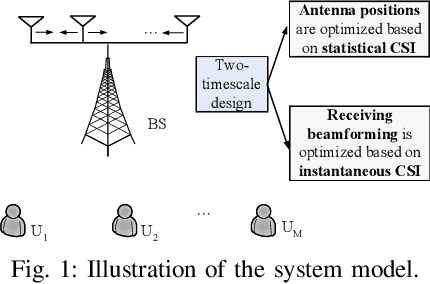
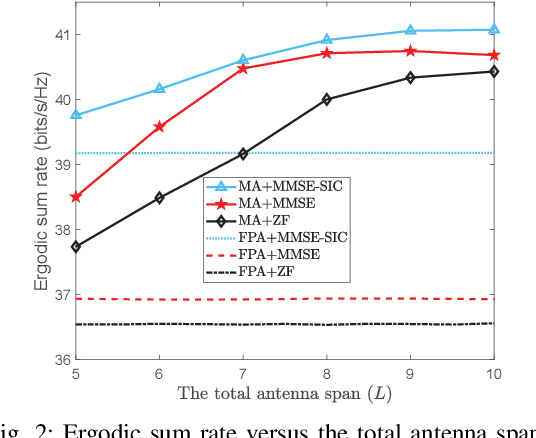
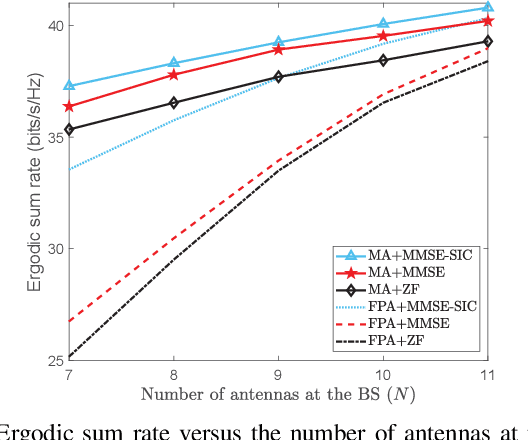
Movable antenna (MA) technology can flexibly reconfigure wireless channels by adjusting antenna positions in a local region, thus owing great potential for enhancing communication performance. This letter investigates MA technology enabled multiuser uplink communications over general Rician fading channels, which consist of a base station (BS) equipped with the MA array and multiple single-antenna users. Since it is practically challenging to collect all instantaneous channel state information (CSI) by traversing all possible antenna positions at the BS, we instead propose a two-timescale scheme for maximizing the ergodic sum rate. Specifically, antenna positions at the BS are first optimized using only the statistical CSI. Subsequently, the receiving beamforming at the BS (for which we consider the three typical zero-forcing (ZF), minimum mean-square error (MMSE) and MMSE with successive interference cancellation (MMSE-SIC) receivers) is designed based on the instantaneous CSI with optimized antenna positions, thus significantly reducing practical implementation complexities. The formulated problems are highly non-convex and we develop projected gradient ascent (PGA) algorithms to effectively handle them. Simulation results illustrate that compared to conventional fixed-position antenna (FPA) array, the MA array can achieve significant performance gains by reaping an additional spatial degree of freedom.