 Add to Chrome
 Add to Firefox
 Add to Edge
Voxel-CKM: Voxelized Radio Frequency Radiance Fields for Fast and Few-Shot CKM Construction
Jun 02, 2026
Channel knowledge maps (CKMs) are designed to predict channel state information (CSI) from user locations, thereby enabling low-overhead CSI acquisition. However, existing CKM construction methods often require hours-to-days of training time and dense measurements, resulting in substantial deployment cost. In this paper, we propose Voxel-CKM, a novel voxelized radio frequency (RF) radiance field framework for fast and few-shot CKM construction. The core idea is to replace implicit neural representations with explicit voxel grids to efficiently capture the spatial variation of wireless channels. Building upon this, we further introduce a compact vector-matrix (VM) decomposition to parameterize these voxel grids using a small set of matrices and vectors, which significantly accelerates convergence and facilitates fast CKM construction. To enable few-shot learning, we incorporate a transmitter prior as an inductive bias to guide the learning process under sparse measurements. Additionally, a total-variation (TV) regularization loss is proposed to mitigate overfitting and stabilize optimization. Experiments show that Voxel-CKM substantially accelerates training convergence and improves performance in the few-shot regime.

High-Fidelity and Location-Robust Respiratory Waveform Monitoring with Single-Antenna WiFi
Apr 22, 2026In recent years, WiFi sensing has been recognized as a promising technology to bring respiratory monitoring into everyday homes, thanks to its contactless nature and ubiquitous availability. However, existing WiFi-based respiratory monitoring systems still fall short of deployment-oriented performance: they suffer from restrained hardware scalability, limited accuracy, and are highly sensitive to user location. To overcome these limitations and push WiFi sensing towards clinically meaningful precision, we propose RespirFi, a novel system that robustly delivers high-fidelity respiratory waveforms with WiFi Channel State Information (CSI), thereby enabling accurate estimation of key physiological biomarkers. At the core of RespirFi is a theoretical human reflection model, through which we perform an in-depth characterization of how CSI variations are shaped by both subcarrier frequency and spatial user location. Guided by these insights, we develop a location-robust waveform construction method that adaptively selects high quality subcarriers and aligns their waveform trends, ensuring accurate waveform recovery. Furthermore, we propose a breathing phase identification method that leverages inter-subcarrier CSI differences to reliably distinguish inhalation from exhalation. We implement RespirFi over commodity WiFi devices, and extensive experiments demonstrate that it outperforms state-of-the-art approaches across a wide range of clinically relevant respiratory metrics.
Location-Agnostic Channel Knowledge Map Construction for Dynamic Scenes
Mar 10, 2026To alleviate the pilot and CSI-feedback burden in 6G, channel knowledge map (CKM) has emerged as a promising approach that predicts CSI solely from user locations. Nevertheless, accurate location information is rarely available in current systems. Moreover, the uncertainty inherent to highly dynamic scenes further degrades the performance of existing schemes that typically assume quasi-static scenarios. In this paper, we propose a novel framework named location-agnostic dynamic CKM (LAD-CKM). Specifically, LAD-CKM is constructed through dynamic radio frequency (RF) radiance field rendering, which takes instantaneous uplink CSI and partial downlink CSI as inputs. To enable effective rendering, a dedicated radiator representation network (RARE-Net) is designed to capture the spatial-spectral correlations within the inputs. Furthermore, an adaptive deformation module is devised to deform the uplink CSI-based queries of RARE-Net according to instantaneous channel dynamics, thereby enhancing CSI prediction accuracy under mobility. In addition, a novel synthetic channel dataset is created in outdoor dynamic scenes via ray-tracing. Simulation results demonstrate that LAD-CKM yields significant performance gains compared with existing baselines in terms of effective data rate.
GPINND: A deep-learning-based state of health estimation for Lithium-ion battery
Feb 04, 2026Electrochemical models offer superior interpretability and reliability for battery degradation diagnosis. However, the high computational cost of iterative parameter identification severely hinders the practical implementation of electrochemically informed state of health (SOH) estimation in real-time systems. To address this challenge, this paper proposes an SOH estimation method that integrates deep learning with electrochemical mechanisms and adopts a sequential training strategy. First, we construct a hybrid-driven surrogate model to learn internal electrochemical dynamics by fusing high-fidelity simulation data with physical constraints. This model subsequently serves as an accurate and differentiable physical kernel for voltage reconstruction. Then, we develop a self-supervised framework to train a parameter identification network by minimizing the voltage reconstruction error. The resulting model enables the non-iterative identification of aging parameters from external measurements. Finally, utilizing the identified parameters as physicochemical health indicators, we establish a high-precision SOH estimation network that leverages data-driven residual correction to compensate for identification deviations. Crucially, a sequential training strategy is applied across these modules to effectively mitigate convergence issues and improve the accuracy of each module. Experimental results demonstrate that the proposed method achieves an average voltage reconstruction root mean square error (RMSE) of 0.0198 V and an SOH estimation RMSE of 0.0014.
Prediction-Powered Risk Monitoring of Deployed Models for Detecting Harmful Distribution Shifts
Feb 02, 2026We study the problem of monitoring model performance in dynamic environments where labeled data are limited. To this end, we propose prediction-powered risk monitoring (PPRM), a semi-supervised risk-monitoring approach based on prediction-powered inference (PPI). PPRM constructs anytime-valid lower bounds on the running risk by combining synthetic labels with a small set of true labels. Harmful shifts are detected via a threshold-based comparison with an upper bound on the nominal risk, satisfying assumption-free finite-sample guarantees in the probability of false alarm. We demonstrate the effectiveness of PPRM through extensive experiments on image classification, large language model (LLM), and telecommunications monitoring tasks.
A PAC-Bayesian Analysis of Channel-Induced Degradation in Edge Inference
Jan 16, 2026In the emerging paradigm of edge inference, neural networks (NNs) are partitioned across distributed edge devices that collaboratively perform inference via wireless transmission. However, standard NNs are generally trained in a noiseless environment, creating a mismatch with the noisy channels during edge deployment. In this paper, we address this issue by characterizing the channel-induced performance deterioration as a generalization error against unseen channels. We introduce an augmented NN model that incorporates channel statistics directly into the weight space, allowing us to derive PAC-Bayesian generalization bounds that explicitly quantifies the impact of wireless distortion. We further provide closed-form expressions for practical channels to demonstrate the tractability of these bounds. Inspired by the theoretical results, we propose a channel-aware training algorithm that minimizes a surrogate objective based on the derived bound. Simulations show that the proposed algorithm can effectively improve inference accuracy by leveraging channel statistics, without end-to-end re-training.
F$^4$-CKM: Learning Channel Knowledge Map with Radio Frequency Radiance Field Rendering
Jan 07, 2026In 6G mobile communications, acquiring accurate and timely channel state information (CSI) becomes increasingly challenging due to the growing antenna array size and bandwidth. To alleviate the CSI feedback burden, the channel knowledge map (CKM) has emerged as a promising approach by leveraging environment-aware techniques to predict CSI based solely on user locations. However, how to effectively construct a CKM remains an open issue. In this paper, we propose F$^4$-CKM, a novel CKM construction framework characterized by four distinctive features: radiance Field rendering, spatial-Frequency-awareness, location-Free usage, and Fast learning. Central to our design is the adaptation of radiance field rendering techniques from computer vision to the radio frequency (RF) domain, enabled by a novel Wireless Radiator Representation (WiRARE) network that captures the spatial-frequency characteristics of wireless channels. Additionally, a novel shaping filter module and an angular sampling strategy are introduced to facilitate CKM construction. Extensive experiments demonstrate that F$^4$-CKM significantly outperforms existing baselines in terms of wireless channel prediction accuracy and efficiency.
Reliable LLM-Based Edge-Cloud-Expert Cascades for Telecom Knowledge Systems
Dec 23, 2025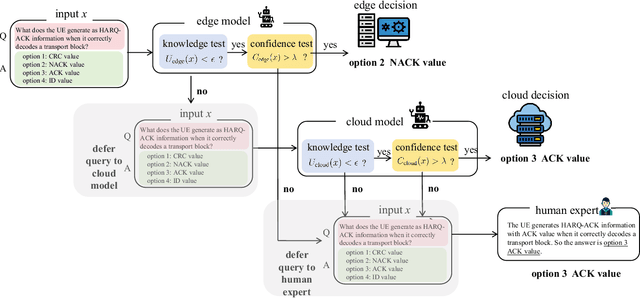
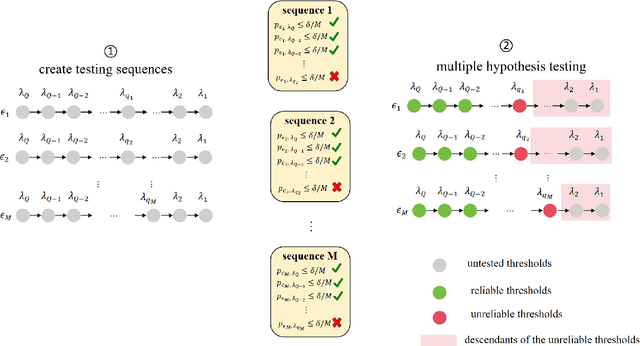
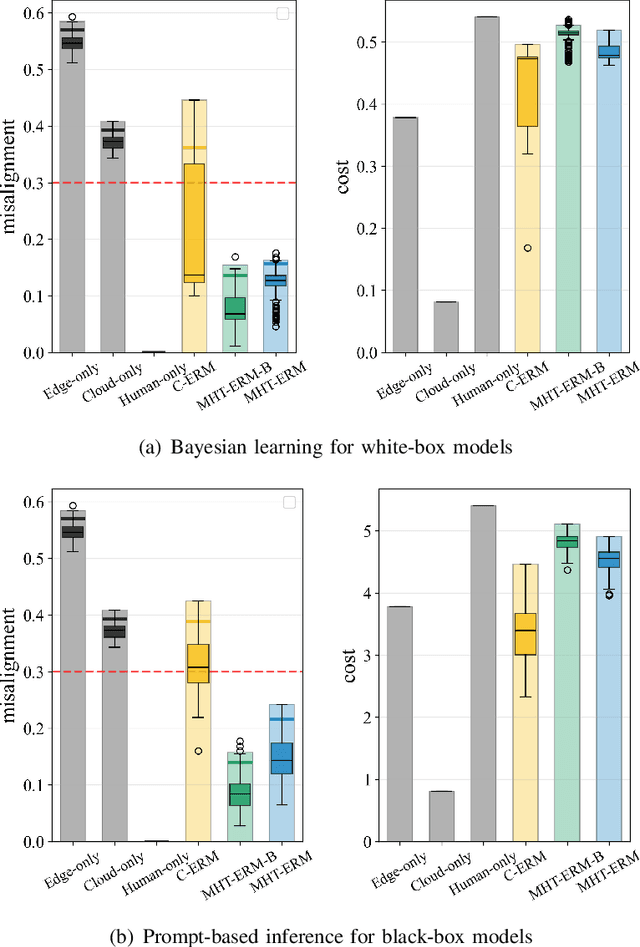
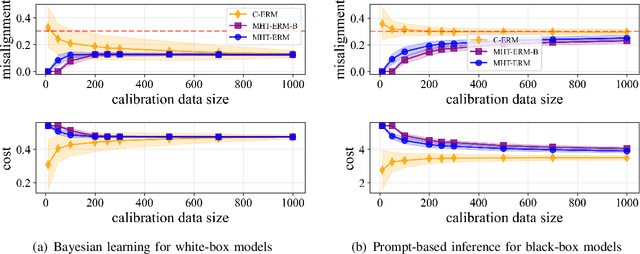
Large language models (LLMs) are emerging as key enablers of automation in domains such as telecommunications, assisting with tasks including troubleshooting, standards interpretation, and network optimization. However, their deployment in practice must balance inference cost, latency, and reliability. In this work, we study an edge-cloud-expert cascaded LLM-based knowledge system that supports decision-making through a question-and-answer pipeline. In it, an efficient edge model handles routine queries, a more capable cloud model addresses complex cases, and human experts are involved only when necessary. We define a misalignment-cost constrained optimization problem, aiming to minimize average processing cost, while guaranteeing alignment of automated answers with expert judgments. We propose a statistically rigorous threshold selection method based on multiple hypothesis testing (MHT) for a query processing mechanism based on knowledge and confidence tests. The approach provides finite-sample guarantees on misalignment risk. Experiments on the TeleQnA dataset -- a telecom-specific benchmark -- demonstrate that the proposed method achieves superior cost-efficiency compared to conventional cascaded baselines, while ensuring reliability at prescribed confidence levels.
Meta-SimGNN: Adaptive and Robust WiFi Localization Across Dynamic Configurations and Diverse Scenarios
Nov 18, 2025To promote the practicality of deep learning-based localization, existing studies aim to address the issue of scenario dependence through meta-learning. However, these studies primarily focus on variations in environmental layouts while overlooking the impact of changes in device configurations, such as bandwidth, the number of access points (APs), and the number of antennas used. Unlike environmental changes, variations in device configurations affect the dimensionality of channel state information (CSI), thereby compromising neural network usability. To address this issue, we propose Meta-SimGNN, a novel WiFi localization system that integrates graph neural networks with meta-learning to improve localization generalization and robustness. First, we introduce a fine-grained CSI graph construction scheme, where each AP is treated as a graph node, allowing for adaptability to changes in the number of APs. To structure the features of each node, we propose an amplitude-phase fusion method and a feature extraction method. The former utilizes both amplitude and phase to construct CSI images, enhancing data reliability, while the latter extracts dimension-consistent features to address variations in bandwidth and the number of antennas. Second, a similarity-guided meta-learning strategy is developed to enhance adaptability in diverse scenarios. The initial model parameters for the fine-tuning stage are determined by comparing the similarity between the new scenario and historical scenarios, facilitating rapid adaptation of the model to the new localization scenario. Extensive experimental results over commodity WiFi devices in different scenarios show that Meta-SimGNN outperforms the baseline methods in terms of localization generalization and accuracy.
Sensing Framework Design and Performance Optimization with Action Detection for ISCC
May 05, 2025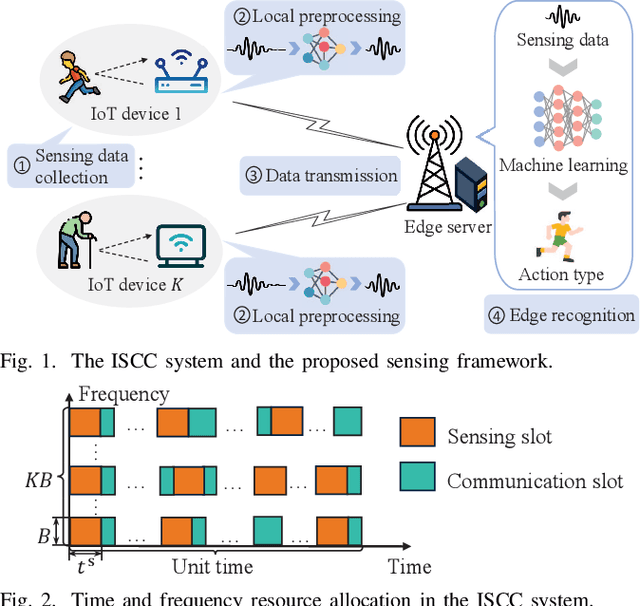
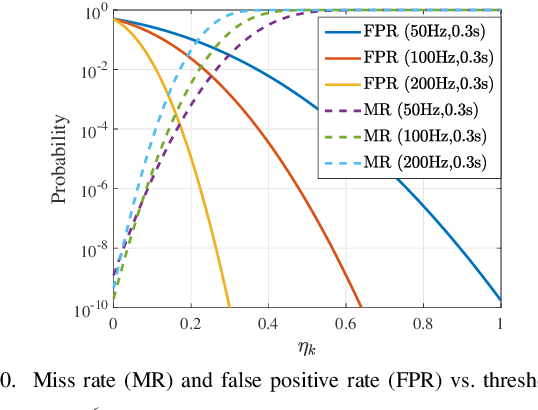
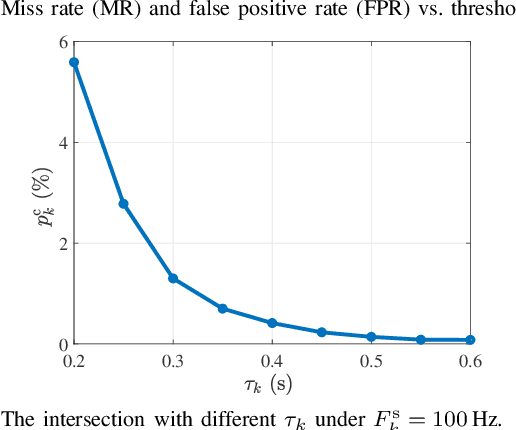
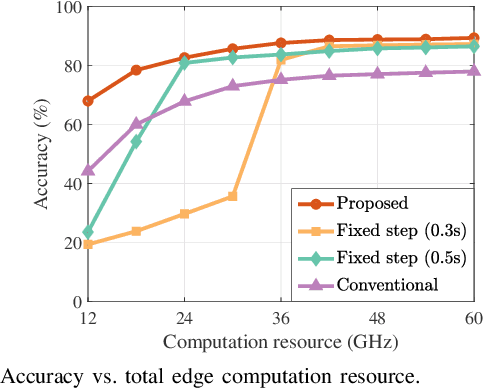
Integrated sensing, communication, and computation (ISCC) has been regarded as a prospective technology for the next-generation wireless network, supporting humancentric intelligent applications. However, the delay sensitivity of these computation-intensive applications, especially in a multidevice ISCC system with limited resources, highlights the urgent need for efficient sensing task execution frameworks. To address this, we propose a resource-efficient sensing framework in this paper. Different from existing solutions, it features a novel action detection module deployed at each device to detect the onset of an action. Only time windows filled with signals of interest are offloaded to the edge server and processed by the edge recognition module, thus reducing overhead. Furthermore, we quantitatively analyze the sensing performance of the proposed sensing framework and formulate a sensing accuracy maximization problem under power, delay, and resource limitations for the multi-device ISCC system. By decomposing it into two subproblems, we develop an alternating direction method of multipliers (ADMM)-based distributed algorithm. It alternatively solves a sensing accuracy maximization subproblem at each device and employs a closed-form computation resource allocation strategy at the edge server till convergence. Finally, a real-world test is conducted using commodity wireless devices to validate the sensing performance analysis. Extensive test results demonstrate that our proposal achieves higher sensing accuracy under the limited resource compared to two baselines.