 Add to Chrome
 Add to Firefox
 Add to Edge
RealWeather: Realistic and Scene-Faithful Weather Translation with Driving World Models
Aug 03, 2026
Realistic weather translation is valuable for developing and evaluating autonomous driving systems, yet collecting paired videos of the same scenes under different weather conditions at scale is impractical. Existing methods therefore rely on synthetic data, 3D weather editing, or geometry-conditioned generation, often compromising weather realism or scene fidelity. We propose RealWeather, a driving world model for both realistic and scene-faithful weather translation. Our key idea is to learn authentic weather dynamics directly from real-world videos. Specifically, RealWeather employs Progressive Realism Bootstrapping, an iterative data-refinement strategy. Assisted by an auxiliary Pseudo-Clear Generation pipeline, training initially starts with pseudo-style conditioning videos. As training proceeds, these inputs are progressively replaced with increasingly realistic videos generated by the model itself. This strategy bridges the pseudo-to-real domain gap, allowing the model to adapt seamlessly to real-world input distributions and naturally support bidirectional clear adverse translation. Furthermore, to strictly enforce structural integrity and suppress hallucinations, we introduce Scene-Fidelity RL Optimization, a reward-driven policy optimization strategy that explicitly penalizes alterations to safety-critical driving elements. Extensive experiments demonstrate that RealWeather significantly outperforms existing methods in visual realism and structural preservation, while enabling robust long-tail weather scenario generation and strong zero-shot out-of-distribution generalization.

RealityBridge: Bridging Editable 3D Gaussian Splatting Driving Simulations and Real-World Videos
Jun 15, 2026Long-tail hazardous scenarios are essential for safety-oriented autonomous driving, yet they are difficult to collect and reproduce at scale. Editable 3D Gaussian Splatting (3DGS) simulation offers a promising alternative by reconstructing real driving scenes and supporting controllable scene editing. However, edited 3DGS-rendered videos still suffer from a significant Sim-to-Real gap, including rendering artifacts, degraded foreground assets, inconsistent illumination, and temporal flickering. Existing restoration and video generation methods are insufficient for this task, as they often fail to jointly repair 3DGS-specific artifacts, improve visual realism, and ensure temporal consistency. To fill this gap, we propose RealityBridge, a structure-preserving and asset-aware Sim-to-Real framework for edited 3DGS driving videos. RealityBridge uses multimodal controls, including rendered videos, foreground masks, edge maps, and semantic masks, together with a lightweight GateNet for adaptive condition allocation across backbone layers. We further construct targeted training data and introduce autoregressive long-video training with reward-guided post-training to improve restoration quality, temporal stability, and hallucination suppression. Extensive experiments on internal and public driving datasets show that RealityBridge outperforms existing methods in artifact removal, illumination harmonization, and long-sequence temporal consistency.
CoRe: Context-Regularized Text Embedding Learning for Text-to-Image Personalization
Aug 28, 2024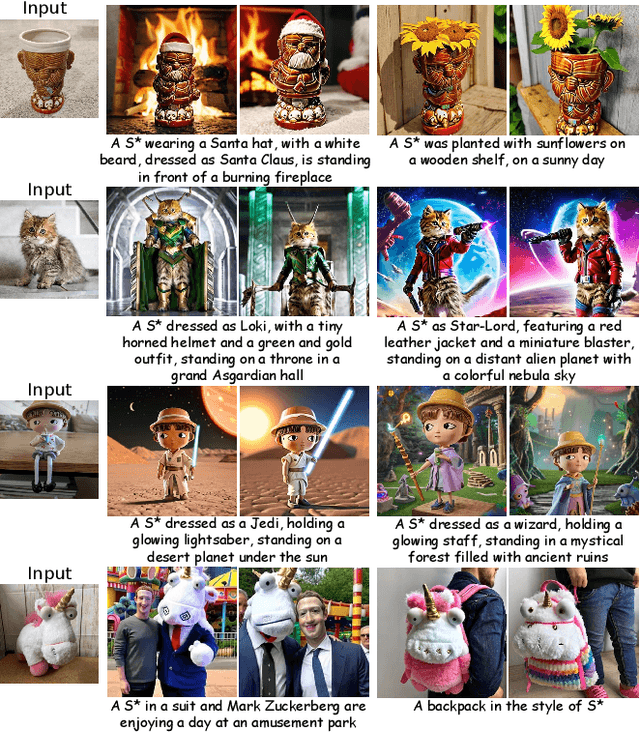


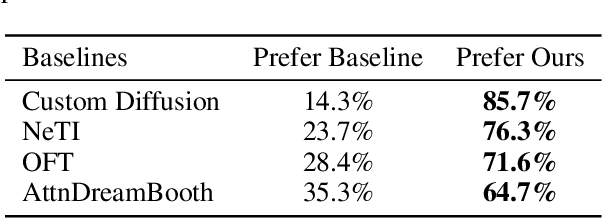
Recent advances in text-to-image personalization have enabled high-quality and controllable image synthesis for user-provided concepts. However, existing methods still struggle to balance identity preservation with text alignment. Our approach is based on the fact that generating prompt-aligned images requires a precise semantic understanding of the prompt, which involves accurately processing the interactions between the new concept and its surrounding context tokens within the CLIP text encoder. To address this, we aim to embed the new concept properly into the input embedding space of the text encoder, allowing for seamless integration with existing tokens. We introduce Context Regularization (CoRe), which enhances the learning of the new concept's text embedding by regularizing its context tokens in the prompt. This is based on the insight that appropriate output vectors of the text encoder for the context tokens can only be achieved if the new concept's text embedding is correctly learned. CoRe can be applied to arbitrary prompts without requiring the generation of corresponding images, thus improving the generalization of the learned text embedding. Additionally, CoRe can serve as a test-time optimization technique to further enhance the generations for specific prompts. Comprehensive experiments demonstrate that our method outperforms several baseline methods in both identity preservation and text alignment. Code will be made publicly available.