 Add to Chrome
 Add to Firefox
 Add to Edge
FEAT: A Linear-Complexity Foundation Model for Extremely Large Structured Data
Mar 17, 2026
Structured data is foundational to healthcare, finance, e-commerce, and scientific data management. Large structured-data models (LDMs) extend the foundation model paradigm to unify heterogeneous datasets for tasks such as classification, regression, and decision support. However, existing LDMs face major limitations. First, most rely on sample-wise self-attention, whose O(N^2) complexity limits the sample count. Second, linear sequence models often degrade representations due to hidden-state compression and artificial causal bias. Third, synthetic-only pre-training often fails to match real-world distributions. We propose FEAT, a linear-complexity foundation model for extremely large structured data. FEAT introduces a multi-layer dual-axis architecture that replaces quadratic attention with hybrid linear encoding. The architecture combines adaptive-fusion bi-Mamba-2 (AFBM) for local sample dependencies and convolutional gated linear attention (Conv-GLA) for global memory. This design enables linear-complexity cross-sample modeling while preserving expressive representations. To improve robustness, FEAT adopts a hybrid structural causal model pipeline and a stable reconstruction objective. Experiments on 11 real-world datasets show that FEAT consistently outperforms baselines in zero-shot performance, while scaling linearly and achieving up to 40x faster inference.

TCRL: Temporal-Coupled Adversarial Training for Robust Constrained Reinforcement Learning in Worst-Case Scenarios
Feb 13, 2026Constrained Reinforcement Learning (CRL) aims to optimize decision-making policies under constraint conditions, making it highly applicable to safety-critical domains such as autonomous driving, robotics, and power grid management. However, existing robust CRL approaches predominantly focus on single-step perturbations and temporally independent adversarial models, lacking explicit modeling of robustness against temporally coupled perturbations. To tackle these challenges, we propose TCRL, a novel temporal-coupled adversarial training framework for robust constrained reinforcement learning (TCRL) in worst-case scenarios. First, TCRL introduces a worst-case-perceived cost constraint function that estimates safety costs under temporally coupled perturbations without the need to explicitly model adversarial attackers. Second, TCRL establishes a dual-constraint defense mechanism on the reward to counter temporally coupled adversaries while maintaining reward unpredictability. Experimental results demonstrate that TCRL consistently outperforms existing methods in terms of robustness against temporally coupled perturbation attacks across a variety of CRL tasks.
CHGNN: A Semi-Supervised Contrastive Hypergraph Learning Network
Mar 10, 2023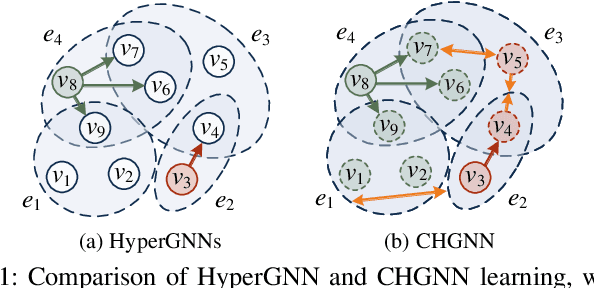
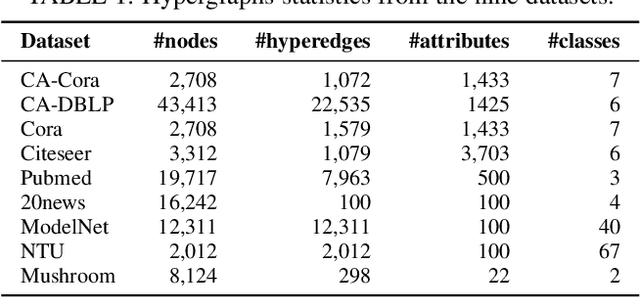
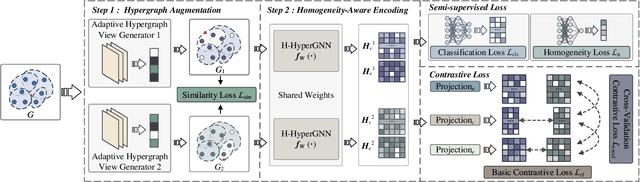
Hypergraphs can model higher-order relationships among data objects that are found in applications such as social networks and bioinformatics. However, recent studies on hypergraph learning that extend graph convolutional networks to hypergraphs cannot learn effectively from features of unlabeled data. To such learning, we propose a contrastive hypergraph neural network, CHGNN, that exploits self-supervised contrastive learning techniques to learn from labeled and unlabeled data. First, CHGNN includes an adaptive hypergraph view generator that adopts an auto-augmentation strategy and learns a perturbed probability distribution of minimal sufficient views. Second, CHGNN encompasses an improved hypergraph encoder that considers hyperedge homogeneity to fuse information effectively. Third, CHGNN is equipped with a joint loss function that combines a similarity loss for the view generator, a node classification loss, and a hyperedge homogeneity loss to inject supervision signals. It also includes basic and cross-validation contrastive losses, associated with an enhanced contrastive loss training process. Experimental results on nine real datasets offer insight into the effectiveness of CHGNN, showing that it outperforms 13 competitors in terms of classification accuracy consistently.