 Add to Chrome
 Add to Firefox
 Add to Edge
Rewarding Beliefs, Not Actions: Consistency-Guided Credit Assignment for Long-Horizon Agents
May 19, 2026
Reinforcement learning from verifiable rewards (RLVR) is a promising paradigm for improving large language model (LLM) agents on long-horizon interactive tasks. However, in partially observable environments, incomplete observations cause agent beliefs to drift over time, while delayed rewards obscure the causal impact of intermediate decisions, exacerbating temporal credit assignment challenges. To address this, we propose ReBel (Reward Belief), a process-level reinforcement learning algorithm that explicitly models structured belief states to summarize interaction history and guide subsequent policy learning. ReBel introduces belief-consistency supervision, converting discrepancies between predicted beliefs and observed feedback into dense self-supervised signals without requiring external step-wise annotations or verifiers. It also employs belief-aware grouping to compare trajectories under similar belief states, yielding more robust and lower-variance advantage estimates. We evaluate ReBel on challenging long-horizon benchmarks, including ALFWorld and WebShop. ReBel improves task success by up to $20.4$ percentage points over the episode-level baseline GRPO and increases sample efficiency by $2.1\times$. These results suggest that belief-aware self-supervision is a promising direction for reliable long-horizon decision-making under partial observability. Code is available at: https://github.com/Fateyetian/Rebel.git.

CoMemNet: Contrastive Sampling with Memory Replay Network for Continual Traffic Prediction
May 07, 2026In recent years, the integration of non-topological space modeling with temporal learning methods has emerged as an effective approach for capturing spatio-temporal information in non-Euclidean graphs. However, most existing methods rely on static underlying graph structures, which are inadequate for capturing the continuously expanding and evolving patterns in streaming traffic networks. To address this challenge, we propose a simple yet efficient dual-branch continual learning framework for traffic prediction, named CoMemNet. The fast-converging Online branch undertakes the primary prediction tasks, while the momentum-updated Target branch extracts historical information using Wasserstein Distance features to create a Dynamic Contrastive Sampler (DC Sampler). This sampler selects a node set with significant dynamic network feature changes for training, effectively mitigating the issue of catastrophic forgetting. Additionally, the backbone incorporates a lightweight Node-Adaptive Temporal Memory Buffer (TMRB-N) to consolidate old knowledge through memory replay and address the risk of memory explosion. Finally, we provide two newly curated open-source datasets. Experimental results demonstrate that CoMemNet achieves state-of-the-art (SOTA) performance across all three large-scale real-world datasets. The code is available at: https://github.com/meiwu5/CoMemNet.
TeleAntiFraud-28k: An Audio-Text Slow-Thinking Dataset for Telecom Fraud Detection
Apr 01, 2025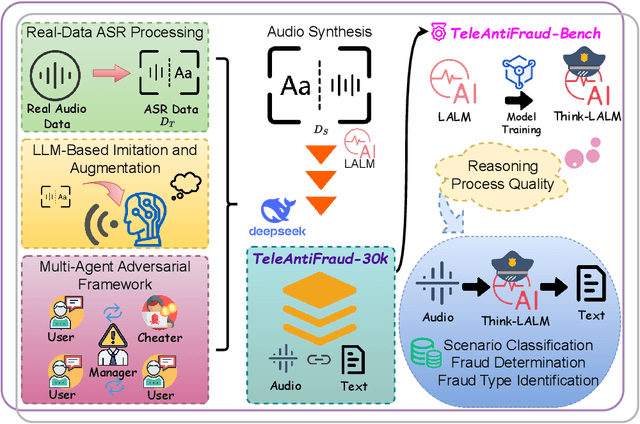
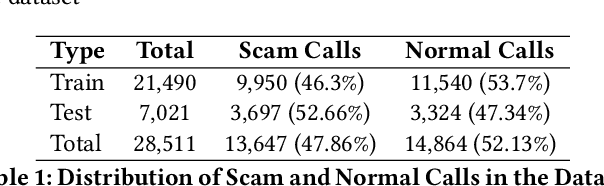
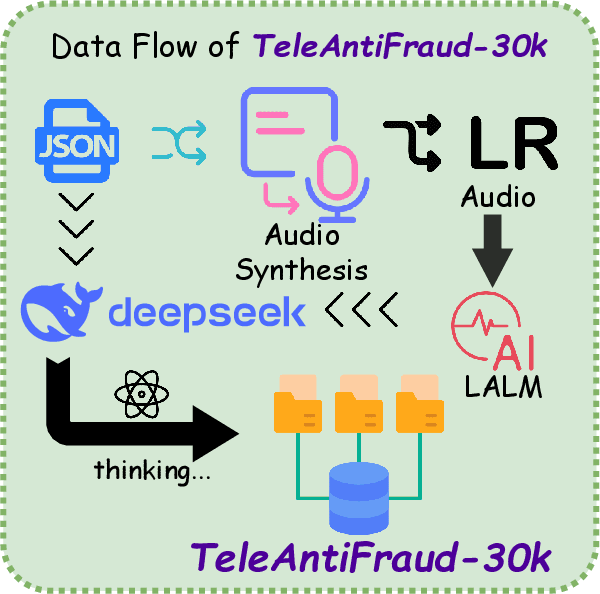
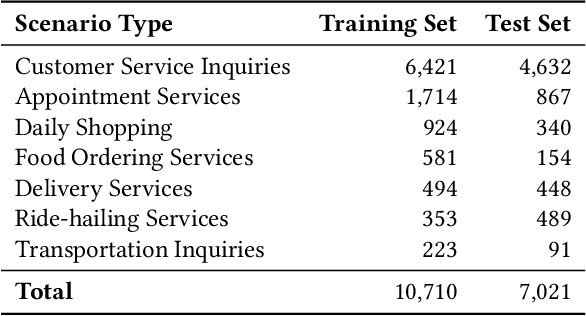
The detection of telecom fraud faces significant challenges due to the lack of high-quality multimodal training data that integrates audio signals with reasoning-oriented textual analysis. To address this gap, we present TeleAntiFraud-28k, the first open-source audio-text slow-thinking dataset specifically designed for automated telecom fraud analysis. Our dataset is constructed through three strategies: (1) Privacy-preserved text-truth sample generation using automatically speech recognition (ASR)-transcribed call recordings (with anonymized original audio), ensuring real-world consistency through text-to-speech (TTS) model regeneration; (2) Semantic enhancement via large language model (LLM)-based self-instruction sampling on authentic ASR outputs to expand scenario coverage; (3) Multi-agent adversarial synthesis that simulates emerging fraud tactics through predefined communication scenarios and fraud typologies. The generated dataset contains 28,511 rigorously processed speech-text pairs, complete with detailed annotations for fraud reasoning. The dataset is divided into three tasks: scenario classification, fraud detection, fraud type classification. Furthermore, we construct TeleAntiFraud-Bench, a standardized evaluation benchmark comprising proportionally sampled instances from the dataset, to facilitate systematic testing of model performance on telecom fraud detection tasks. We also contribute a production-optimized supervised fine-tuning (SFT) model trained on hybrid real/synthetic data, while open-sourcing the data processing framework to enable community-driven dataset expansion. This work establishes a foundational framework for multimodal anti-fraud research while addressing critical challenges in data privacy and scenario diversity. The project will be released at https://github.com/JimmyMa99/TeleAntiFraud.
DSGBench: A Diverse Strategic Game Benchmark for Evaluating LLM-based Agents in Complex Decision-Making Environments
Mar 08, 2025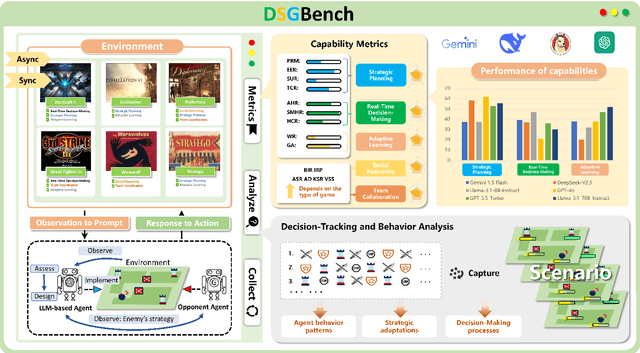
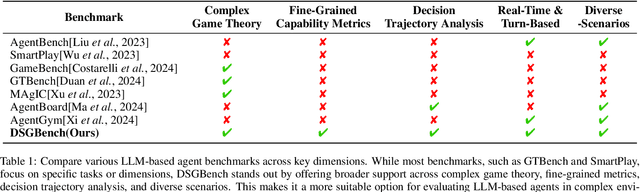
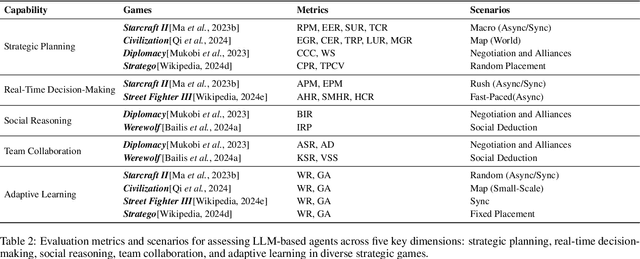
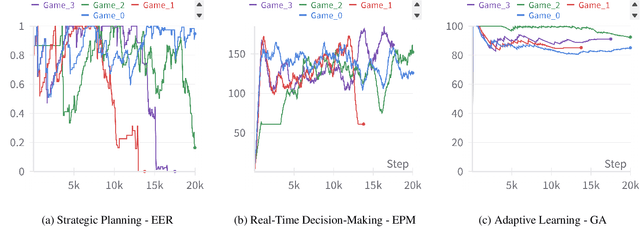
Large Language Model~(LLM) based agents have been increasingly popular in solving complex and dynamic tasks, which requires proper evaluation systems to assess their capabilities. Nevertheless, existing benchmarks usually either focus on single-objective tasks or use overly broad assessing metrics, failing to provide a comprehensive inspection of the actual capabilities of LLM-based agents in complicated decision-making tasks. To address these issues, we introduce DSGBench, a more rigorous evaluation platform for strategic decision-making. Firstly, it incorporates six complex strategic games which serve as ideal testbeds due to their long-term and multi-dimensional decision-making demands and flexibility in customizing tasks of various difficulty levels or multiple targets. Secondly, DSGBench employs a fine-grained evaluation scoring system which examines the decision-making capabilities by looking into the performance in five specific dimensions and offering a comprehensive assessment in a well-designed way. Furthermore, DSGBench also incorporates an automated decision-tracking mechanism which enables in-depth analysis of agent behaviour patterns and the changes in their strategies. We demonstrate the advances of DSGBench by applying it to multiple popular LLM-based agents and our results suggest that DSGBench provides valuable insights in choosing LLM-based agents as well as improving their future development. DSGBench is available at https://github.com/DeciBrain-Group/DSGBench.