 Add to Chrome
 Add to Firefox
 Add to Edge
Look Up and Look Back: Hidden Attention and Latent Orientation in a Frozen Foundation Model for Panoramic SLAM
Aug 02, 2026
Monocular panoramic SLAM benefits from substantial visual overlap under large camera rotations, yet remains prone to errors caused by camera tilt, scale drift, and false loop closures. We show that a frozen panoramic geometry foundation model provides useful internal cues beyond its explicit geometric outputs: intermediate tokens encode gravity in the camera frame, while cross-view attention provides a compatibility cue for potential revisits. Building on these cues, we present HALO-SLAM. A gravity readout enables IMU-free spherical upright canonicalization. For loop closure, we introduce a cost-aware three-stage cascade combining DBoW2 event-level retrieval, attention-based compatibility filtering, and dense geometric validation through symmetric submap augmentation. Accepted revisits yield pixel-aligned 3D--3D correspondences in both local gauges, from which robust $\mathrm{Sim}(3)$ constraints are estimated and jointly optimized with sequential constraints in a global pose graph. Across 125 sequences from five real-world panoramic benchmarks, our method achieves \textbf{100\%} sequence success (\textbf{125/125}) under the stated criterion and the lowest ATE among the evaluated methods on all five benchmarks, reducing ATE by \textbf{30--88\%} relative to the best ERP-native baseline on each benchmark.

Anticipatory Risk-Guided Reinforcement Learning for Safe Flight Through Dynamic Clutter
Jul 26, 2026Safe quadrotor navigation in cluttered and dynamic environments depends not only on instantaneous geometric perception, but more critically on anticipating collision risks induced by relative motion. Conventional modular pipelines frequently suffer from perception latency, while end-to-end learning methods relying on implicit scalar rewards often struggle to extract reliable spatio-temporal features without physics-grounded supervision. To address this, we propose an anticipatory risk-guided reinforcement learning framework. Leveraging privileged simulator states, we construct a directionally aligned future collision risk map based on the Closest Point of Approach (CPA). Through an asymmetric actor-critic architecture, the network is trained to self-predict this structured risk, which explicitly guides the visual policy during deployment. A lightweight spatio-temporal encoder extracts motion cues directly from onboard depth sequences, bypassing explicit object tracking or optical flow estimation. Extensive simulated and real-world experiments demonstrate that our method effectively improves safety margins and flight efficiency in dense dynamic clutters compared to existing baselines. Furthermore, the learned policy achieves robust zero-shot Sim-to-Real transfer on a physical quadrotor, relying purely on abstracted spatio-temporal depth sequences and its self-predicted risk priors, validating the effectiveness of our approach and its robust generalization from simulation to reality.
A 24-GHz CMOS Transformer-Based Three-Tline Series Doherty Power Amplifier Achieving 39% PAE
Nov 15, 2025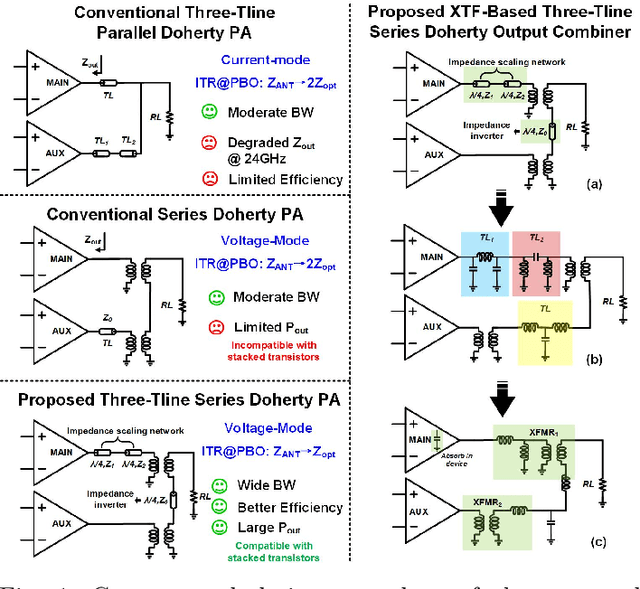
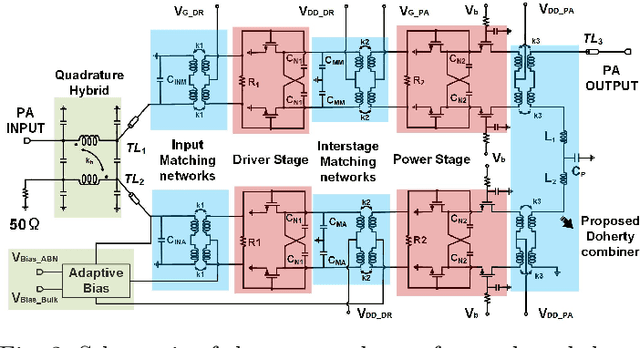
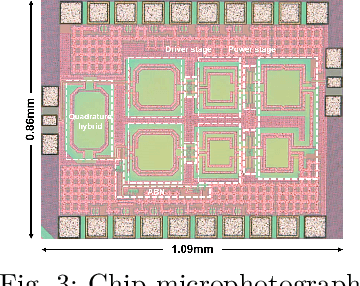
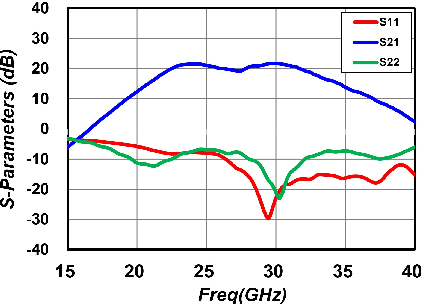
This paper presents a transformer-based three- transmission-line (Tline) series Doherty power amplifier (PA) implemented in 65-nm CMOS, targeting broadband K/Ka-band applications. By integrating an impedance-scaling network into the output matching structure, the design enables effective load modulation and reduced impedance transformation ratio (ITR) at power back-off when employing stacked cascode transistors. The PA demonstrates a -3-dB small-signal gain bandwidth from 22 to 32.5 GHz, a saturated output power (Psat) of 21.6 dBm, and a peak power-added efficiency (PAE) of 39%. At 6dB back-off, the PAE remains above 24%, validating its suitability for high- efficiency mm-wave phased-array transmitters in next-generation wireless systems.