 Add to Chrome
 Add to Firefox
 Add to Edge
OneModel: A Unified Foundation for Platform-Scale Multi-Scenario Ranking
Aug 20, 2026
Platform-scale recommender systems often span multiple business streams such as organic recommendation, advertising, and merchant services, where user behaviors form a continuous cross-stream trajectory. Maintaining separate ranking systems fragments user representations and increases engineering cost. We propose \textbf{OneModel}, a unified framework for multi-stream final ranking. OneModel maps heterogeneous behaviors into shared event sequences, learns long-context user representations with an action-oriented backbone, and introduces \emph{Scenario-aware Information Modulation} to balance cross-stream transfer and stream-specific specialization. For production deployment, OneModel further adopts stratified user representation, multi-objective training, and optimized online serving with feature decomposition, user feature prefetching, shared user-tower computation, and graph-level inference optimization. We deploy OneModel in production at \emph{Xiaohongshu}, where it delivers consistent offline gains over strong baselines and scales favorably with context length and model capacity. Online A/B tests improve Time Spent by \textbf{+0.33\%} and Engagement by \textbf{+1.25\%} in Explore Feed, lift advertising value by \textbf{+3.43\%} and CTR by \textbf{+8.18\%} in Feed Advertising, and raise DGMV by \textbf{+1.1867\%} and GPM by \textbf{+2.1585\%} in Merchant Recommendation, validating unified multi-stream ranking as an effective production foundation.

LASER: An Efficient Target-Aware Segmented Attention Framework for End-to-End Long Sequence Modeling
Feb 12, 2026Modeling ultra-long user behavior sequences is pivotal for capturing evolving and lifelong interests in modern recommendation systems. However, deploying such models in real-time industrial environments faces a strict "Latency Wall", constrained by two distinct bottlenecks: the high I/O latency of retrieving massive user histories and the quadratic computational complexity of standard attention mechanisms. To break these bottlenecks, we present LASER, a full-stack optimization framework developed and deployed at Xiaohongshu (RedNote). Our approach tackles the challenges through two complementary innovations: (1) System efficiency: We introduce SeqVault, a unified schema-aware serving infrastructure for long user histories. By implementing a hybrid DRAM-SSD indexing strategy, SeqVault reduces retrieval latency by 50% and CPU usage by 75%, ensuring millisecond-level access to full real-time and life-cycle user histories. (2) Algorithmic efficiency: We propose a Segmented Target Attention (STA) mechanism to address the computational overhead. Motivated by the inherent sparsity of user interests, STA employs a sigmoid-based gating strategy that acts as a silence mechanism to filter out noisy items. Subsequently, a lightweight Global Stacked Target Attention (GSTA) module refines these compressed segments to capture cross-segment dependencies without incurring high computational costs. This design performs effective sequence compression, reducing the complexity of long-sequence modeling while preserving critical signals. Extensive offline evaluations demonstrate that LASER consistently outperforms state-of-the-art baselines. In large-scale online A/B testing serving over 100 million daily active users, LASER achieved a 2.36% lift in ADVV and a 2.08% lift in revenue, demonstrating its scalability and significant commercial impact.
Adaptive Neighboring Selection Algorithm Based on Curvature Prediction in Manifold Learning
Apr 13, 2017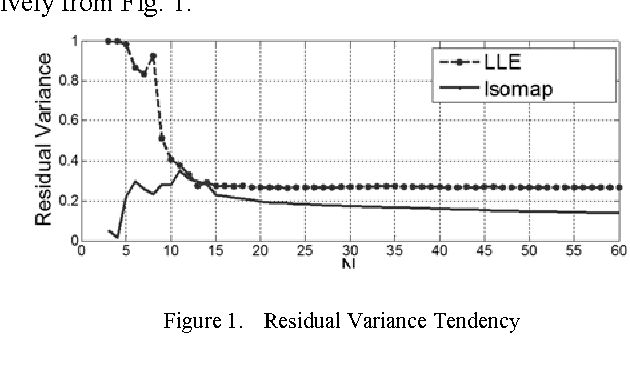
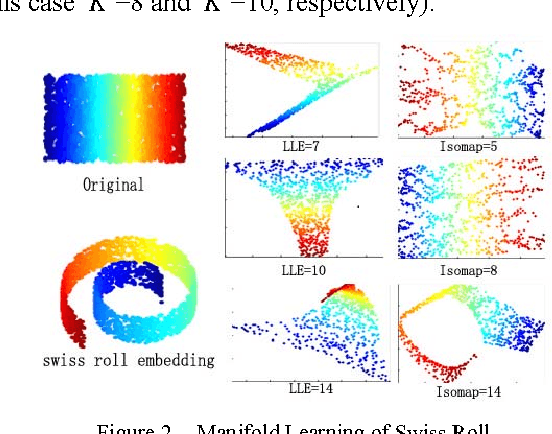
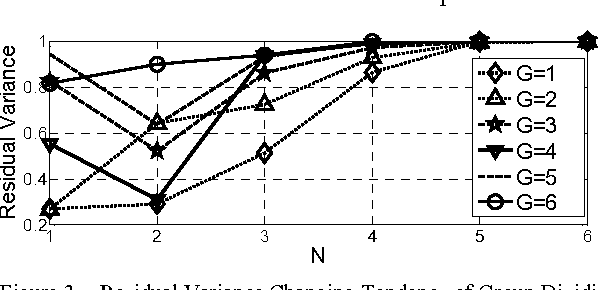
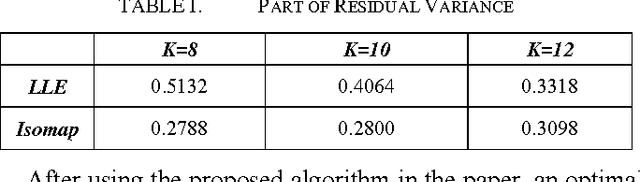
Recently manifold learning algorithm for dimensionality reduction attracts more and more interests, and various linear and nonlinear, global and local algorithms are proposed. The key step of manifold learning algorithm is the neighboring region selection. However, so far for the references we know, few of which propose a generally accepted algorithm to well select the neighboring region. So in this paper, we propose an adaptive neighboring selection algorithm, which successfully applies the LLE and ISOMAP algorithms in the test. It is an algorithm that can find the optimal K nearest neighbors of the data points on the manifold. And the theoretical basis of the algorithm is the approximated curvature of the data point on the manifold. Based on Riemann Geometry, Jacob matrix is a proper mathematical concept to predict the approximated curvature. By verifying the proposed algorithm on embedding Swiss roll from R3 to R2 based on LLE and ISOMAP algorithm, the simulation results show that the proposed adaptive neighboring selection algorithm is feasible and able to find the optimal value of K, making the residual variance relatively small and better visualization of the results. By quantitative analysis, the embedding quality measured by residual variance is increased 45.45% after using the proposed algorithm in LLE.
* 3 figures, from Journal of Harbin Institute of Technology