 Add to Chrome
 Add to Firefox
 Add to Edge
Relevance Matters: A Multi-Task and Multi-Stage Large Language Model Approach for E-commerce Query Rewriting
Mar 03, 2026
For e-commerce search, user experience is measured by users' behavioral responses to returned products, like click-through rate and conversion rate, as well as the relevance between returned products and search queries. Consequently, relevance and user conversion constitute the two primary objectives in query rewriting, a strategy to bridge the lexical gap between user expressions and product descriptions. This research proposes a multi-task and multi-stage query rewriting framework grounded in large language models (LLMs). Critically, in contrast to previous works that primarily emphasized rewritten query generation, we inject the relevance task into query rewriting. Specifically, leveraging a pretrained model on user data and product information from JD.com, the approach initiates with multi-task supervised fine-tuning (SFT) comprising of the rewritten query generation task and the relevance tagging task between queries and rewrites. Subsequently, we employ Group Relative Policy Optimization (GRPO) for the model's objective alignment oriented toward enhancing the relevance and stimulating user conversions. Through offline evaluation and online A/B test, our framework illustrates substantial improvements in the effectiveness of e-commerce query rewriting, resulting in elevating the search results' relevance and boosting the number of purchases made per user (UCVR). Since August 2025, our approach has been implemented on JD.com, one of China's leading online shopping platforms.

LREF: A Novel LLM-based Relevance Framework for E-commerce
Mar 12, 2025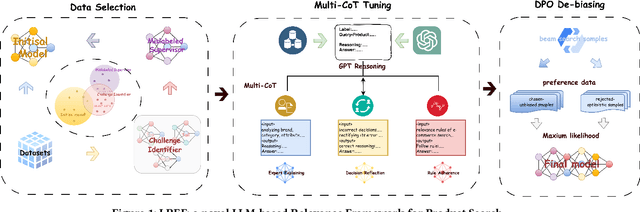
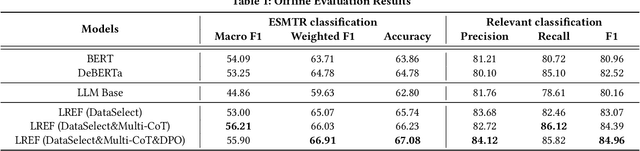
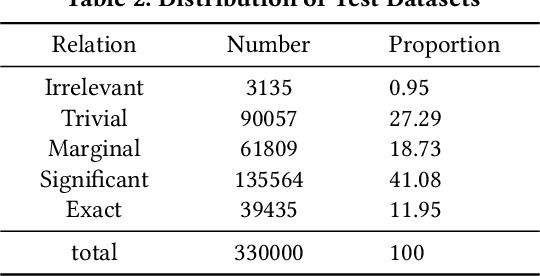

Query and product relevance prediction is a critical component for ensuring a smooth user experience in e-commerce search. Traditional studies mainly focus on BERT-based models to assess the semantic relevance between queries and products. However, the discriminative paradigm and limited knowledge capacity of these approaches restrict their ability to comprehend the relevance between queries and products fully. With the rapid advancement of Large Language Models (LLMs), recent research has begun to explore their application to industrial search systems, as LLMs provide extensive world knowledge and flexible optimization for reasoning processes. Nonetheless, directly leveraging LLMs for relevance prediction tasks introduces new challenges, including a high demand for data quality, the necessity for meticulous optimization of reasoning processes, and an optimistic bias that can result in over-recall. To overcome the above problems, this paper proposes a novel framework called the LLM-based RElevance Framework (LREF) aimed at enhancing e-commerce search relevance. The framework comprises three main stages: supervised fine-tuning (SFT) with Data Selection, Multiple Chain of Thought (Multi-CoT) tuning, and Direct Preference Optimization (DPO) for de-biasing. We evaluate the performance of the framework through a series of offline experiments on large-scale real-world datasets, as well as online A/B testing. The results indicate significant improvements in both offline and online metrics. Ultimately, the model was deployed in a well-known e-commerce application, yielding substantial commercial benefits.
A Multi-Granularity Matching Attention Network for Query Intent Classification in E-commerce Retrieval
Mar 28, 2023


Query intent classification, which aims at assisting customers to find desired products, has become an essential component of the e-commerce search. Existing query intent classification models either design more exquisite models to enhance the representation learning of queries or explore label-graph and multi-task to facilitate models to learn external information. However, these models cannot capture multi-granularity matching features from queries and categories, which makes them hard to mitigate the gap in the expression between informal queries and categories. This paper proposes a Multi-granularity Matching Attention Network (MMAN), which contains three modules: a self-matching module, a char-level matching module, and a semantic-level matching module to comprehensively extract features from the query and a query-category interaction matrix. In this way, the model can eliminate the difference in expression between queries and categories for query intent classification. We conduct extensive offline and online A/B experiments, and the results show that the MMAN significantly outperforms the strong baselines, which shows the superiority and effectiveness of MMAN. MMAN has been deployed in production and brings great commercial value for our company.