 Add to Chrome
 Add to Firefox
 Add to Edge
QUEST: Training Frontier Deep Research Agents with Fully Synthetic Tasks
May 22, 2026
Deep research agents extend the role of search engines from retrieving keyword-matched pages to synthesizing knowledge, fundamentally changing how humans interact with information. However, frontier systems remain proprietary, while existing open agents often generalize poorly across different task types, leaving unclear how to train a broadly capable deep research agent. We release QUEST, a family of open models (ranging from 2B to 35B) that serve as general-purpose deep research agents designed to handle a wide range of long-horizon search tasks, with strong capabilities in fact seeking, citation grounding, and report synthesis. To build QUEST, we propose an effective training recipe combining mid-training, supervised fine-tuning, and reinforcement learning. Central to this recipe is a curated data synthesis pipeline based on unified rubric trees, which applies to different task types and enables synthesizing training data with verifiable rewards without human annotation. In addition, QUEST incorporates a built-in context management mechanism that enables effective long-horizon reasoning and knowledge synthesis. Using only 8K synthesized tasks, QUEST approaches or even surpasses frontier closed-source agents across eight deep research benchmarks spanning diverse task types, and achieves the best overall performance among recent open-weight agents. We released everything: models, data, and training scripts.

LASER: An Efficient Target-Aware Segmented Attention Framework for End-to-End Long Sequence Modeling
Feb 12, 2026Modeling ultra-long user behavior sequences is pivotal for capturing evolving and lifelong interests in modern recommendation systems. However, deploying such models in real-time industrial environments faces a strict "Latency Wall", constrained by two distinct bottlenecks: the high I/O latency of retrieving massive user histories and the quadratic computational complexity of standard attention mechanisms. To break these bottlenecks, we present LASER, a full-stack optimization framework developed and deployed at Xiaohongshu (RedNote). Our approach tackles the challenges through two complementary innovations: (1) System efficiency: We introduce SeqVault, a unified schema-aware serving infrastructure for long user histories. By implementing a hybrid DRAM-SSD indexing strategy, SeqVault reduces retrieval latency by 50% and CPU usage by 75%, ensuring millisecond-level access to full real-time and life-cycle user histories. (2) Algorithmic efficiency: We propose a Segmented Target Attention (STA) mechanism to address the computational overhead. Motivated by the inherent sparsity of user interests, STA employs a sigmoid-based gating strategy that acts as a silence mechanism to filter out noisy items. Subsequently, a lightweight Global Stacked Target Attention (GSTA) module refines these compressed segments to capture cross-segment dependencies without incurring high computational costs. This design performs effective sequence compression, reducing the complexity of long-sequence modeling while preserving critical signals. Extensive offline evaluations demonstrate that LASER consistently outperforms state-of-the-art baselines. In large-scale online A/B testing serving over 100 million daily active users, LASER achieved a 2.36% lift in ADVV and a 2.08% lift in revenue, demonstrating its scalability and significant commercial impact.
Implicit Reasoning in Transformers is Reasoning through Shortcuts
Mar 10, 2025Test-time compute is emerging as a new paradigm for enhancing language models' complex multi-step reasoning capabilities, as demonstrated by the success of OpenAI's o1 and o3, as well as DeepSeek's R1. Compared to explicit reasoning in test-time compute, implicit reasoning is more inference-efficient, requiring fewer generated tokens. However, why does the advanced reasoning capability fail to emerge in the implicit reasoning style? In this work, we train GPT-2 from scratch on a curated multi-step mathematical reasoning dataset and conduct analytical experiments to investigate how language models perform implicit reasoning in multi-step tasks. Our findings reveal: 1) Language models can perform step-by-step reasoning and achieve high accuracy in both in-domain and out-of-domain tests via implicit reasoning. However, this capability only emerges when trained on fixed-pattern data. 2) Conversely, implicit reasoning abilities emerging from training on unfixed-pattern data tend to overfit a specific pattern and fail to generalize further. Notably, this limitation is also observed in state-of-the-art large language models. These findings suggest that language models acquire implicit reasoning through shortcut learning, enabling strong performance on tasks with similar patterns while lacking generalization.
Evaluating Character Understanding of Large Language Models via Character Profiling from Fictional Works
Apr 19, 2024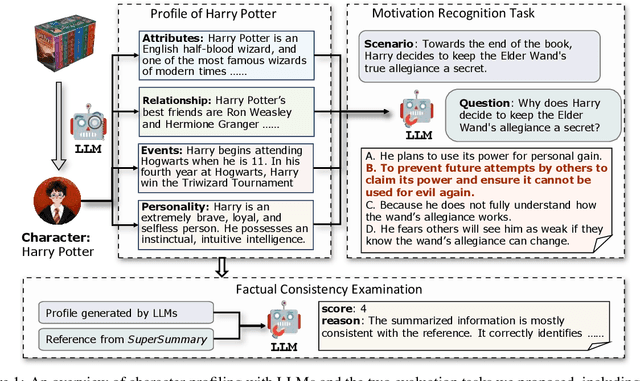
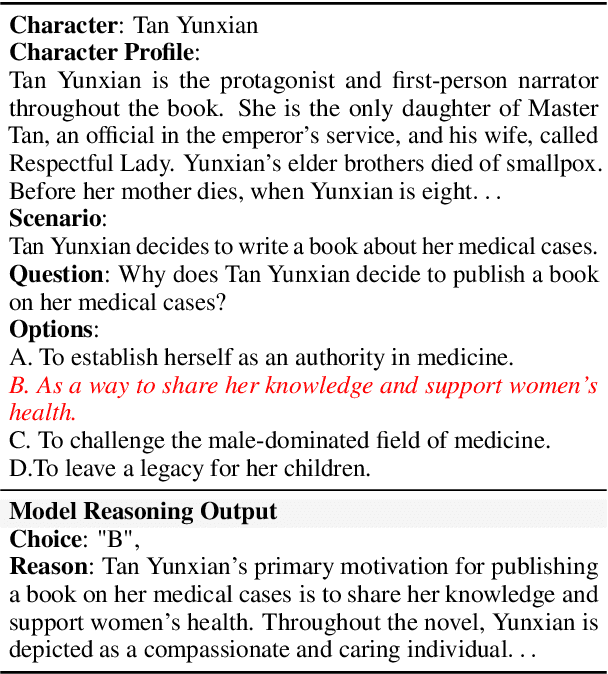
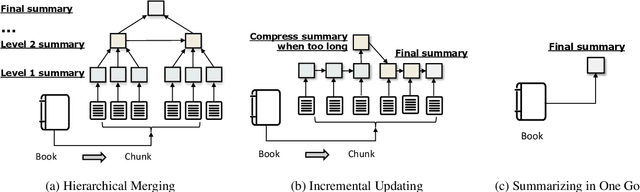
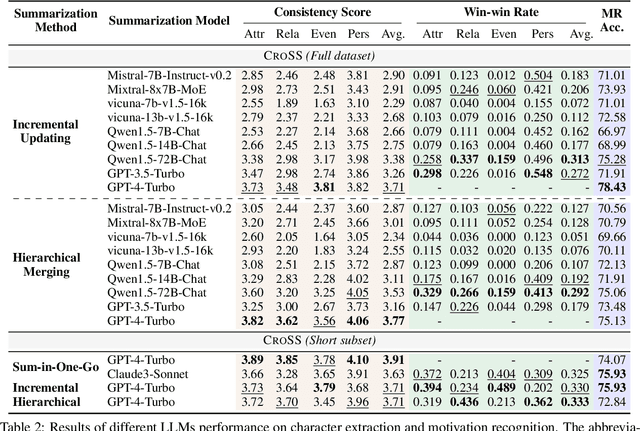
Large language models (LLMs) have demonstrated impressive performance and spurred numerous AI applications, in which role-playing agents (RPAs) are particularly popular, especially for fictional characters. The prerequisite for these RPAs lies in the capability of LLMs to understand characters from fictional works. Previous efforts have evaluated this capability via basic classification tasks or characteristic imitation, failing to capture the nuanced character understanding with LLMs. In this paper, we propose evaluating LLMs' character understanding capability via the character profiling task, i.e., summarizing character profiles from corresponding materials, a widely adopted yet understudied practice for RPA development. Specifically, we construct the CroSS dataset from literature experts and assess the generated profiles by comparing ground truth references and their applicability in downstream tasks. Our experiments, which cover various summarization methods and LLMs, have yielded promising results. These results strongly validate the character understanding capability of LLMs. We believe our constructed resource will promote further research in this field. Resources are available at https://github.com/Joanna0123/character_profiling.