 Add to Chrome
 Add to Firefox
 Add to Edge
Category-based and Popularity-guided Video Game Recommendation: A Balance-oriented Framework
Apr 16, 2026
In recent years, the video game industry has experienced substantial growth, presenting players with a vast array of game choices. This surge in options has spurred the need for a specialized recommender system tailored for video games. However, current video game recommendation approaches tend to prioritize accuracy over diversity, potentially leading to unvaried game suggestions. In addition, the existing game recommendation methods commonly lack the ability to establish strict connections between games to enhance accuracy. Furthermore, many existing diversity-focused methods fail to leverage crucial item information, such as item category and popularity during neighbor modeling and message propagation. To address these challenges, we introduce a novel framework, called CPGRec, comprising three modules, namely accuracy-driven, diversity-driven, and comprehensive modules. The first module extends the state-of-the-art accuracy-focused game recommendation method by connecting games in a more stringent manner to enhance recommendation accuracy. The second module connects neighbors with diverse categories within the proposed game graph and harnesses the advantages of popular game nodes to amplify the influence of long-tail games within the player-game bipartite graph, thereby enriching recommendation diversity. The third module combines the above two modules and employs a new negative-sample rating score reweighting method to balance accuracy and diversity. Experimental results on the Steam dataset demonstrate the effectiveness of our proposed method in improving game recommendations. The dataset and source codes are anonymously released at: https://github.com/CPGRec2024/CPGRec.git.

CPGRec+: A Balance-oriented Framework for Personalized Video Game Recommendations
Apr 16, 2026The rapid expansion of gaming industry requires advanced recommender systems tailored to its dynamic landscape. Existing Graph Neural Network (GNN)-based methods primarily prioritize accuracy over diversity, overlooking their inherent trade-off. To address this, we previously proposed CPGRec, a balance-oriented gaming recommender system. However, CPGRec fails to account for critical disparities in player-game interactions, which carry varying significance in reflecting players' personal preferences and may exacerbate over-smoothness issues inherent in GNN-based models. Moreover, existing approaches underutilize the reasoning capabilities and extensive knowledge of large language models (LLMs) in addressing these limitations. To bridge this gap, we propose two new modules. First, Preference-informed Edge Reweighting (PER) module assigns signed edge weights to qualitatively distinguish significant player interests and disinterests while then quantitatively measuring preference strength to mitigate over-smoothing in graph convolutions. Second, Preference-informed Representation Generation (PRG) module leverages LLMs to generate contextualized descriptions of games and players by reasoning personal preferences from comparing global and personal interests, thereby refining representations of players and games. Experiments on \textcolor{black}{two Steam datasets} demonstrate CPGRec+'s superior accuracy and diversity over state-of-the-art models. The code is accessible at https://github.com/HsipingLi/CPGRec-Plus.
* Published in ACM Transactions on Information Systems (TOIS). 43 pages, 9 figures
Chi-Square Wavelet Graph Neural Networks for Heterogeneous Graph Anomaly Detection
May 25, 2025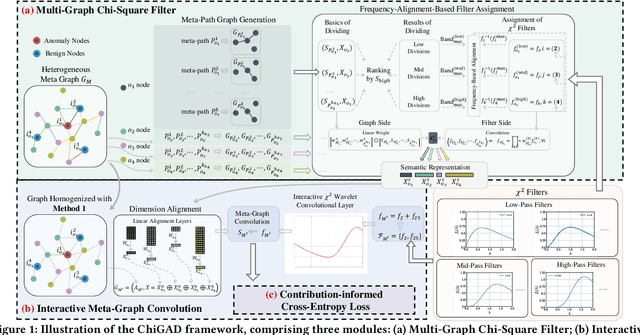
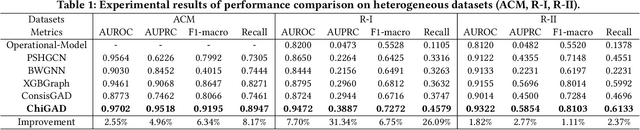
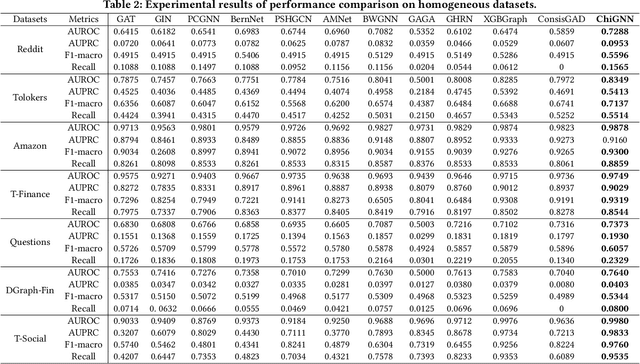
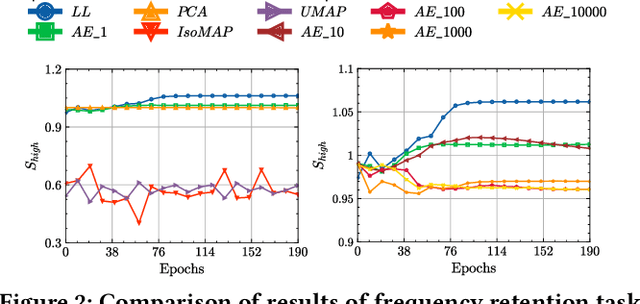
Graph Anomaly Detection (GAD) in heterogeneous networks presents unique challenges due to node and edge heterogeneity. Existing Graph Neural Network (GNN) methods primarily focus on homogeneous GAD and thus fail to address three key issues: (C1) Capturing abnormal signal and rich semantics across diverse meta-paths; (C2) Retaining high-frequency content in HIN dimension alignment; and (C3) Learning effectively from difficult anomaly samples with class imbalance. To overcome these, we propose ChiGAD, a spectral GNN framework based on a novel Chi-Square filter, inspired by the wavelet effectiveness in diverse domains. Specifically, ChiGAD consists of: (1) Multi-Graph Chi-Square Filter, which captures anomalous information via applying dedicated Chi-Square filters to each meta-path graph; (2) Interactive Meta-Graph Convolution, which aligns features while preserving high-frequency information and incorporates heterogeneous messages by a unified Chi-Square Filter; and (3) Contribution-Informed Cross-Entropy Loss, which prioritizes difficult anomalies to address class imbalance. Extensive experiments on public and industrial datasets show that ChiGAD outperforms state-of-the-art models on multiple metrics. Additionally, its homogeneous variant, ChiGNN, excels on seven GAD datasets, validating the effectiveness of Chi-Square filters. Our code is available at https://github.com/HsipingLi/ChiGAD.