 Add to Chrome
 Add to Firefox
 Add to Edge
Contrastive Learning for Interpretable Anomaly Detection at Collider Experiments
Aug 13, 2026
Generic event-level anomaly detection for collider physics has two recurring problems: anomaly scores are hard to interpret, and they correlate strongly with energy scale and object multiplicity. We present Organized Representation via Contrastive learning for Anomaly detection (ORCA), a two-stage framework that first learns an embedding space via supervised contrastive learning across a diverse set of physics processes, then runs a standard autoencoder in that space to generate event-level anomaly scores. On a simulated dataset consistent with conditions at the High-Luminosity Large Hadron Collider, ORCA delivers significant gains in both breadth and depth of sensitivity to new physics signals with respect to a baseline autoencoder architecture. Beyond improved sensitivity, the contrastive embedding makes the anomalous sample interpretable: because known processes occupy distinct regions of the space, a maximum-likelihood template fit to the embedding distributions can attribute events in an anomalous sample to template physics processes with quantified uncertainties. We demonstrate that the fit accurately recovers injected signal yields, including for signals excluded from the training of the embedding, and characterizes signals absent from the template library through the known processes they most resemble. These results establish ORCA as a route to interpretable anomaly detection-based searches at colliders, where the embedding geometry carries higher dimensional physics information compared to standard one-dimensional output fits, enhancing downstream statistical analysis.

A Lightweight Foundation Model for Collider Physics with Multi-Domain Adaptation
Jul 29, 2026We present a lightweight approach to foundation modeling (\textbf{NEXUS}) that leverages pre-trained learning from collider physics data towards out-of-domain tasks in other scientific datasets, using a fully connected autoencoder model with approximately 3 million parameters. The model pre-trains with no supervision over a large-scale collision dataset from the Large Hadron Collider modeled by charged particle track features. Downstream tasks for collider analyses, such as kinematic regression and event classification, are developed on pre-trained model weights and achieve improved accuracy with only small labeled datasets when compared to equivalent architectures trained from scratch. The benefits of pre-training are additionally investigated through latent space interpretation and application to other domains, including gravitational waves, flood forecasting, and neural activity. Furthermore, the relative computational simplicity of NEXUS is demonstrated compared to transformer approaches at comparable scale, opening the door to power-efficient inference and real-time or edge applications of foundation models in scientific experiments.
Classical Hardware Acceleration of Quantum Autoencoders for Real-Time Anomaly Detection in Collider Experiments
Jul 22, 2026Quantum machine learning (QML) algorithms in high energy physics (HEP) can efficiently represent and leverage long-range, high-order correlations in high-dimensional collider data, potentially with fewer parameters and favorable scaling relative to classical models. Deployment of QML in real-time collider applications such as trigger systems requires the ability to emulate and compile quantum circuits classically, then synthesize the resulting quantum gates onto low-latency hardware accelerators, namely field-programmable gate arrays (FPGAs). We present a study of variational quantum autoencoder models for real-time anomaly detection triggers in modern collider experiments. The models achieve performance comparable to state-of-the-art classical approaches and, after FPGA synthesis, satisfy resource usage and timing constraints consistent with trigger applications in future colliders. This work provides one of the first FPGA implementations of QML models for HEP triggers, enabling higher-capability models in today's classical data acquisition pipelines while advancing quantum readiness of collider experiment infrastructure.
SciFi: A Safe, Lightweight, User-Friendly, and Fully Autonomous Agentic AI Workflow for Scientific Applications
Apr 14, 2026Recent advances in agentic AI have enabled increasingly autonomous workflows, but existing systems still face substantial challenges in achieving reliable deployment in real-world scientific research. In this work, we present a safe, lightweight, and user-friendly agentic framework for the autonomous execution of well-defined scientific tasks. The framework combines an isolated execution environment, a three-layer agent loop, and a self-assessing do-until mechanism to ensure safe and reliable operation while effectively leveraging large language models of varying capability levels. By focusing on structured tasks with clearly defined context and stopping criteria, the framework supports end-to-end automation with minimal human intervention, enabling researchers to offload routine workloads and devote more effort to creative activities and open-ended scientific inquiry.
Hardware-Aware Tensor Networks for Real-Time Quantum-Inspired Anomaly Detection at Particle Colliders
Mar 27, 2026Quantum machine learning offers the ability to capture complex correlations in high-dimensional feature spaces, crucial for the challenge of detecting beyond the Standard Model physics in collider events, along with the potential for unprecedented computational efficiency in future quantum processors. Near-term utilization of these benefits can be achieved by developing quantum-inspired algorithms for deployment in classical hardware to enable applications at the "edge" of current scientific experiments. This work demonstrates the use of tensor networks for real-time anomaly detection in collider detectors. A spaced matrix product operator (SMPO) is developed that provides sensitivity to a variety beyond the Standard Model benchmarks, and can be implemented in field programmable gate array hardware with resources and latency consistent with trigger deployment. The cascaded SMPO architecture is introduced as an SMPO variation that affords greater flexibility and efficiency in ways that are key to edge applications in resource-constrained environments. These results reveal the benefit and near-term feasibility of deploying quantum-inspired ML in high energy colliders.
Machine Learning on Heterogeneous, Edge, and Quantum Hardware for Particle Physics (ML-HEQUPP)
Feb 24, 2026The next generation of particle physics experiments will face a new era of challenges in data acquisition, due to unprecedented data rates and volumes along with extreme environments and operational constraints. Harnessing this data for scientific discovery demands real-time inference and decision-making, intelligent data reduction, and efficient processing architectures beyond current capabilities. Crucial to the success of this experimental paradigm are several emerging technologies, such as artificial intelligence and machine learning (AI/ML) and silicon microelectronics, and the advent of quantum algorithms and processing. Their intersection includes areas of research such as low-power and low-latency devices for edge computing, heterogeneous accelerator systems, reconfigurable hardware, novel codesign and synthesis strategies, readout for cryogenic or high-radiation environments, and analog computing. This white paper presents a community-driven vision to identify and prioritize research and development opportunities in hardware-based ML systems and corresponding physics applications, contributing towards a successful transition to the new data frontier of fundamental science.
Edge Machine Learning for Cluster Counting in Next-Generation Drift Chambers
Nov 16, 2025Drift chambers have long been central to collider tracking, but future machines like a Higgs factory motivate higher granularity and cluster counting for particle ID, posing new data processing challenges. Machine learning (ML) at the "edge", or in cell-level readout, can dramatically reduce the off-detector data rate for high-granularity drift chambers by performing cluster counting at-source. We present machine learning algorithms for cluster counting in real-time readout of future drift chambers. These algorithms outperform traditional derivative-based techniques based on achievable pion-kaon separation. When synthesized to FPGA resources, they can achieve latencies consistent with real-time operation in a future Higgs factory scenario, thus advancing both R&D for future collider detectors as well as hardware-based ML for edge applications in high energy physics.
Convolutional Autoencoders for Data Compression and Anomaly Detection in Small Satellite Technologies
Apr 29, 2025Small satellite technologies have enhanced the potential and feasibility of geodesic missions, through simplification of design and decreased costs allowing for more frequent launches. On-satellite data acquisition systems can benefit from the implementation of machine learning (ML), for better performance and greater efficiency on tasks such as image processing or feature extraction. This work presents convolutional autoencoders for implementation on the payload of small satellites, designed to achieve dual functionality of data compression for more efficient off-satellite transmission, and at-source anomaly detection to inform satellite data-taking. This capability is demonstrated for a use case of disaster monitoring using aerial image datasets of the African continent, offering avenues for both novel ML-based approaches in small satellite applications along with the expansion of space technology and artificial intelligence in Africa.
Building Machine Learning Challenges for Anomaly Detection in Science
Mar 03, 2025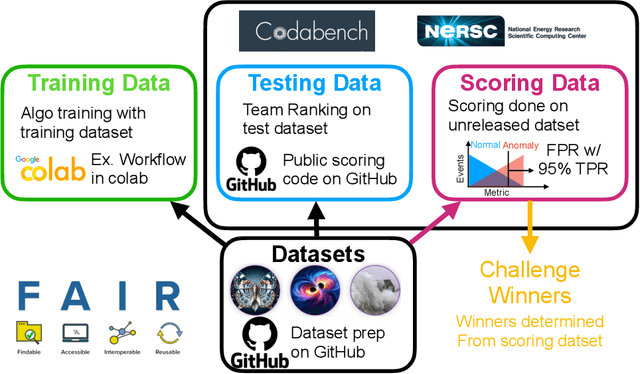
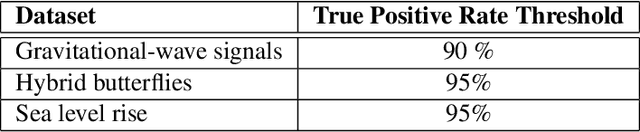
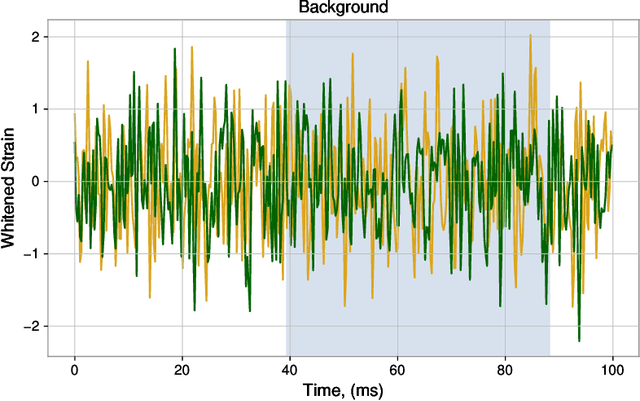
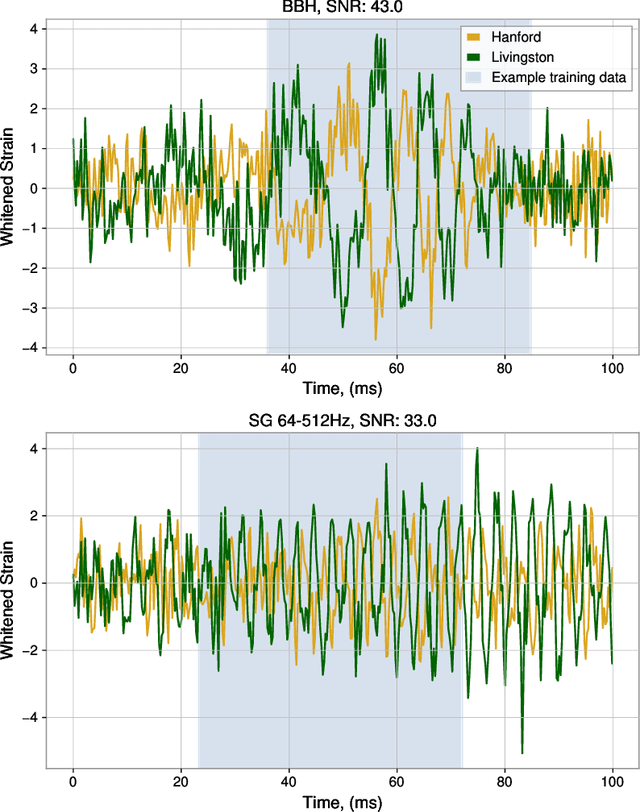
Scientific discoveries are often made by finding a pattern or object that was not predicted by the known rules of science. Oftentimes, these anomalous events or objects that do not conform to the norms are an indication that the rules of science governing the data are incomplete, and something new needs to be present to explain these unexpected outliers. The challenge of finding anomalies can be confounding since it requires codifying a complete knowledge of the known scientific behaviors and then projecting these known behaviors on the data to look for deviations. When utilizing machine learning, this presents a particular challenge since we require that the model not only understands scientific data perfectly but also recognizes when the data is inconsistent and out of the scope of its trained behavior. In this paper, we present three datasets aimed at developing machine learning-based anomaly detection for disparate scientific domains covering astrophysics, genomics, and polar science. We present the different datasets along with a scheme to make machine learning challenges around the three datasets findable, accessible, interoperable, and reusable (FAIR). Furthermore, we present an approach that generalizes to future machine learning challenges, enabling the possibility of large, more compute-intensive challenges that can ultimately lead to scientific discovery.
Analysis of Hardware Synthesis Strategies for Machine Learning in Collider Trigger and Data Acquisition
Nov 18, 2024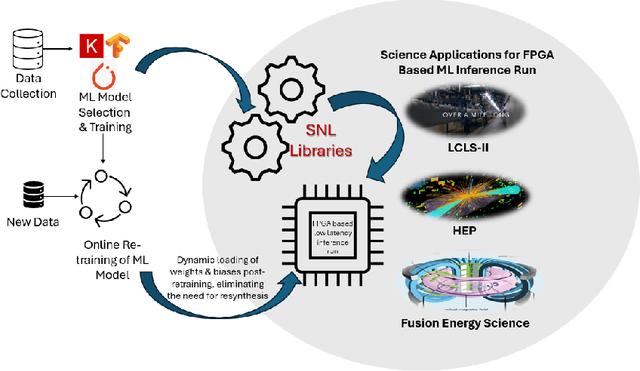

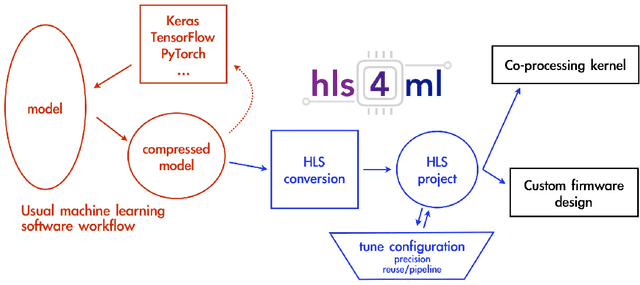

To fully exploit the physics potential of current and future high energy particle colliders, machine learning (ML) can be implemented in detector electronics for intelligent data processing and acquisition. The implementation of ML in real-time at colliders requires very low latencies that are unachievable with a software-based approach, requiring optimization and synthesis of ML algorithms for deployment on hardware. An analysis of neural network inference efficiency is presented, focusing on the application of collider trigger algorithms in field programmable gate arrays (FPGAs). Trade-offs are evaluated between two frameworks, the SLAC Neural Network Library (SNL) and hls4ml, in terms of resources and latency for different model sizes. Results highlight the strengths and limitations of each approach, offering valuable insights for optimizing real-time neural network deployments at colliders. This work aims to guide researchers and engineers in selecting the most suitable hardware and software configurations for real-time, resource-constrained environments.