 Add to Chrome
 Add to Firefox
 Add to Edge
AISPA: User-Centric System Prompt Auditing for Large Language Model Applications
Jul 30, 2026
System prompts are instructions configured by developers to govern the behaviors of foundation models in AI applications. They are used throughout commercial AI products, but are rarely disclosed to the public or regulators, creating a serious trust and accountability gap in the wide deployment of AI systems. In this paper, we introduce Artificial Intelligence System Prompt Assurance (AISPA), a user-centric framework for systematically auditing system prompts in AI systems. AISPA examines specific parts of a system prompt and evaluates them along eight dimensions that matter to users. We then use this framework to review 3,249 instructions from system prompts in 88 commercial AI products, classifying each instruction as either protective (of users) or problematic. Our audit surfaces four core findings. First, system prompt design varies substantially across products and developers, with some organizations averaging over 60 protective instructions per product while others average fewer than 5. Second, protective instructions are widely adopted but shallow in scope: 98.9% of products contain at least one, yet only 24% cover all eight dimensions of the AISPA taxonomy. Third, system prompts have grown steadily longer and more protective of users, suggesting that user protection is becoming a more visible concern in commercial prompt design. Fourth, despite this progress, problematic instructions remain pervasive: roughly 40% of products contain at least one instruction that works against user interests, and protective and problematic instructions frequently coexist within the same prompt. Our findings highlight the need for greater transparency, standardization, and independent oversight for system prompts in commercial AI products.

Fixed-Set Robustness in Programming by Example: Example Corruption and Semantic Partition Recovery
Jul 01, 2026Programming-by-example systems infer programs from a small set of input-output examples. Robust PBE work usually models wrong examples as samples from a stochastic noise process and then minimizes an expected or empirical loss. This paper studies a different failure mode: an adversary who sees the synthesizer and chooses the examples whose corruption most damages the returned program. We formalize fixed-set worst-case corruption for finite PBE version spaces, implement exact-within-bounded-pool and heuristic corruption searches for a string-transformation DSL, and introduce version-space partition aggregation (VPA), a defense that synthesizes on disjoint example groups and votes by semantic signatures. The central claim is deliberately bounded and partly negative: low-margin PBE tasks have an adversarial robustness dimension that random-typo and noisy-PBE evaluations miss, while semantic partition aggregation helps only when the clean semantics keep a partition vote margin, which often fails on realistic tasks. Evidence from curated/generated DSL tasks, accepted public SyGuS PBE_SLIA slices, SYNTRA Playgol v2, and noisy-PBE objective baselines supports that boundary. One curated edit flips all 8 spike tasks while 200-trial typo, DSL-pool, and distance-matched random controls succeed on 10.3%, 11.0%, and 16.7%; generated margin-1 rows flip under budget 1 yet VPA recovers them; on public SyGuS the vote margin is near one, so an adaptive attacker drives VPA accuracy to zero; accepted public SyGuS slices move across exact-within-pool budget boundaries; and Playgol shows positive paired-bootstrap gaps against typo and same-pool random controls on the 141 accepted rows. A small exact-output prompt harness over 20 controlled margin-1 tasks shows the same qualitative clean-to-attacked pattern across local and API models, while it is treated as a scope check, not a broad LLM benchmark.
Bridging BCI and Communications: A MIMO Framework for EEG-to-ECoG Wireless Channel Modeling
May 16, 2025As a method to connect human brain and external devices, Brain-computer interfaces (BCIs) are receiving extensive research attention. Recently, the integration of communication theory with BCI has emerged as a popular trend, offering potential to enhance system performance and shape next-generation communications. A key challenge in this field is modeling the brain wireless communication channel between intracranial electrocorticography (ECoG) emitting neurons and extracranial electroencephalography (EEG) receiving electrodes. However, the complex physiology of brain challenges the application of traditional channel modeling methods, leaving relevant research in its infancy. To address this gap, we propose a frequency-division multiple-input multiple-output (MIMO) estimation framework leveraging simultaneous macaque EEG and ECoG recordings, while employing neurophysiology-informed regularization to suppress noise interference. This approach reveals profound similarities between neural signal propagation and multi-antenna communication systems. Experimental results show improved estimation accuracy over conventional methods while highlighting a trade-off between frequency resolution and temporal stability determined by signal duration. This work establish a conceptual bridge between neural interfacing and communication theory, accelerating synergistic developments in both fields.
Revealing the evanescent components in Kronecker-product based codebooks: insights and implications
Jul 09, 2024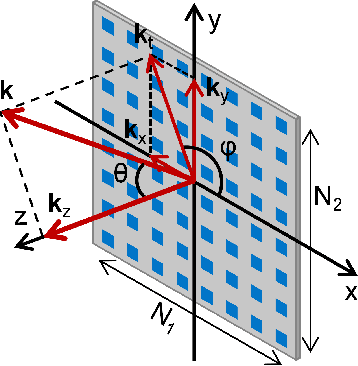
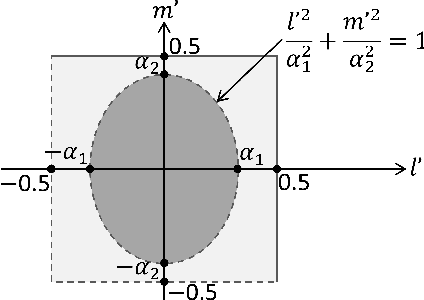
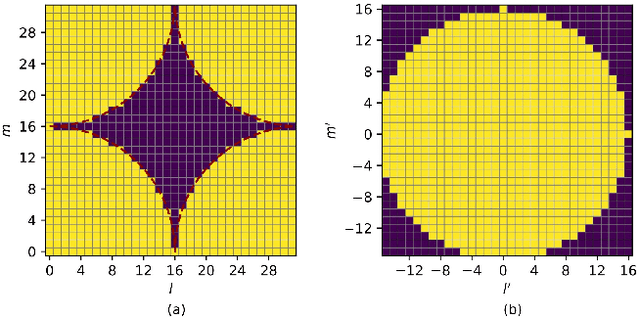
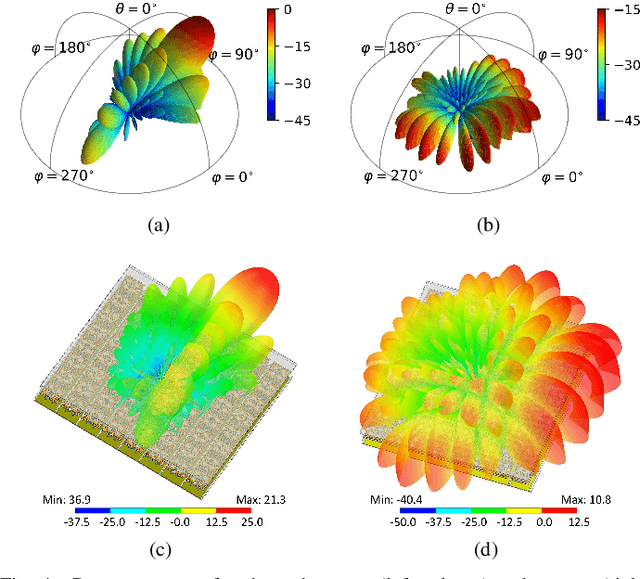
The orthogonal bases of discrete Fourier transform (DFT) has been recognized as the standard spatial-domain bases for Type I, Type II and enhanced Type II codewords by the 3rd Generation Partnership Project (3GPP). For uniform planar arrays, these spatial-domain bases are derived as the Kronecker product of one-dimensional DFT bases. Theoretically, each spatial basis corresponds to a beam directed towards a specific angle of departure and the set of bases represent the orthogonal beams that cover the front hemisphere of an array. While the Kronecker-product based precoding scheme facilitates the concise indexing of a codeword in the codebooks through precoding matrix indicators (PMIs) in channel state information feedback, it introduces redundant spatial beams characterized by high spatial-frequency components. This paper investigates the presence of codewords representing high spatial-frequency components within the Kronecker-product based codebooks. Through theoretical analysis and simulations, we confirm the redundancy of these codewords in MIMO communications, advocating for their removal from the codebooks to enhance system performance. Several topics relevant to the high spatial components are also involved in the discussion. Practical suggestions regarding future standard design are provided based on our theoretical analysis and simulation results.
Patterned Beam Training: A Novel Low-Complexity and Low-Overhead Scheme for ELAA
Jun 01, 2024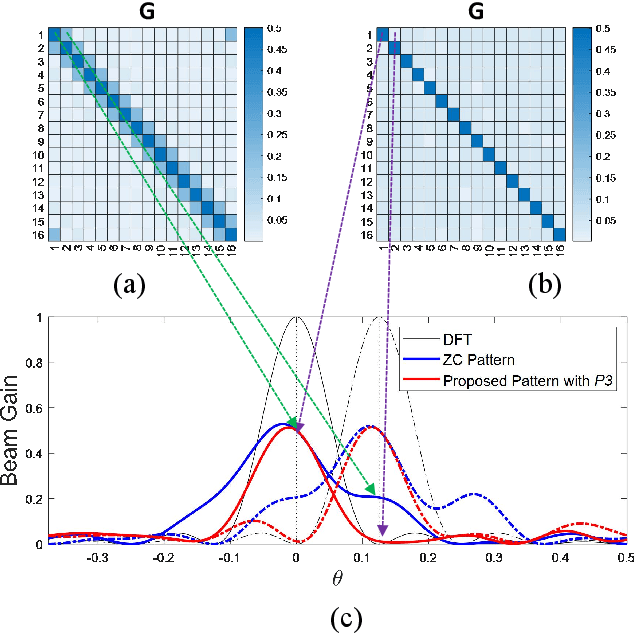
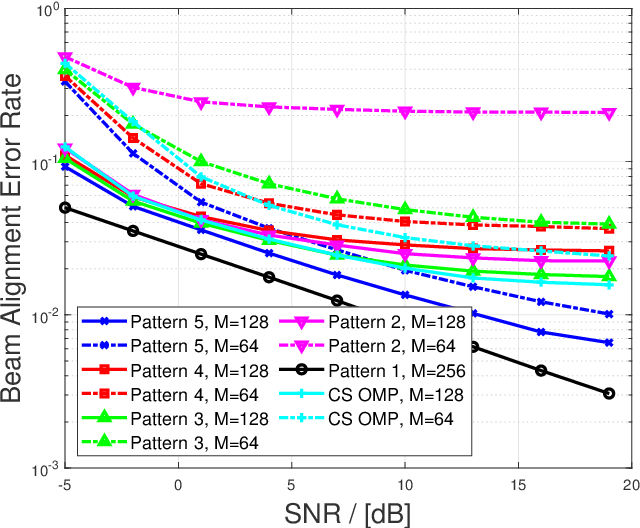
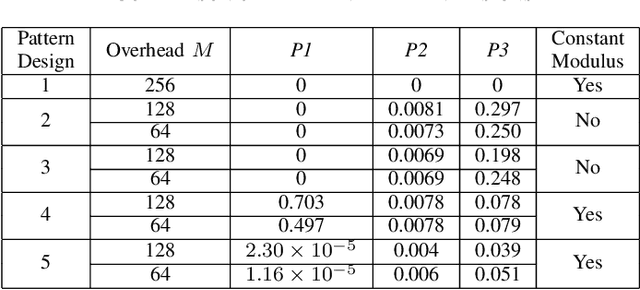
Extremely large antenna arrays (ELAAs) can provide higher spectral efficiency. However, the use of narrower beams for data transmission significantly increases the overhead associated with beam training. In this letter, we propose a novel patterned beam training (PBT) scheme characterized by its low overhead and complexity. This scheme requires only a single linear operation by both the base station and the user equipment to determine the optimal beam, reducing the training overhead to half or even less compared to traditional exhaustive search methods. Furthermore, We discuss the pattern design principles in detail and provide specific forms. Simulation results demonstrate that the proposed scheme outperforms the compared methods in terms of beam alignment accuracy and achieves a balance between signal-to-noise ratio (SNR) conditions and training overhead, making it a promising alternative.
Fast Beam Training and Performance Analysis for Extremely Large Aperture Array
Apr 28, 2024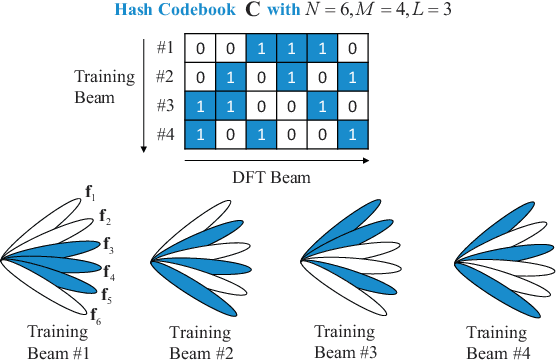
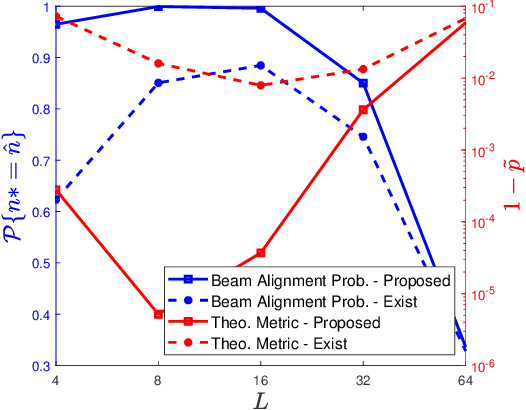
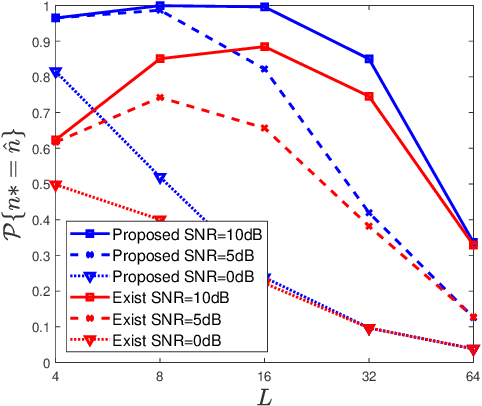
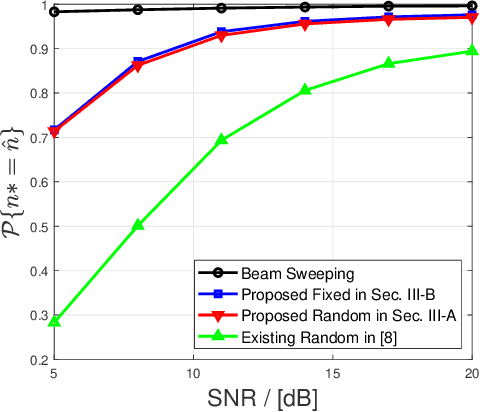
Extremely large aperture array (ELAA) can significantly enhance beamforming gain and spectral efficiency. Unfortunately, the use of narrower beams for data transmission results in a substantial increase in the cost of beam training. In this paper, we study a high-efficiency and low-overhead scheme named hash beam training. Specifically, two improved hash codebook design methods, random and fixed, are proposed. Moreover, we analyze beam alignment performance. Since the derived beam alignment success probability is a complex function, we also propose a heuristic metric to evaluate the impact of codebook parameter on performance. Finally, simulation results validate the theoretical analysis, indicating that the proposed beam training scheme can achieve fast beam alignment with lower overhead and higher accuracy.