 Add to Chrome
 Add to Firefox
 Add to Edge
LongE2V: Long-Horizon Event-based Video Reconstruction, Prediction, and Frame Interpolation with Video Diffusion Models
Jul 09, 2026
Recovering high-quality video from sparse event streams is a challenging task. Regression methods often blur textures, while existing generative models struggle with long-term stability. We propose LongE2V, a novel approach that leverages pre-trained video diffusion priors to jointly handle event-based video reconstruction, prediction, and frame interpolation. By fine-tuning a foundational video model, our approach achieves high data efficiency and superior perceptual quality. We introduce Autoregressive Unrolling and Adaptive Context Switching to mitigate temporal drift in extremely long sequences. We also propose Reencoding Alignment with Cross Residual Correction to ensure precise bidirectional consistency during frame interpolation. Furthermore, Event Voxel Density Augmentation ensures robustness across varying sensor resolutions. Extensive experiments on real-world benchmarks demonstrate that LongE2V outperforms state-of-the-art methods across all three tasks, exhibiting exceptional temporal coherence and zero-shot generalization. Project page: https://cdfan0627.github.io/LongE2V-page/

Generative Refocusing: Flexible Defocus Control from a Single Image
Dec 18, 2025
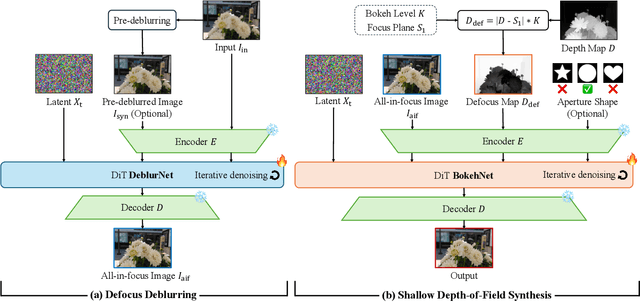
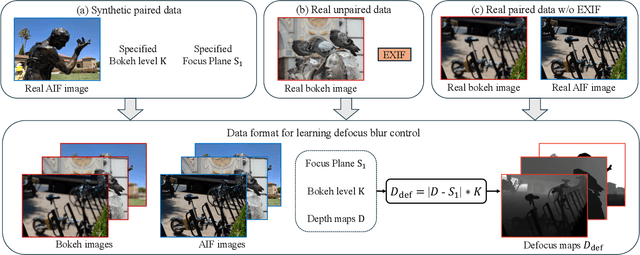
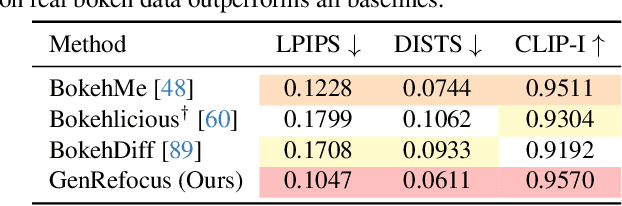
Depth-of-field control is essential in photography, but getting the perfect focus often takes several tries or special equipment. Single-image refocusing is still difficult. It involves recovering sharp content and creating realistic bokeh. Current methods have significant drawbacks. They need all-in-focus inputs, depend on synthetic data from simulators, and have limited control over aperture. We introduce Generative Refocusing, a two-step process that uses DeblurNet to recover all-in-focus images from various inputs and BokehNet for creating controllable bokeh. Our main innovation is semi-supervised training. This method combines synthetic paired data with unpaired real bokeh images, using EXIF metadata to capture real optical characteristics beyond what simulators can provide. Our experiments show we achieve top performance in defocus deblurring, bokeh synthesis, and refocusing benchmarks. Additionally, our Generative Refocusing allows text-guided adjustments and custom aperture shapes.
AuraFusion360: Augmented Unseen Region Alignment for Reference-based 360° Unbounded Scene Inpainting
Feb 07, 2025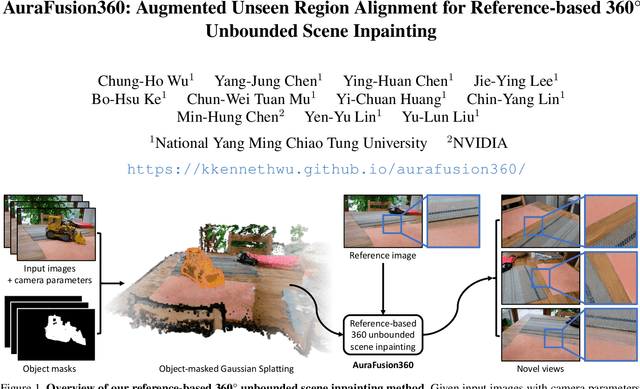
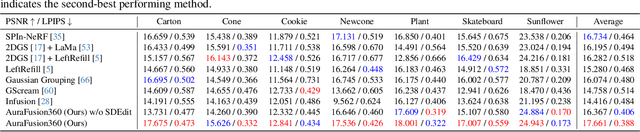
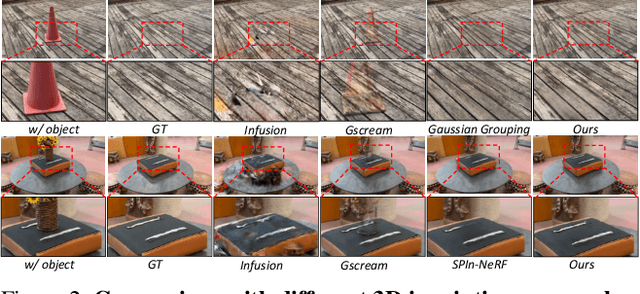
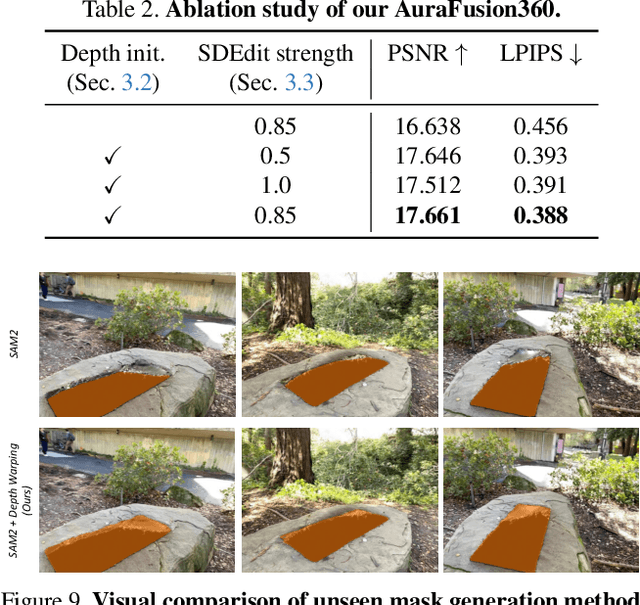
Three-dimensional scene inpainting is crucial for applications from virtual reality to architectural visualization, yet existing methods struggle with view consistency and geometric accuracy in 360{\deg} unbounded scenes. We present AuraFusion360, a novel reference-based method that enables high-quality object removal and hole filling in 3D scenes represented by Gaussian Splatting. Our approach introduces (1) depth-aware unseen mask generation for accurate occlusion identification, (2) Adaptive Guided Depth Diffusion, a zero-shot method for accurate initial point placement without requiring additional training, and (3) SDEdit-based detail enhancement for multi-view coherence. We also introduce 360-USID, the first comprehensive dataset for 360{\deg} unbounded scene inpainting with ground truth. Extensive experiments demonstrate that AuraFusion360 significantly outperforms existing methods, achieving superior perceptual quality while maintaining geometric accuracy across dramatic viewpoint changes. See our project page for video results and the dataset at https://kkennethwu.github.io/aurafusion360/.