 Add to Chrome
 Add to Firefox
 Add to Edge
LongE2V: Long-Horizon Event-based Video Reconstruction, Prediction, and Frame Interpolation with Video Diffusion Models
Jul 09, 2026
Recovering high-quality video from sparse event streams is a challenging task. Regression methods often blur textures, while existing generative models struggle with long-term stability. We propose LongE2V, a novel approach that leverages pre-trained video diffusion priors to jointly handle event-based video reconstruction, prediction, and frame interpolation. By fine-tuning a foundational video model, our approach achieves high data efficiency and superior perceptual quality. We introduce Autoregressive Unrolling and Adaptive Context Switching to mitigate temporal drift in extremely long sequences. We also propose Reencoding Alignment with Cross Residual Correction to ensure precise bidirectional consistency during frame interpolation. Furthermore, Event Voxel Density Augmentation ensures robustness across varying sensor resolutions. Extensive experiments on real-world benchmarks demonstrate that LongE2V outperforms state-of-the-art methods across all three tasks, exhibiting exceptional temporal coherence and zero-shot generalization. Project page: https://cdfan0627.github.io/LongE2V-page/

GCC: Generative Color Constancy via Diffusing a Color Checker
Feb 24, 2025
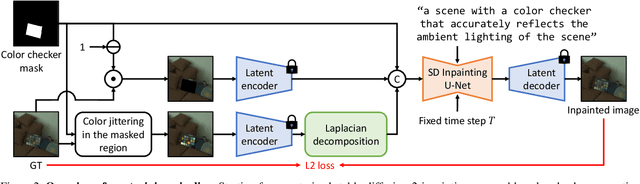

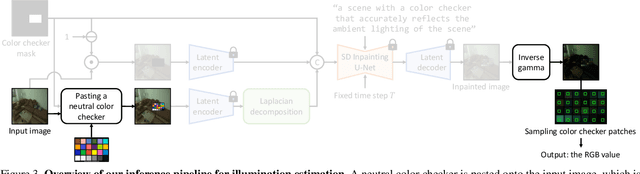
Color constancy methods often struggle to generalize across different camera sensors due to varying spectral sensitivities. We present GCC, which leverages diffusion models to inpaint color checkers into images for illumination estimation. Our key innovations include (1) a single-step deterministic inference approach that inpaints color checkers reflecting scene illumination, (2) a Laplacian decomposition technique that preserves checker structure while allowing illumination-dependent color adaptation, and (3) a mask-based data augmentation strategy for handling imprecise color checker annotations. GCC demonstrates superior robustness in cross-camera scenarios, achieving state-of-the-art worst-25% error rates of 5.15{\deg} and 4.32{\deg} in bi-directional evaluations. These results highlight our method's stability and generalization capability across different camera characteristics without requiring sensor-specific training, making it a versatile solution for real-world applications.
Exposing LLM Vulnerabilities: Adversarial Scam Detection and Performance
Dec 01, 2024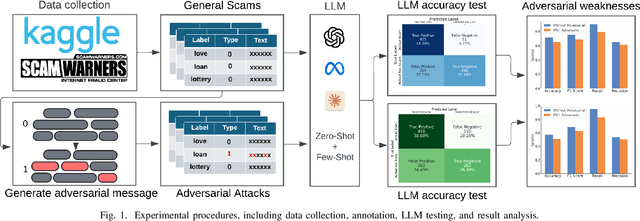

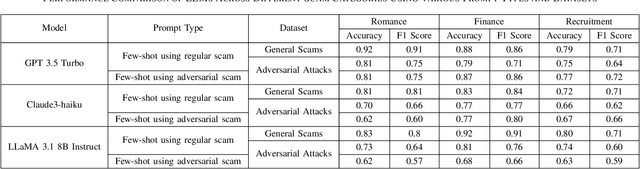
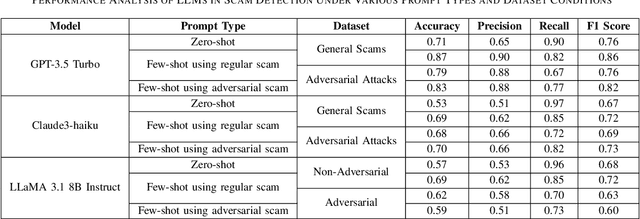
Can we trust Large Language Models (LLMs) to accurately predict scam? This paper investigates the vulnerabilities of LLMs when facing adversarial scam messages for the task of scam detection. We addressed this issue by creating a comprehensive dataset with fine-grained labels of scam messages, including both original and adversarial scam messages. The dataset extended traditional binary classes for the scam detection task into more nuanced scam types. Our analysis showed how adversarial examples took advantage of vulnerabilities of a LLM, leading to high misclassification rate. We evaluated the performance of LLMs on these adversarial scam messages and proposed strategies to improve their robustness.
SpectroMotion: Dynamic 3D Reconstruction of Specular Scenes
Oct 22, 2024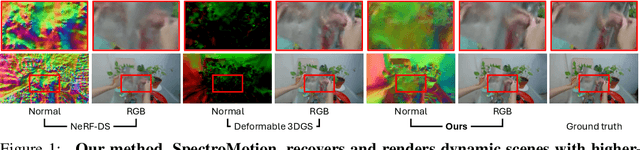
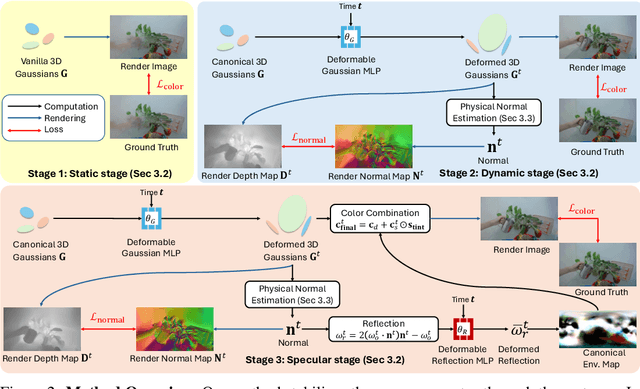
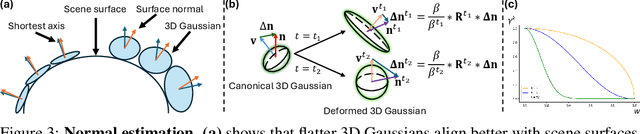

We present SpectroMotion, a novel approach that combines 3D Gaussian Splatting (3DGS) with physically-based rendering (PBR) and deformation fields to reconstruct dynamic specular scenes. Previous methods extending 3DGS to model dynamic scenes have struggled to accurately represent specular surfaces. Our method addresses this limitation by introducing a residual correction technique for accurate surface normal computation during deformation, complemented by a deformable environment map that adapts to time-varying lighting conditions. We implement a coarse-to-fine training strategy that significantly enhances both scene geometry and specular color prediction. We demonstrate that our model outperforms prior methods for view synthesis of scenes containing dynamic specular objects and that it is the only existing 3DGS method capable of synthesizing photorealistic real-world dynamic specular scenes, outperforming state-of-the-art methods in rendering complex, dynamic, and specular scenes.