 Add to Chrome
 Add to Firefox
 Add to Edge
AlloEgo-VLM: Disambiguating Allocentric and Egocentric Reference Frames in Vision-Language Models
Aug 16, 2026
This study investigates the challenge of ambiguity faced by Vision-Language Models (VLMs) in understanding spatial semantics. Spatial cognition, shaped by cognitive psychology, spatial science, and cultural context, often assigns directionality to objects. However, natural language descriptions of spatial relations frequently omit explicit reference frames, leading to semantic ambiguity and potentially serious errors for embodied AI robots. Existing VLMs, due to insufficient training on reference frames and object orientations, often produce inconsistent responses. To address this issue, we construct a new dataset, AlloEgo-View, comprising (image, query, view-specific answer) triplets that capture key object relations from both allocentric and egocentric perspectives. The view-specific descriptions follow a structured spatial representation that annotate detailed scene descriptions, reference and target objects, their orientations, reference frames, and view types. Building on AlloEgo-View, we develop AlloEgo-VLM, a framework to disambiguate allocentric and egocentric reference frames, even under ambiguous queries, and to be easily integrated into existing VLMs via supervised fine-tuning. Furthermore, we deploy our framework onto an embodied robotic platform within NVIDIA Isaac Sim to validate its real-world feasibility in open-ended object searching tasks. Experiments highlight the limitations of current VLMs in handling view-specific queries and demonstrate the strong disambiguation ability of AlloEgo-VLM.

SAFE: Scene-Aware Feature Modulation for Color Constancy with Learned Color Space in Pure-Color Scenes
Aug 14, 2026Color constancy on pure-color scenes is challenging: when most pixels share a narrow band of hues, every chromaticity-based cue collapses to a single point and standard estimators become ambiguous. We propose a compact framework that couples two innovations: (i) SAFE, a Scene-Aware FeaturE modulation network that organizes illumination cues into a structured four-token representation, which is then selectively reweighted based on scene complexity features; (ii) the Learned Color Space (LCS), a scene-dependent chromaticity normalization that directly addresses the chromaticity collapse problem for pure-color scenes. Experiment results show that SAFE consistently improves performance in pure-color scenes. Compared to the best-performing baseline in each metric, it reduces the mean angular error by 10%, the best-25% error by 20%, and the worst-25% error by 5.8%.
BOCCHI: A More Realistic and Challenging Benchmark for Local Motion Blur Detection with MSDCT-UNet
Jul 11, 2026Local motion blur detection requires pixel-level localization of blurred regions. Existing benchmarks let models rely on gradient shortcuts that fail to transfer. We introduce BOCCHI (Blurred Objects Captured across Cameras with Human-annotated Imagery), a real-captured benchmark whose sharp regions overlap the blur gradient distribution and defeat these shortcuts, and propose MSDCT-UNet (Multi-Scale Discrete Cosine Transform UNet), a frequency-aware encoder-decoder injecting multi-scale DCT priors through DCT Attention and FiLM. MSDCT-UNet ranks first in in-domain mIoU and boundary localization on BOCCHI, and BOCCHI-trained models outperform every other training source on cross-dataset transfer with only 633 training images.
AnchorSteer: Self-Discovered Concept Injection for Structure-Preserving Music Editing
May 29, 2026Controllable music editing is to modify high-level attributes while strictly preserving rhythmic and melodic structures. However, this task is challenged by a semantic-structural entanglement: steering methods often degrade structure to achieve editing performance, while structural adaptors suppress semantic responsiveness. We propose AnchorSteer, a framework that disentangles this tension by coupling structural anchoring with self-discovered semantic steering. The proposed approach probes internal representations to extract interpretable, label-free concept vectors via a self-supervised reconstruction objective, isolating attributes without curated data. During editing, these portable, plug-and-play concept vectors are injected into diffusion hidden manifolds while a structural adaptor enforces consistency. Variants for unconditioned and conditioned injections are provided to balance robustness and semantic strength. Experiments on ZoME-Bench and subjective tests show that the proposed framework outperforms both steering-only and anchoring-only baselines, enabling significant semantic transformations with high-fidelity structural preservation.
Sparse Bayesian Learning Algorithms Revisited: From Learning Majorizers to Structured Algorithmic Learning using Neural Networks
Apr 02, 2026Sparse Bayesian Learning is one of the most popular sparse signal recovery methods, and various algorithms exist under the SBL paradigm. However, given a performance metric and a sparse recovery problem, it is difficult to know a-priori the best algorithm to choose. This difficulty is in part due to a lack of a unified framework to derive SBL algorithms. We address this issue by first showing that the most popular SBL algorithms can be derived using the majorization-minimization (MM) principle, providing hitherto unknown convergence guarantees to this class of SBL methods. Moreover, we show that the two most popular SBL update rules not only fall under the MM framework but are both valid descent steps for a common majorizer, revealing a deeper analytical compatibility between these algorithms. Using this insight and properties from MM theory we expand the class of SBL algorithms, and address finding the best SBL algorithm via data within the MM framework. Second, we go beyond the MM framework by introducing the powerful modeling capabilities of deep learning to further expand the class of SBL algorithms, aiming to learn a superior SBL update rule from data. We propose a novel deep learning architecture that can outperform the classical MM based ones across different sparse recovery problems. Our architecture's complexity does not scale with the measurement matrix dimension, hence providing a unique opportunity to test generalization capability across different matrices. For parameterized dictionaries, this invariance allows us to train and test the model across different parameter ranges. We also showcase our model's ability to learn a functional mapping by its zero-shot performance on unseen measurement matrices. Finally, we test our model's performance across different numbers of snapshots, signal-to-noise ratios, and sparsity levels.
Guitar Tone Morphing by Diffusion-based Model
Oct 09, 2025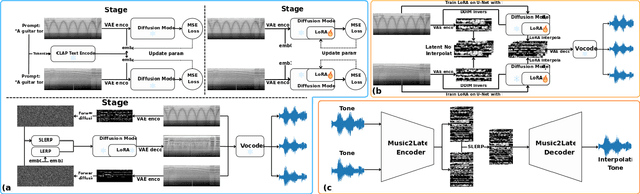

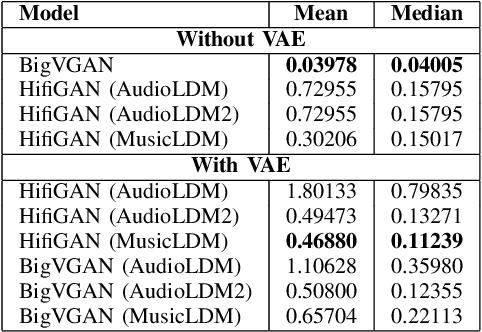
In Music Information Retrieval (MIR), modeling and transforming the tone of musical instruments, particularly electric guitars, has gained increasing attention due to the richness of the instrument tone and the flexibility of expression. Tone morphing enables smooth transitions between different guitar sounds, giving musicians greater freedom to explore new textures and personalize their performances. This study explores learning-based approaches for guitar tone morphing, beginning with LoRA fine-tuning to improve the model performance on limited data. Moreover, we introduce a simpler method, named spherical interpolation using Music2Latent. It yields significantly better results than the more complex fine-tuning approach. Experiments show that the proposed architecture generates smoother and more natural tone transitions, making it a practical and efficient tool for music production and real-time audio effects.
* 5 pages
A Comparative Study of Invariance-Aware Loss Functions for Deep Learning-based Gridless Direction-of-Arrival Estimation
Mar 16, 2025Covariance matrix reconstruction has been the most widely used guiding objective in gridless direction-of-arrival (DoA) estimation for sparse linear arrays. Many semidefinite programming (SDP)-based methods fall under this category. Although deep learning-based approaches enable the construction of more sophisticated objective functions, most methods still rely on covariance matrix reconstruction. In this paper, we propose new loss functions that are invariant to the scaling of the matrices and provide a comparative study of losses with varying degrees of invariance. The proposed loss functions are formulated based on the scale-invariant signal-to-distortion ratio between the target matrix and the Gram matrix of the prediction. Numerical results show that a scale-invariant loss outperforms its non-invariant counterpart but is inferior to the recently proposed subspace loss that is invariant to the change of basis. These results provide evidence that designing loss functions with greater degrees of invariance is advantageous in deep learning-based gridless DoA estimation.
Subspace Representation Learning for Sparse Linear Arrays to Localize More Sources than Sensors: A Deep Learning Methodology
Aug 29, 2024


Localizing more sources than sensors with a sparse linear array (SLA) has long relied on minimizing a distance between two covariance matrices and recent algorithms often utilize semidefinite programming (SDP). Although deep neural network (DNN)-based methods offer new alternatives, they still depend on covariance matrix fitting. In this paper, we develop a novel methodology that estimates the co-array subspaces from a sample covariance for SLAs. Our methodology trains a DNN to learn signal and noise subspace representations that are invariant to the selection of bases. To learn such representations, we propose loss functions that gauge the separation between the desired and the estimated subspace. In particular, we propose losses that measure the length of the shortest path between subspaces viewed on a union of Grassmannians, and prove that it is possible for a DNN to approximate signal subspaces. The computation of learning subspaces of different dimensions is accelerated by a new batch sampling strategy called consistent rank sampling. The methodology is robust to array imperfections due to its geometry-agnostic and data-driven nature. In addition, we propose a fully end-to-end gridless approach that directly learns angles to study the possibility of bypassing subspace methods. Numerical results show that learning such subspace representations is more beneficial than learning covariances or angles. It outperforms conventional SDP-based methods such as the sparse and parametric approach (SPA) and existing DNN-based covariance reconstruction methods for a wide range of signal-to-noise ratios (SNRs), snapshots, and source numbers for both perfect and imperfect arrays.
A DNN based Normalized Time-frequency Weighted Criterion for Robust Wideband DoA Estimation
Feb 20, 2023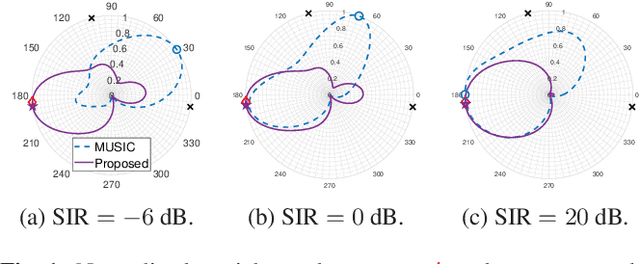

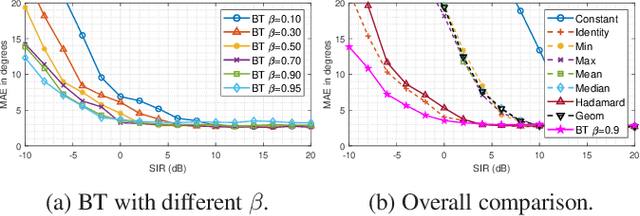
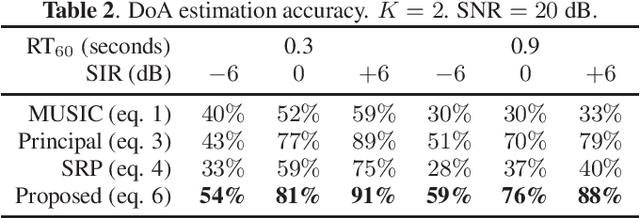
Deep neural networks (DNNs) have greatly benefited direction of arrival (DoA) estimation methods for speech source localization in noisy environments. However, their localization accuracy is still far from satisfactory due to the vulnerability to nonspeech interference. To improve the robustness against interference, we propose a DNN based normalized time-frequency (T-F) weighted criterion which minimizes the distance between the candidate steering vectors and the filtered snapshots in the T-F domain. Our method requires no eigendecomposition and uses a simple normalization to prevent the optimization objective from being misled by noisy filtered snapshots. We also study different designs of T-F weights guided by a DNN. We find that duplicating the Hadamard product of speech ratio masks is highly effective and better than other techniques such as direct masking and taking the mean in the proposed approach. However, the best-performing design of T-F weights is criterion-dependent in general. Experiments show that the proposed method outperforms popular DNN based DoA estimation methods including widely used subspace methods in noisy and reverberant environments.
Leveraging Heteroscedastic Uncertainty in Learning Complex Spectral Mapping for Single-channel Speech Enhancement
Nov 16, 2022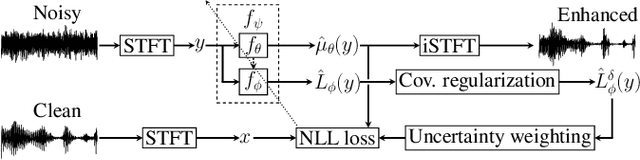
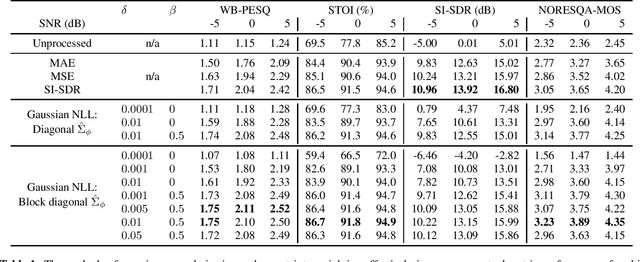
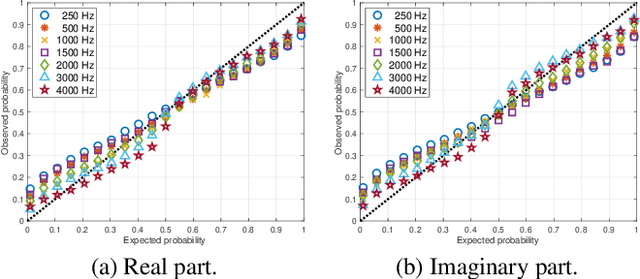
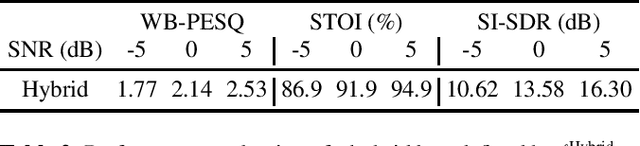
Most speech enhancement (SE) models learn a point estimate, and do not make use of uncertainty estimation in the learning process. In this paper, we show that modeling heteroscedastic uncertainty by minimizing a multivariate Gaussian negative log-likelihood (NLL) improves SE performance at no extra cost. During training, our approach augments a model learning complex spectral mapping with a temporary submodel to predict the covariance of the enhancement error at each time-frequency bin. Due to unrestricted heteroscedastic uncertainty, the covariance introduces an undersampling effect, detrimental to SE performance. To mitigate undersampling, our approach inflates the uncertainty lower bound and weights each loss component with their uncertainty, effectively compensating severely undersampled components with more penalties. Our multivariate setting reveals common covariance assumptions such as scalar and diagonal matrices. By weakening these assumptions, we show that the NLL achieves superior performance compared to popular losses including the mean squared error (MSE), mean absolute error (MAE), and scale-invariant signal-to-distortion ratio (SI-SDR).