 Add to Chrome
 Add to Firefox
 Add to Edge
ViewMind3D: Modular View-Aware Inference for Training-Free 3D-QA
Jul 30, 2026
Recent advances in large language models (LLMs) and vision-language models (VLMs) have enabled new possibilities for 3D question answering (3D-QA), a key capability for embodied AI and robotic perception. However, most existing methods rely on 3D-specific training or fine-tuning with costly annotations, limiting their scalability and real-world applicability. We present \textbf{ViewMind3D}, a fully training-free and modular framework for 3D spatial reasoning over multi-view observations of a scene without requiring complete 3D reconstruction. The framework decomposes the 3D-QA task into four interpretable components: (1) question-driven multi-view selection, (2) guided visual grounding with language-conditioned object cues, (3) spatial context encoding via a bird's-eye-view (BEV) viewpoint indicator, and (4) structured answer generation through role-based reasoning. This design enables structured, robust, and interpretable reasoning without requiring model tuning. Experimental results on ScanQA and SQA3D show that ViewMind3D achieves competitive performance compared to prior training-free and fine-tuned 3D-LLMs. In particular, our method improves performance on spatially grounded question types, such as ``What'' questions in SQA3D, while maintaining strong overall accuracy (50.8\%) and achieving 73.4 CIDEr on ScanQA. These results demonstrate that effective 3D reasoning can be achieved through modular orchestration of general-purpose LLMs and VLMs for robotic perception in real-world environments.

VEGAS: Human-Aligned Video Caption Evaluation via Gaze
Jul 09, 2026Vision-language models excel at video captioning, yet typically generate descriptions that fail to capture individual viewers' attention. We propose VEGAS (Video caption Evaluation via GAze Score), a training-free metric that leverages test-time gaze to sample personalized, attention-aligned text. It is a cross-modal, information-theoretic metric that quantifies how well a candidate caption matches a viewer's focus. To evaluate VEGAS, we curate a dataset of egocentric activities and instructional slides paired with synchronized gaze and reference annotations. We then select captions based on VEGAS via rejection sampling without model retraining. Experiments show that VEGAS-selected captions align significantly better with human focus and improve downstream caption-to-video retrieval, demonstrating the practical utility of incorporating viewer attention during inference.
What We are Missing in Multimodal LLM Evaluation?
Jun 24, 2026Multimodal large language models (MLLMs) can process diverse inputs, e.g., text, images, audio, and video, and generate textual responses. While their capabilities have advanced rapidly, evaluation of such models has not kept pace. Most existing evaluation benchmarks are limited to isolated tasks and reveal little about whether a model integrates information across modalities. We examine current means for evaluating MLLMs and review the existing benchmark taxonomy to identify gaps, including temporal-spatial coherence, physical world understanding, multimodal consistency, and selective attention. Addressing these gaps is essential for measuring real progress in multimodal intelligence and exposing capability boundaries.
SSR: A Generic Framework for Text-Aided Map Compression for Localization
Mar 04, 2026Mapping is crucial in robotics for localization and downstream decision-making. As robots are deployed in ever-broader settings, the maps they rely on continue to increase in size. However, storing these maps indefinitely (cold storage), transferring them across networks, or sending localization queries to cloud-hosted maps imposes prohibitive memory and bandwidth costs. We propose a text-enhanced compression framework that reduces both memory and bandwidth footprints while retaining high-fidelity localization. The key idea is to treat text as an alternative modality: one that can be losslessly compressed with large language models. We propose leveraging lightweight text descriptions combined with very small image feature vectors, which capture "complementary information" as a compact representation for the mapping task. Building on this, our novel technique, Similarity Space Replication (SSR), learns an adaptive image embedding in one shot that captures only the information "complementary" to the text descriptions. We validate our compression framework on multiple downstream localization tasks, including Visual Place Recognition as well as object-centric Monte Carlo localization in both indoor and outdoor settings. SSR achieves 2 times better compression than competing baselines on state-of-the-art datasets, including TokyoVal, Pittsburgh30k, Replica, and KITTI.
ViSIL: Unified Evaluation of Information Loss in Multimodal Video Captioning
Jan 14, 2026Multimodal video captioning condenses dense footage into a structured format of keyframes and natural language. By creating a cohesive multimodal summary, this approach anchors generative AI in rich semantic evidence and serves as a lightweight proxy for high-efficiency retrieval. However, traditional metrics like BLEU or ROUGE fail to quantify information coverage across disparate modalities, such as comparing a paragraph of text to a sequence of keyframes. To address this, we propose the Video Summary Information Loss (ViSIL) score, an information-theoretic framework that quantifies the video information not captured by a summary via vision-language model (VLM) inference. By measuring the information loss, ViSIL is a unified metric that enables direct comparison across multimodal summary formats despite their structural discrepancies. Our results demonstrate that ViSIL scores show a statistically significant correlation with both human and VLM performance on Video Question Answering (VQA) tasks. ViSIL also enables summary selection to optimize the trade-off between information loss and processing speed, establishing a Pareto-optimal frontier that outperforms text summaries by $7\%$ in VQA accuracy without increasing processing load.
VIBE: Video-to-Text Information Bottleneck Evaluation for TL;DR
May 23, 2025Many decision-making tasks, where both accuracy and efficiency matter, still require human supervision. For example, tasks like traffic officers reviewing hour-long dashcam footage or researchers screening conference videos can benefit from concise summaries that reduce cognitive load and save time. Yet current vision-language models (VLMs) often produce verbose, redundant outputs that hinder task performance. Existing video caption evaluation depends on costly human annotations and overlooks the summaries' utility in downstream tasks. We address these gaps with Video-to-text Information Bottleneck Evaluation (VIBE), an annotation-free method that scores VLM outputs using two metrics: grounding (how well the summary aligns with visual content) and utility (how informative it is for the task). VIBE selects from randomly sampled VLM outputs by ranking them according to the two scores to support effective human decision-making. Human studies on LearningPaper24, SUTD-TrafficQA, and LongVideoBench show that summaries selected by VIBE consistently improve performance-boosting task accuracy by up to 61.23% and reducing response time by 75.77% compared to naive VLM summaries or raw video.
Dense Dynamics-Aware Reward Synthesis: Integrating Prior Experience with Demonstrations
Dec 02, 2024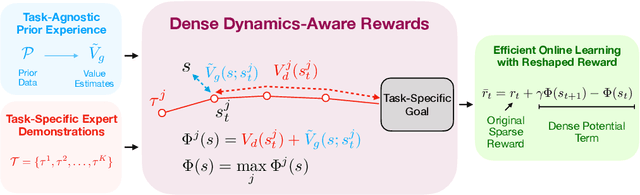
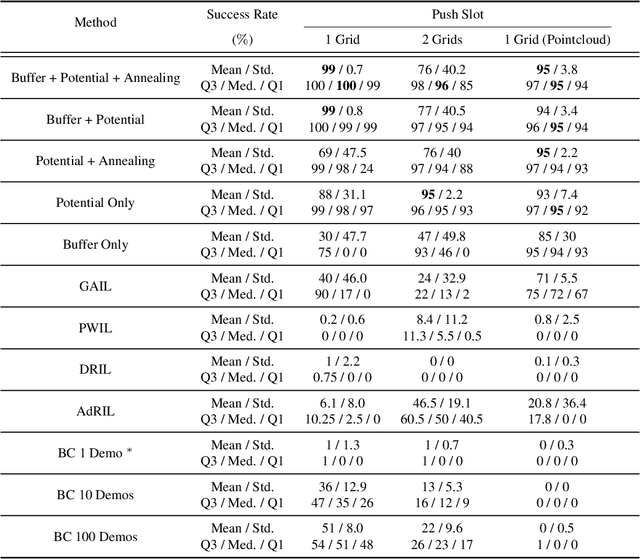
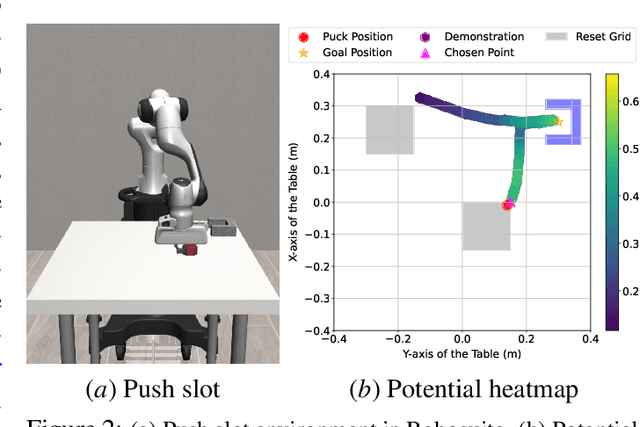
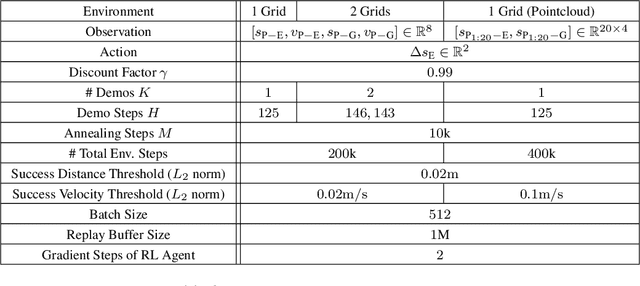
Many continuous control problems can be formulated as sparse-reward reinforcement learning (RL) tasks. In principle, online RL methods can automatically explore the state space to solve each new task. However, discovering sequences of actions that lead to a non-zero reward becomes exponentially more difficult as the task horizon increases. Manually shaping rewards can accelerate learning for a fixed task, but it is an arduous process that must be repeated for each new environment. We introduce a systematic reward-shaping framework that distills the information contained in 1) a task-agnostic prior data set and 2) a small number of task-specific expert demonstrations, and then uses these priors to synthesize dense dynamics-aware rewards for the given task. This supervision substantially accelerates learning in our experiments, and we provide analysis demonstrating how the approach can effectively guide online learning agents to faraway goals.
Any2Any: Incomplete Multimodal Retrieval with Conformal Prediction
Nov 25, 2024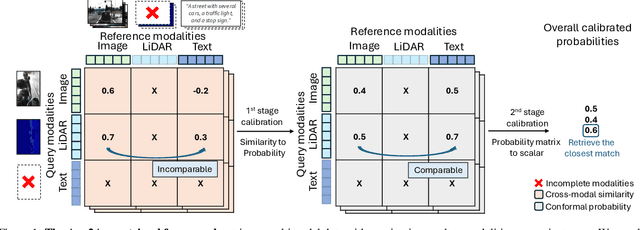
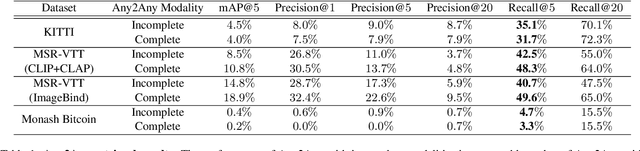
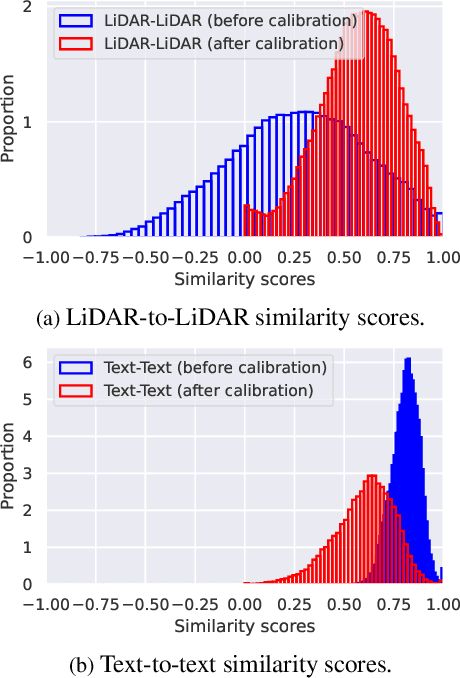
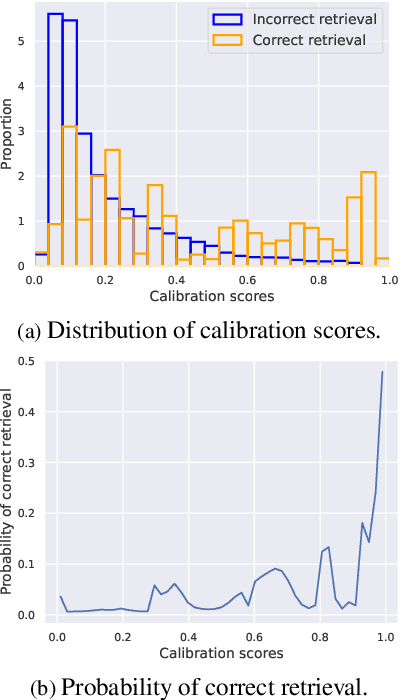
Autonomous agents perceive and interpret their surroundings by integrating multimodal inputs, such as vision, audio, and LiDAR. These perceptual modalities support retrieval tasks, such as place recognition in robotics. However, current multimodal retrieval systems encounter difficulties when parts of the data are missing due to sensor failures or inaccessibility, such as silent videos or LiDAR scans lacking RGB information. We propose Any2Any-a novel retrieval framework that addresses scenarios where both query and reference instances have incomplete modalities. Unlike previous methods limited to the imputation of two modalities, Any2Any handles any number of modalities without training generative models. It calculates pairwise similarities with cross-modal encoders and employs a two-stage calibration process with conformal prediction to align the similarities. Any2Any enables effective retrieval across multimodal datasets, e.g., text-LiDAR and text-time series. It achieves a Recall@5 of 35% on the KITTI dataset, which is on par with baseline models with complete modalities.
CSA: Data-efficient Mapping of Unimodal Features to Multimodal Features
Oct 10, 2024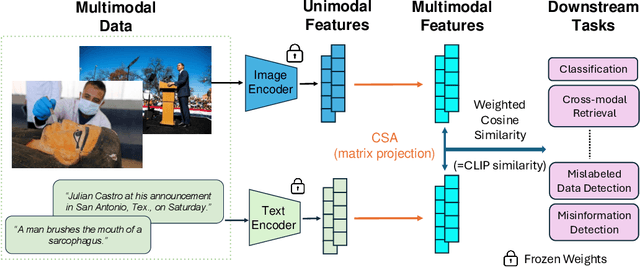
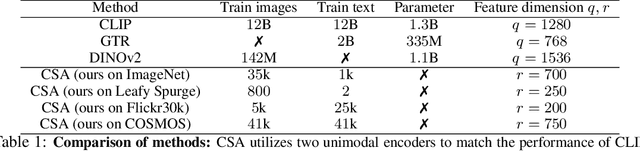
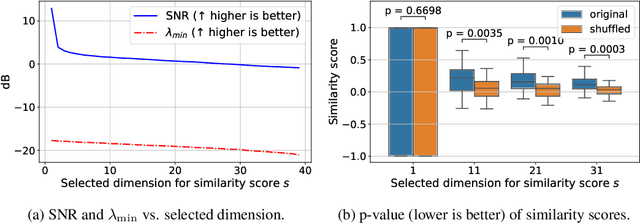
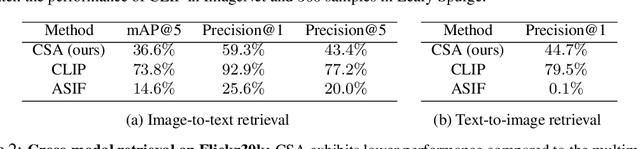
Multimodal encoders like CLIP excel in tasks such as zero-shot image classification and cross-modal retrieval. However, they require excessive training data. We propose canonical similarity analysis (CSA), which uses two unimodal encoders to replicate multimodal encoders using limited data. CSA maps unimodal features into a multimodal space, using a new similarity score to retain only the multimodal information. CSA only involves the inference of unimodal encoders and a cubic-complexity matrix decomposition, eliminating the need for extensive GPU-based model training. Experiments show that CSA outperforms CLIP while requiring $300,000\times$ fewer multimodal data pairs and $6\times$ fewer unimodal data for ImageNet classification and misinformative news captions detection. CSA surpasses the state-of-the-art method to map unimodal features to multimodal features. We also demonstrate the ability of CSA with modalities beyond image and text, paving the way for future modality pairs with limited paired multimodal data but abundant unpaired unimodal data, such as lidar and text.
Exploiting Distribution Constraints for Scalable and Efficient Image Retrieval
Oct 09, 2024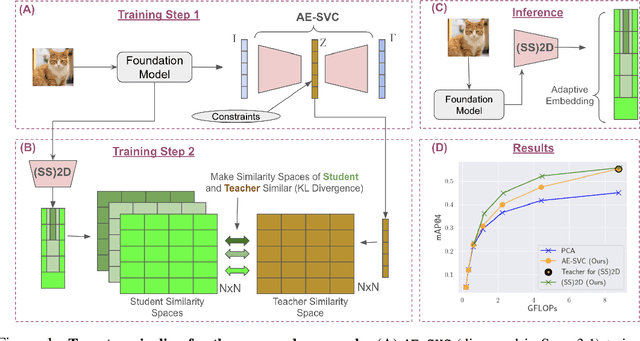
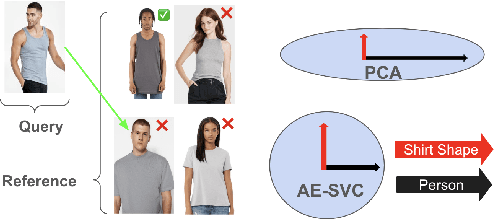
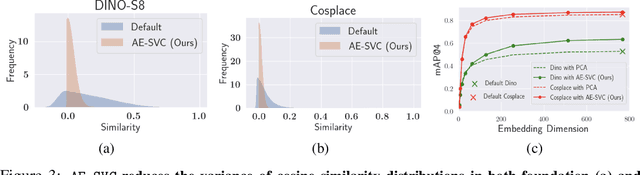
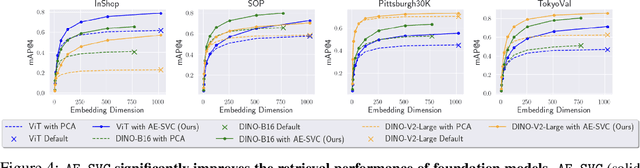
Image retrieval is crucial in robotics and computer vision, with downstream applications in robot place recognition and vision-based product recommendations. Modern retrieval systems face two key challenges: scalability and efficiency. State-of-the-art image retrieval systems train specific neural networks for each dataset, an approach that lacks scalability. Furthermore, since retrieval speed is directly proportional to embedding size, existing systems that use large embeddings lack efficiency. To tackle scalability, recent works propose using off-the-shelf foundation models. However, these models, though applicable across datasets, fall short in achieving performance comparable to that of dataset-specific models. Our key observation is that, while foundation models capture necessary subtleties for effective retrieval, the underlying distribution of their embedding space can negatively impact cosine similarity searches. We introduce Autoencoders with Strong Variance Constraints (AE-SVC), which, when used for projection, significantly improves the performance of foundation models. We provide an in-depth theoretical analysis of AE-SVC. Addressing efficiency, we introduce Single-shot Similarity Space Distillation ((SS)$_2$D), a novel approach to learn embeddings with adaptive sizes that offers a better trade-off between size and performance. We conducted extensive experiments on four retrieval datasets, including Stanford Online Products (SoP) and Pittsburgh30k, using four different off-the-shelf foundation models, including DinoV2 and CLIP. AE-SVC demonstrates up to a $16\%$ improvement in retrieval performance, while (SS)$_2$D shows a further $10\%$ improvement for smaller embedding sizes.