 Add to Chrome
 Add to Firefox
 Add to Edge
InpaintDPO: Mitigating Spatial Relationship Hallucinations in Foreground-conditioned Inpainting via Diverse Preference Optimization
Dec 16, 2025
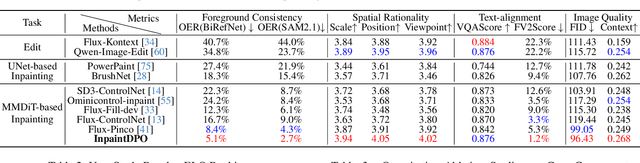
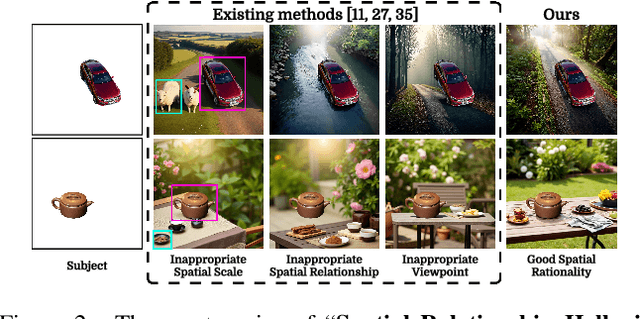
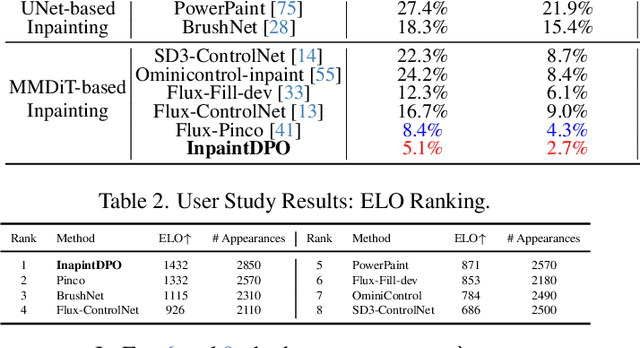
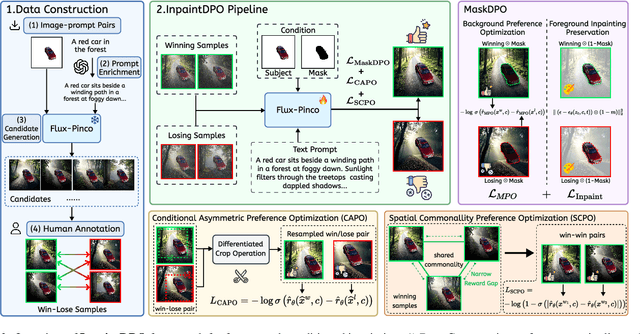
Foreground-conditioned inpainting, which aims at generating a harmonious background for a given foreground subject based on the text prompt, is an important subfield in controllable image generation. A common challenge in current methods, however, is the occurrence of Spatial Relationship Hallucinations between the foreground subject and the generated background, including inappropriate scale, positional relationships, and viewpoints. Critically, the subjective nature of spatial rationality makes it challenging to quantify, hindering the use of traditional reward-based RLHF methods. To address this issue, we propose InpaintDPO, the first Direct Preference Optimization (DPO) based framework dedicated to spatial rationality in foreground-conditioned inpainting, ensuring plausible spatial relationships between foreground and background elements. To resolve the gradient conflicts in standard DPO caused by identical foreground in win-lose pairs, we propose MaskDPO, which confines preference optimization exclusively to the background to enhance background spatial relationships, while retaining the inpainting loss in the foreground region for robust foreground preservation. To enhance coherence at the foreground-background boundary, we propose Conditional Asymmetric Preference Optimization, which samples pairs with differentiated cropping operations and applies global preference optimization to promote contextual awareness and enhance boundary coherence. Finally, based on the observation that winning samples share a commonality in plausible spatial relationships, we propose Shared Commonality Preference Optimization to enhance the model's understanding of spatial commonality across high-quality winning samples, further promoting shared spatial rationality.

A$^\text{T}$A: Adaptive Transformation Agent for Text-Guided Subject-Position Variable Background Inpainting
Apr 02, 2025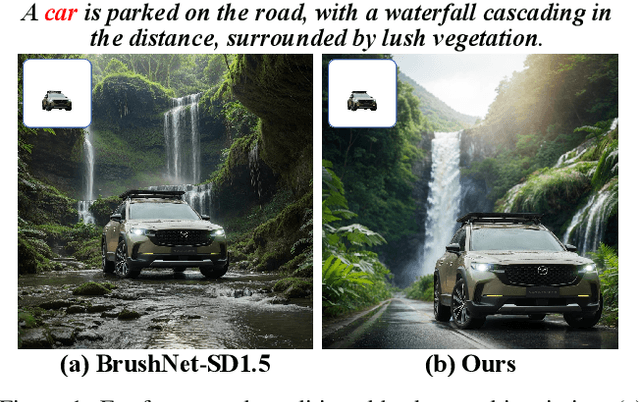
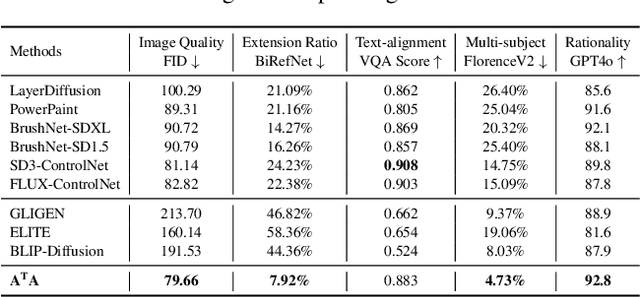
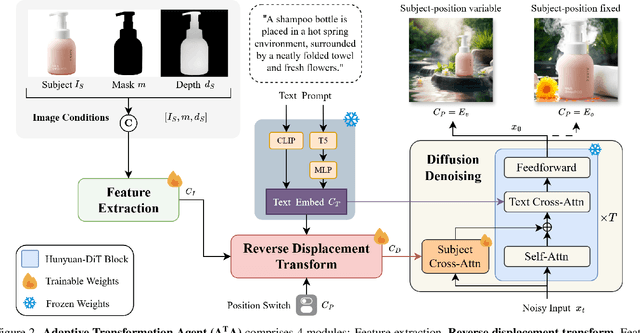
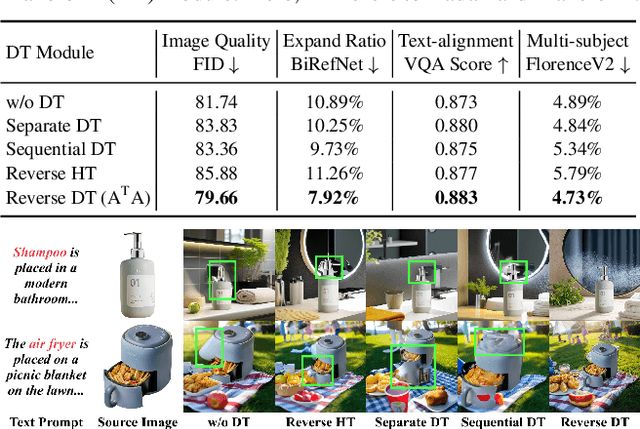
Image inpainting aims to fill the missing region of an image. Recently, there has been a surge of interest in foreground-conditioned background inpainting, a sub-task that fills the background of an image while the foreground subject and associated text prompt are provided. Existing background inpainting methods typically strictly preserve the subject's original position from the source image, resulting in inconsistencies between the subject and the generated background. To address this challenge, we propose a new task, the "Text-Guided Subject-Position Variable Background Inpainting", which aims to dynamically adjust the subject position to achieve a harmonious relationship between the subject and the inpainted background, and propose the Adaptive Transformation Agent (A$^\text{T}$A) for this task. Firstly, we design a PosAgent Block that adaptively predicts an appropriate displacement based on given features to achieve variable subject-position. Secondly, we design the Reverse Displacement Transform (RDT) module, which arranges multiple PosAgent blocks in a reverse structure, to transform hierarchical feature maps from deep to shallow based on semantic information. Thirdly, we equip A$^\text{T}$A with a Position Switch Embedding to control whether the subject's position in the generated image is adaptively predicted or fixed. Extensive comparative experiments validate the effectiveness of our A$^\text{T}$A approach, which not only demonstrates superior inpainting capabilities in subject-position variable inpainting, but also ensures good performance on subject-position fixed inpainting.
Pinco: Position-induced Consistent Adapter for Diffusion Transformer in Foreground-conditioned Inpainting
Dec 05, 2024Foreground-conditioned inpainting aims to seamlessly fill the background region of an image by utilizing the provided foreground subject and a text description. While existing T2I-based image inpainting methods can be applied to this task, they suffer from issues of subject shape expansion, distortion, or impaired ability to align with the text description, resulting in inconsistencies between the visual elements and the text description. To address these challenges, we propose Pinco, a plug-and-play foreground-conditioned inpainting adapter that generates high-quality backgrounds with good text alignment while effectively preserving the shape of the foreground subject. Firstly, we design a Self-Consistent Adapter that integrates the foreground subject features into the layout-related self-attention layer, which helps to alleviate conflicts between the text and subject features by ensuring that the model can effectively consider the foreground subject's characteristics while processing the overall image layout. Secondly, we design a Decoupled Image Feature Extraction method that employs distinct architectures to extract semantic and shape features separately, significantly improving subject feature extraction and ensuring high-quality preservation of the subject's shape. Thirdly, to ensure precise utilization of the extracted features and to focus attention on the subject region, we introduce a Shared Positional Embedding Anchor, greatly improving the model's understanding of subject features and boosting training efficiency. Extensive experiments demonstrate that our method achieves superior performance and efficiency in foreground-conditioned inpainting.
AttentionPainter: An Efficient and Adaptive Stroke Predictor for Scene Painting
Oct 21, 2024
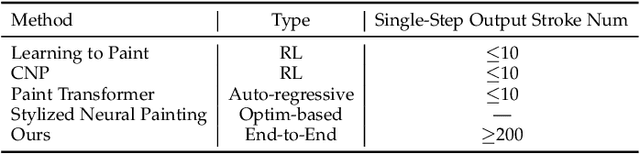
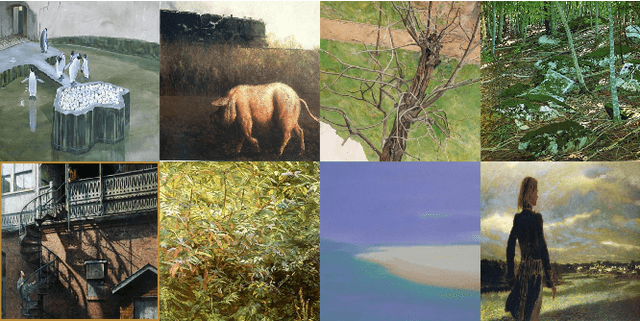
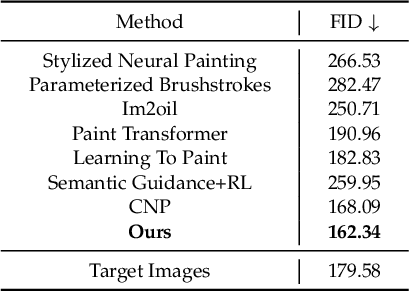
Stroke-based Rendering (SBR) aims to decompose an input image into a sequence of parameterized strokes, which can be rendered into a painting that resembles the input image. Recently, Neural Painting methods that utilize deep learning and reinforcement learning models to predict the stroke sequences have been developed, but suffer from longer inference time or unstable training. To address these issues, we propose AttentionPainter, an efficient and adaptive model for single-step neural painting. First, we propose a novel scalable stroke predictor, which predicts a large number of stroke parameters within a single forward process, instead of the iterative prediction of previous Reinforcement Learning or auto-regressive methods, which makes AttentionPainter faster than previous neural painting methods. To further increase the training efficiency, we propose a Fast Stroke Stacking algorithm, which brings 13 times acceleration for training. Moreover, we propose Stroke-density Loss, which encourages the model to use small strokes for detailed information, to help improve the reconstruction quality. Finally, we propose a new stroke diffusion model for both conditional and unconditional stroke-based generation, which denoises in the stroke parameter space and facilitates stroke-based inpainting and editing applications helpful for human artists design. Extensive experiments show that AttentionPainter outperforms the state-of-the-art neural painting methods.