 Add to Chrome
 Add to Firefox
 Add to Edge
Tandem: Riding Together with Large and Small Language Models for Efficient Reasoning
Apr 26, 2026
Recent advancements in large language models (LLMs) have catalyzed the rise of reasoning-intensive inference paradigms, where models perform explicit step-by-step reasoning before generating final answers. While such approaches improve answer quality and interpretability, they incur substantial computational overhead due to the prolonged generation sequences. In this paper, we propose Tandem, a novel collaborative framework that synergizes large and small language models (LLMs and SLMs) to achieve high-quality reasoning with significantly reduced computational cost. Specifically, the LLM serves as a strategic coordinator, efficiently generating a compact set of critical reasoning insights. These insights are then used to guide a smaller, more efficient SLM in executing the full reasoning process and delivering the final response. To balance efficiency and reliability, Tandem introduces a cost-aware termination mechanism that adaptively determines when sufficient reasoning guidance has been accumulated, enabling early stopping of the LLM's generation. Experiments on mathematical reasoning and code generation benchmarks demonstrate that Tandem reduces computational costs by approximately 40% compared to standalone LLM reasoning, while achieving superior or competitive performance. Furthermore, the sufficiency classifier trained on one domain transfers effectively to others without retraining. The code is available at: https://github.com/Applied-Machine-Learning-Lab/ACL2026_Tandem.

GenOpticalFlow: A Generative Approach to Unsupervised Optical Flow Learning
Mar 23, 2026Optical flow estimation is a fundamental problem in computer vision, yet the reliance on expensive ground-truth annotations limits the scalability of supervised approaches. Although unsupervised and semi-supervised methods alleviate this issue, they often suffer from unreliable supervision signals based on brightness constancy and smoothness assumptions, leading to inaccurate motion estimation in complex real-world scenarios. To overcome these limitations, we introduce \textbf{\modelname}, a novel framework that synthesizes large-scale, perfectly aligned frame--flow data pairs for supervised optical flow training without human annotations. Specifically, our method leverages a pre-trained depth estimation network to generate pseudo optical flows, which serve as conditioning inputs for a next-frame generation model trained to produce high-fidelity, pixel-aligned subsequent frames. This process enables the creation of abundant, high-quality synthetic data with precise motion correspondence. Furthermore, we propose an \textit{inconsistent pixel filtering} strategy that identifies and removes unreliable pixels in generated frames, effectively enhancing fine-tuning performance on real-world datasets. Extensive experiments on KITTI2012, KITTI2015, and Sintel demonstrate that \textbf{\modelname} achieves competitive or superior results compared to existing unsupervised and semi-supervised approaches, highlighting its potential as a scalable and annotation-free solution for optical flow learning. We will release our code upon acceptance.
SD4R: Sparse-to-Dense Learning for 3D Object Detection with 4D Radar
Feb 24, 20264D radar measurements offer an affordable and weather-robust solution for 3D perception. However, the inherent sparsity and noise of radar point clouds present significant challenges for accurate 3D object detection, underscoring the need for effective and robust point clouds densification. Despite recent progress, existing densification methods often fail to address the extreme sparsity of 4D radar point clouds and exhibit limited robustness when processing scenes with a small number of points. In this paper, we propose SD4R, a novel framework that transforms sparse radar point clouds into dense representations. SD4R begins by utilizing a foreground point generator (FPG) to mitigate noise propagation and produce densified point clouds. Subsequently, a logit-query encoder (LQE) enhances conventional pillarization, resulting in robust feature representations. Through these innovations, our SD4R demonstrates strong capability in both noise reduction and foreground point densification. Extensive experiments conducted on the publicly available View-of-Delft dataset demonstrate that SD4R achieves state-of-the-art performance. Source code is available at https://github.com/lancelot0805/SD4R.
BIM: Block-Wise Self-Supervised Learning with Masked Image Modeling
Nov 28, 2023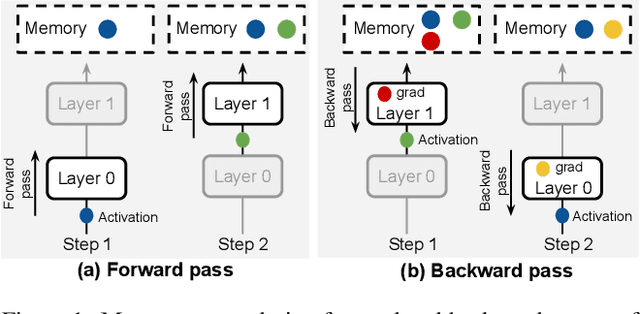
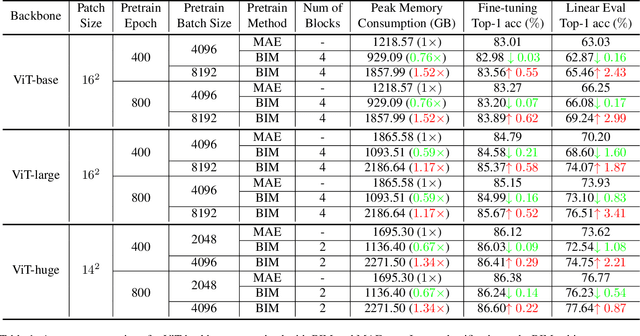
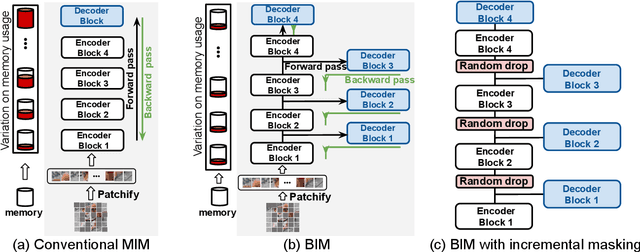
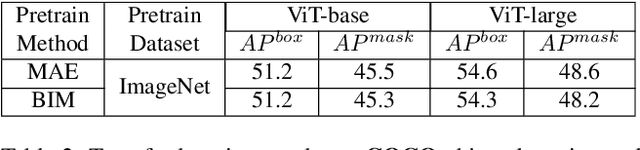
Like masked language modeling (MLM) in natural language processing, masked image modeling (MIM) aims to extract valuable insights from image patches to enhance the feature extraction capabilities of the underlying deep neural network (DNN). Contrasted with other training paradigms like supervised learning and unsupervised contrastive learning, masked image modeling (MIM) pretraining typically demands significant computational resources in order to manage large training data batches (e.g., 4096). The significant memory and computation requirements pose a considerable challenge to its broad adoption. To mitigate this, we introduce a novel learning framework, termed~\textit{Block-Wise Masked Image Modeling} (BIM). This framework involves decomposing the MIM tasks into several sub-tasks with independent computation patterns, resulting in block-wise back-propagation operations instead of the traditional end-to-end approach. Our proposed BIM maintains superior performance compared to conventional MIM while greatly reducing peak memory consumption. Moreover, BIM naturally enables the concurrent training of numerous DNN backbones of varying depths. This leads to the creation of multiple trained DNN backbones, each tailored to different hardware platforms with distinct computing capabilities. This approach significantly reduces computational costs in comparison with training each DNN backbone individually. Our framework offers a promising solution for resource constrained training of MIM.