 Add to Chrome
 Add to Firefox
 Add to Edge
Structured-Sparsity-Aware Joint User Activity Detection and Channel Estimation for OTFS-Based Grant-Free Random Access
Aug 04, 2026
Grant-free random access (GFRA) is a promising solution for massive machine-type communications (mMTC) in future wireless networks. However, reliable user activity detection and channel estimation are critical challenges, particularly when orthogonal time-frequency space (OTFS) modulation is integrated with GFRA to address doubly selective channels induced by high mobility. In this paper, we propose an OTFS-based GFRA framework that exploits the inherent structured sparsity of delay-Doppler channels. By adopting a basis expansion model (BEM), we formulate joint user activity detection and channel estimation as a structured compressive sensing problem. A bi-level sparsity structure is identified, consisting of common sparsity across multiple receive antennas and activation sparsity across mMTC users. To effectively leverage this structure, we construct a two-layer factor graph and develop a structured sparsity expectation propagation (SS-EP) algorithm for efficient Bayesian inference. Simulation results demonstrate that the proposed scheme significantly outperforms existing benchmarks.

Multi-Hop RIS ISAC for Target Positioning: A Tensor Decomposition-based Approach
Aug 03, 2026Reconfigurable intelligent surface (RIS) has demon- strated remarkable potential to enhance the performance of integrated sensing and communication (ISAC), particularly when the line-of-sight (LoS) paths are obstructed. By controlling the reconfigurable elements on the surface, RIS can establish virtual LoS paths and provide considerable passive beamforming gains, thereby significantly improving the received signal quality. In this paper, we design a novel multi-hop RIS ISAC system for target positioning, where multiple RISs are deployed to assist the communication from a transmitter to associated users while simultaneously enhancing receiver sensing performance in target positioning. Specifically, we formulate an optimization problem to minimize the root mean square error (RMSE) of the target detection while guaranteeing the communication requirements of the users. To solve this problem, we first unfold the cascaded sens- ing channel through parallel factor decomposition, and develop a low-rank CANDECOMP/PARAFAC decomposition (CPD)-based scheme to extract the location parameters (i.e., angle of arrival, angle of departure and delay) of the sensing targets. Then, we develop a scheme for jointly selecting the transmit beamforming and RIS phase shift configurations to maximize the sensing energy at the receiver, which in turn leads to improved accuracy in target positioning. We also provide a uniqueness analysis, complexity analysis, and Cramér-Rao lower bound (CRLB) of the parameters estimated by our methodology. Simulation results validate the improvement in target positioning obtained by our design relative to baselines.
CSI RefineNet: A Soft Data-Aided Iterative Receiver for High-Mobility OFDM Systems
Jul 26, 2026In high-mobility orthogonal frequency division multiplexing (OFDM) systems, rapid channel variation can make the channel state information (CSI) estimated from pilots inaccurate for data subcarriers, leading to a mismatch with their effective channel. To address this issue, this paper proposes a CSI RefineNet receiver, where the CSI is iteratively refined using soft symbol decisions in a data-aided manner. Specifically, a pilot-driven initialization module is first employed to obtain a coarse CSI estimation and the corresponding symbol posterior probabilities. Based on these posteriors, soft data-aided channel observations are constructed over all subcarriers and fused with the initial CSI to refine the channel estimation. The refined CSI is subsequently fed back to the equalization and detection modules, thereby forming an iterative receiver structure. To improve training stability and fully exploit the refinement capability, a two-stage training strategy is also developed. Simulation results demonstrate that the proposed CSI RefineNet receiver achieves superior BER performance and strong robustness under different velocities, modulation orders, and pilot spacing configurations in high-mobility OFDM systems.
Data-aided Channel Estimation and Sensing With Sparse Bayesian Learning for AFDM-ISAC System
Jul 21, 2026Affine frequency division multiplexing (AFDM) has emerged as a promising waveform for next-generation integrated sensing and communication (ISAC) systems. However, it becomes challenging to improve spectral efficiency while simultaneously obtaining accurate channel and sensing-related parameters, particularly in doubly-dispersive channels with fractional delays and fractional Doppler shifts. To tackle this challenge, by formulating the channel estimation task as a multiple measurement vector (MMV) off-grid sparse recovery problem, we propose a data-aided grid-evolution sparse Bayesian learning (D-GESBL) scheme for channel estimation and sensing under a superimposed pilot framework. Specifically, we develop an efficient data-aided iterative receiver, in which reliably decoded data symbols are fed back as additional pseudo-pilot information to assist channel estimation and sensing. To mitigate off-grid mismatch and improve the overall estimation accuracy, we develop a grid evolution procedure that iteratively adjusts the virtual grids in the discrete affine Fourier (DAF) domain according to the estimated off-grid components. Furthermore, by integrating the generalized approximate message passing (GAMP) algorithm into the proposed SBL framework, we also develop a low-complexity data-aided GAMP-based grid-evolution SBL (D-GAMP-GESBL) algorithm. Finally, the numerical results validate the effectiveness of our proposed schemes and demonstrate their superiority over existing state-of-the-art methods.
A Unified Framework for Ambiguity Function Shaping and PAPR Control in AFDM Systems
Apr 24, 2026Affine frequency division multiplexing (AFDM) has emerged as a promising integrated sensing and communication (ISAC) waveform due to its intrinsic chirp signalling nature. Nevertheless, practical AFDM-based ISAC still faces two key obstacles, namely, high ambiguity function (AF) sidelobes and high peak-to-average power ratio (PAPR). By leveraging the reserved chirp-subcarrier (RCS) symbols, we develop a unified AFDM waveform design framework for AF shaping and/or PAPR control. The proposed framework supports three modes: AF shaping via weighted integrated sidelobe level (ISL) minimization, PAPR minimization, and joint AF shaping and PAPR control under a prescribed PAPR constraint. To solve the formulated nonconvex problem and to accommodate the discrete-phase constraints on the optionally optimized pre-chirp parameters, a joint ISL-PAPR-discrete-phase majorization-minimization (JIPD-MM) algorithm is developed. Simulation results verify the effectiveness of the proposed framework under all three design modes. The joint mode further demonstrates that the prescribed PAPR constraint can be effectively satisfied while still achieving meaningful ISL reduction. These gains are also reflected in improved weak-target detectability under multitarget scenarios and lower bit error rate (BER) under power-amplifier (PA) nonlinearity.
A Novel Angle-Delay-Doppler Estimation Scheme for AFDM-ISAC System in Mixed Near-field and Far-field Scenarios
Apr 09, 2025The recently proposed multi-chirp waveform, affine frequency division multiplexing (AFDM), is considered as a potential candidate for integrated sensing and communication (ISAC). However, acquiring accurate target sensing parameter information becomes challenging due to fractional delay and Doppler shift occurrence, as well as effects introduced by the coexistence of near-field (NF) and far-field (FF) targets associated with large-scale antenna systems. In this paper, we propose a novel angle-delay-Doppler estimation scheme for AFDM-ISAC system in mixed NF and FF scenarios. Specifically, we model the received ISAC signals as a third-order tensor that admits a low-rank CANDECOMP/PARAFAC (CP) format. By employing the Vandermonde nature of the factor matrix and the spatial smoothing technique, we develop a structured CP decomposition method that guarantees the condition for uniqueness. We further propose a low-complexity estimation scheme to acquire target sensing parameters with fractional values, including angle of arrival/departure (AoA/AoD), delay and Doppler shift accurately. We also derive the Cram\'er-Rao Lower Bound (CRLB) as a benchmark and analyze the complexity of our proposed scheme. Finally, simulation results are provided to demonstrate the effectiveness and superiority of our proposed scheme.
Target Sensing With Off-grid Sparse Bayesian Learning for AFDM-ISAC System
Mar 13, 2025The recently proposed multi-chirp waveform, affine frequency division multiplexing (AFDM), is regarded as a prospective candidate for integrated sensing and communication (ISAC) due to its robust performance in high-mobility scenarios and full diversity achievement in doubly dispersive channels. However, the insufficient Doppler resolution caused by limited transmission duration can reduce the accuracy of parameter estimation. In this paper, we propose a new off-grid target parameter estimation scheme to jointly estimate the range and velocity of the targets for AFDM-ISAC system, where the off-grid Doppler components are incorporated to enhance estimation accuracy. Specifically, we form the sensing model as an off-grid sparse signal recovery problem relying on the virtual delay and Doppler grids defined in the discrete affine Fourier (DAF) domain, where the off-grid components are regarded as hyper-parameters for estimation. We also employ the expectation-maximization (EM) technique via a sparse Bayesian learning (SBL) framework to update hyper-parameters iteratively. Simulation results indicate that our proposed off-grid algorithm outperforms existing algorithms in sensing performance and is highly robust to the AFDM-ISAC high-mobility scenario.
Vehicle Reconstruction and Texture Estimation Using Deep Implicit Semantic Template Mapping
Nov 30, 2020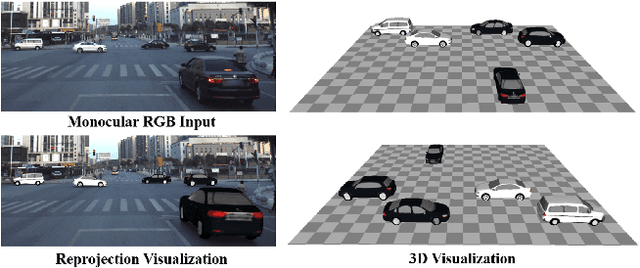
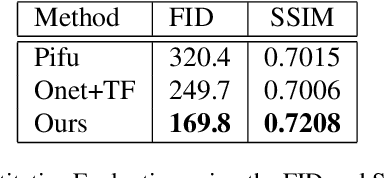
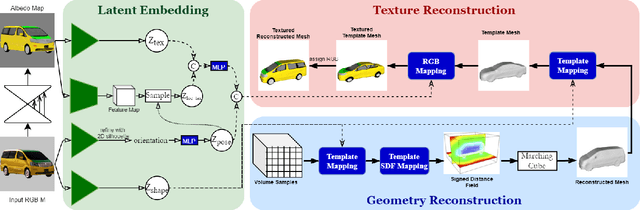
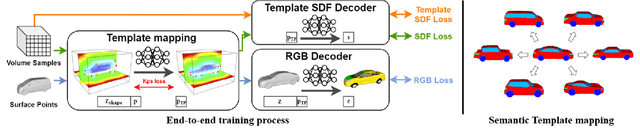
We introduce VERTEX, an effective solution to recover 3D shape and intrinsic texture of vehicles from uncalibrated monocular input in real-world street environments. To fully utilize the template prior of vehicles, we propose a novel geometry and texture joint representation, based on implicit semantic template mapping. Compared to existing representations which infer 3D texture distribution, our method explicitly constrains the texture distribution on the 2D surface of the template as well as avoids limitations of fixed resolution and topology. Moreover, by fusing the global and local features together, our approach is capable to generate consistent and detailed texture in both visible and invisible areas. We also contribute a new synthetic dataset containing 830 elaborate textured car models labeled with sparse key points and rendered using Physically Based Rendering (PBRT) system with measured HDRI skymaps to obtain highly realistic images. Experiments demonstrate the superior performance of our approach on both testing dataset and in-the-wild images. Furthermore, the presented technique enables additional applications such as 3D vehicle texture transfer and material identification.