 Add to Chrome
 Add to Firefox
 Add to Edge
Remember-R1: Mitigating Long-Context Visual Forgetting through Reinforcement Learning
Aug 02, 2026
Multimodal large language models (MLLMs) increasingly rely on long chain-of-thought reasoning for complex tasks. However, as reasoning sequences lengthen, models may gradually rely less on visual evidence and more on accumulated textual context, leading to visual forgetting. Existing approaches do not directly constrain how visual evidence is used and maintained along the original reasoning trajectory, leaving long-context visual forgetting insufficiently addressed. To address this issue, we propose Remember-R1, a reinforcement learning framework that mitigates long-context visual forgetting by applying process-level supervision directly on the original reasoning trajectory. Specifically, Remember-R1 introduces rewards that encourage broader coverage of matched visual keywords, stronger persistence of visual dependence in later reasoning steps, and greater focus on question-relevant image regions. Experiments across multiple model scales and diverse multimodal benchmarks demonstrate that Remember-R1 consistently improves reasoning performance. Additional analyses further show that it slows the decline of visual attention during generation, supporting its effectiveness in mitigating long-context visual forgetting.

IQA-T1: Tool-based Visual Evidence Reasoning for Image Quality Assessment
Jul 14, 2026Image Quality Assessment (IQA) in open-world environments remains challenging due to limited generalization and interpretability. Recent approaches based on multimodal large language models (MLLMs) introduce textual reasoning for quality prediction, yet their judgments rely heavily on semantically biased internal representations, making them insensitive to low-level perceptual degradations. We propose IQA-T1, a tool-based visual evidence reasoning framework that augments MLLM reasoning with explicit perceptual observations. During inference, the model autonomously invokes specialized analysis tools to generate structured visual evidence, such as noise residual maps, gradient statistics, and frequency spectra, which are progressively integrated into the reasoning process. To support this paradigm, we construct Q-Tool, a dataset containing 11k multimodal reasoning chains grounded in tool-generated evidence. Extensive experiments on seven IQA benchmarks show that IQA-T1 achieves the best overall performance across datasets while producing interpretable and evidence-grounded quality assessments. Code and dataset are available at https://github.com/zibuyu-02/IQA-T1.
Effective Out-of-Distribution Detection in Classifier Based on PEDCC-Loss
Apr 10, 2022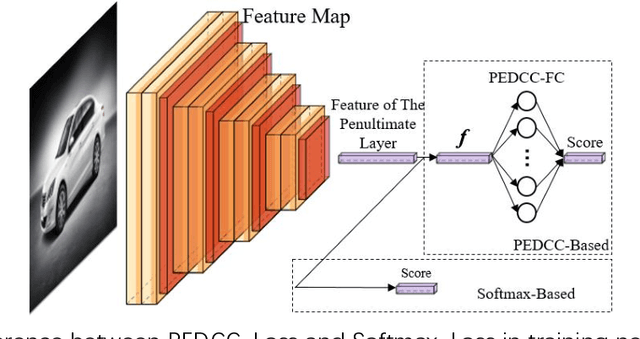
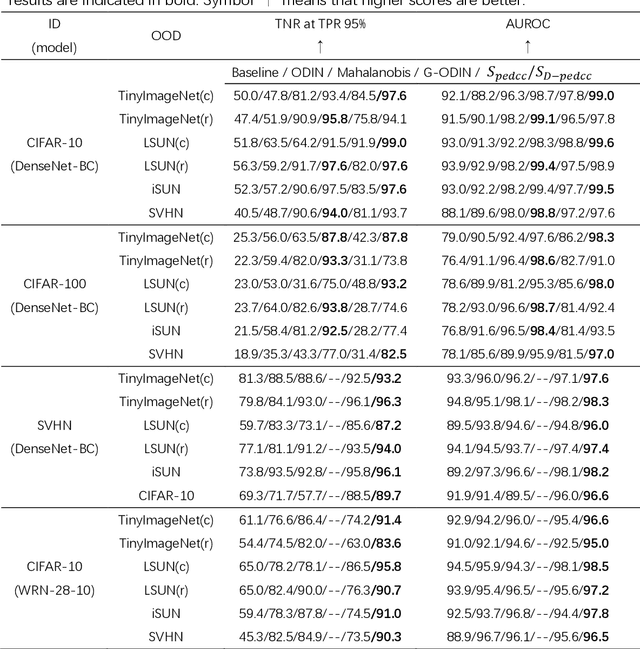
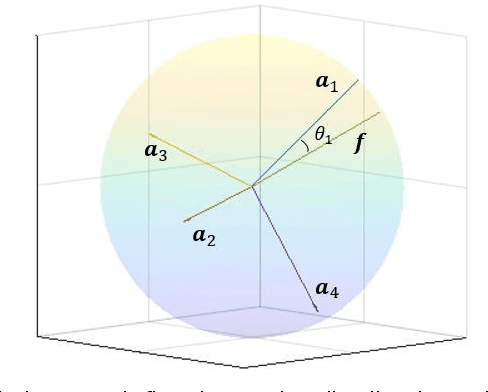
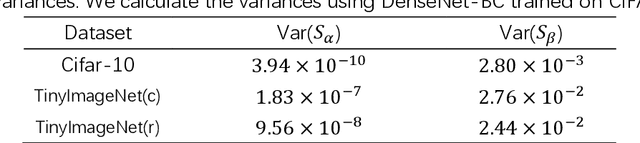
Deep neural networks suffer from the overconfidence issue in the open world, meaning that classifiers could yield confident, incorrect predictions for out-of-distribution (OOD) samples. Thus, it is an urgent and challenging task to detect these samples drawn far away from training distribution based on the security considerations of artificial intelligence. Many current methods based on neural networks mainly rely on complex processing strategies, such as temperature scaling and input preprocessing, to obtain satisfactory results. In this paper, we propose an effective algorithm for detecting out-of-distribution examples utilizing PEDCC-Loss. We mathematically analyze the nature of the confidence score output by the PEDCC (Predefined Evenly-Distribution Class Centroids) classifier, and then construct a more effective scoring function to distinguish in-distribution (ID) and out-of-distribution. In this method, there is no need to preprocess the input samples and the computational burden of the algorithm is reduced. Experiments demonstrate that our method can achieve better OOD detection performance.
Generation and frame characteristics of predefined evenly-distributed class centroids for pattern classification
May 02, 2021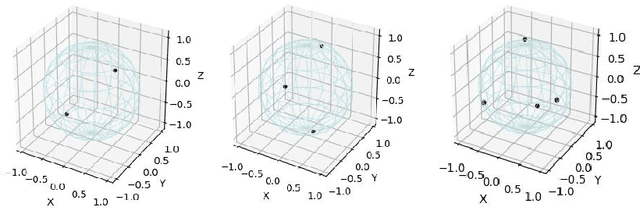
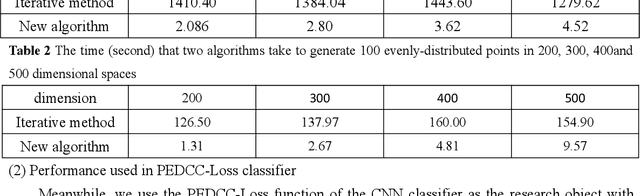
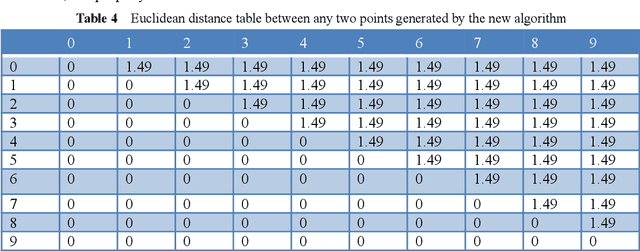
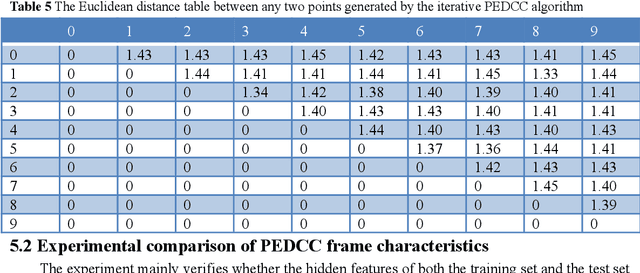
Predefined evenly-distributed class centroids (PEDCC) can be widely used in models and algorithms of pattern classification, such as CNN classifiers, classification autoencoders, clustering, and semi-supervised learning, etc. Its basic idea is to predefine the class centers, which are evenly-distributed on the unit hypersphere in feature space, to maximize the inter-class distance. The previous method of generating PEDCC uses an iterative algorithm based on a charge model, that is, the initial values of various centers (charge positions) are randomly set from the normal distribution, and the charge positions are updated iteratively with the help of the repulsive force between charges of the same polarity. The class centers generated by the algorithm will produce some errors with the theoretically evenly-distributed points, and the generation time will be longer. This paper takes advantage of regular polyhedron in high-dimensional space and the evenly distribution of points on the n dimensional hypersphere to generate PEDCC mathematically. Then, we discussed the basic and extensive characteristics of the frames formed by PEDCC. Finally, experiments show that new algorithm is not only faster than the iterative method, but also more accurate in position. The mathematical analysis and experimental results of this paper can provide a theoretical tool for using PEDCC to solve the key problems in the field of pattern recognition, such as interpretable supervised/unsupervised learning, incremental learning, uncertainty analysis and so on.