 Add to Chrome
 Add to Firefox
 Add to Edge
KlingAvatar 2.0 Technical Report
Dec 15, 2025
Avatar video generation models have achieved remarkable progress in recent years. However, prior work exhibits limited efficiency in generating long-duration high-resolution videos, suffering from temporal drifting, quality degradation, and weak prompt following as video length increases. To address these challenges, we propose KlingAvatar 2.0, a spatio-temporal cascade framework that performs upscaling in both spatial resolution and temporal dimension. The framework first generates low-resolution blueprint video keyframes that capture global semantics and motion, and then refines them into high-resolution, temporally coherent sub-clips using a first-last frame strategy, while retaining smooth temporal transitions in long-form videos. To enhance cross-modal instruction fusion and alignment in extended videos, we introduce a Co-Reasoning Director composed of three modality-specific large language model (LLM) experts. These experts reason about modality priorities and infer underlying user intent, converting inputs into detailed storylines through multi-turn dialogue. A Negative Director further refines negative prompts to improve instruction alignment. Building on these components, we extend the framework to support ID-specific multi-character control. Extensive experiments demonstrate that our model effectively addresses the challenges of efficient, multimodally aligned long-form high-resolution video generation, delivering enhanced visual clarity, realistic lip-teeth rendering with accurate lip synchronization, strong identity preservation, and coherent multimodal instruction following.

Kling-Avatar: Grounding Multimodal Instructions for Cascaded Long-Duration Avatar Animation Synthesis
Sep 11, 2025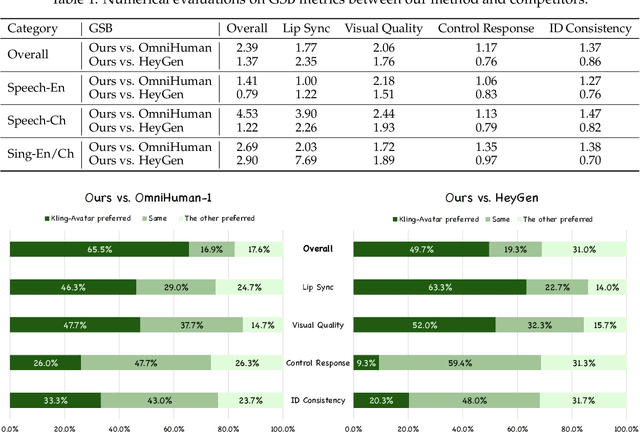
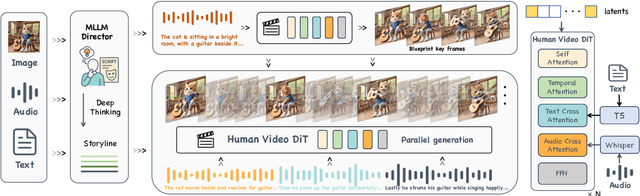
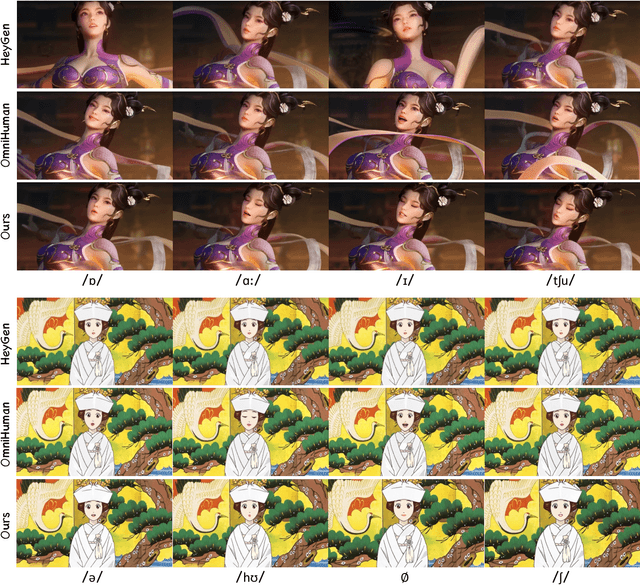
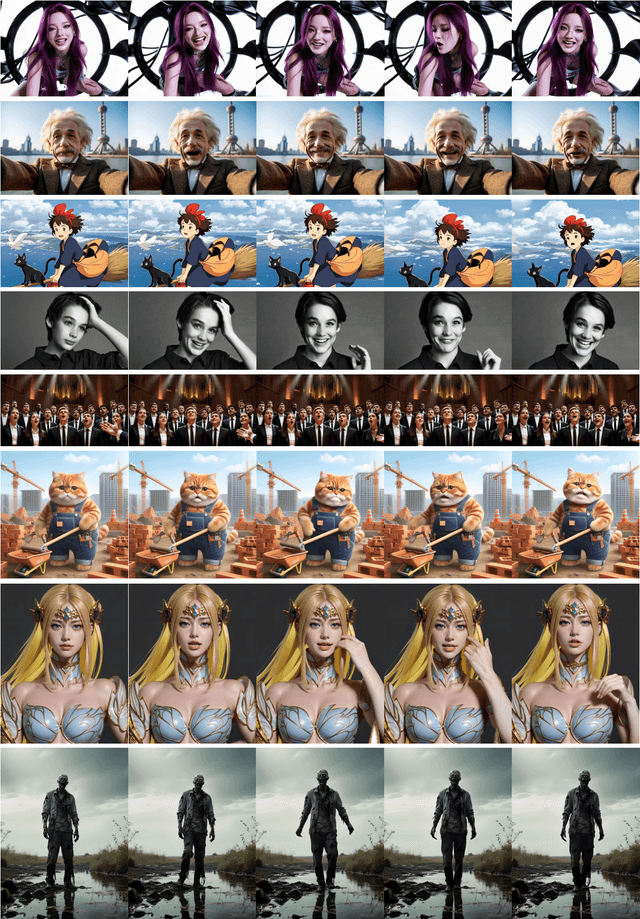
Recent advances in audio-driven avatar video generation have significantly enhanced audio-visual realism. However, existing methods treat instruction conditioning merely as low-level tracking driven by acoustic or visual cues, without modeling the communicative purpose conveyed by the instructions. This limitation compromises their narrative coherence and character expressiveness. To bridge this gap, we introduce Kling-Avatar, a novel cascaded framework that unifies multimodal instruction understanding with photorealistic portrait generation. Our approach adopts a two-stage pipeline. In the first stage, we design a multimodal large language model (MLLM) director that produces a blueprint video conditioned on diverse instruction signals, thereby governing high-level semantics such as character motion and emotions. In the second stage, guided by blueprint keyframes, we generate multiple sub-clips in parallel using a first-last frame strategy. This global-to-local framework preserves fine-grained details while faithfully encoding the high-level intent behind multimodal instructions. Our parallel architecture also enables fast and stable generation of long-duration videos, making it suitable for real-world applications such as digital human livestreaming and vlogging. To comprehensively evaluate our method, we construct a benchmark of 375 curated samples covering diverse instructions and challenging scenarios. Extensive experiments demonstrate that Kling-Avatar is capable of generating vivid, fluent, long-duration videos at up to 1080p and 48 fps, achieving superior performance in lip synchronization accuracy, emotion and dynamic expressiveness, instruction controllability, identity preservation, and cross-domain generalization. These results establish Kling-Avatar as a new benchmark for semantically grounded, high-fidelity audio-driven avatar synthesis.