 Add to Chrome
 Add to Firefox
 Add to Edge
VisPercep: A Vision-Language Approach to Enhance Visual Perception for People with Blindness and Low Vision
Oct 31, 2023
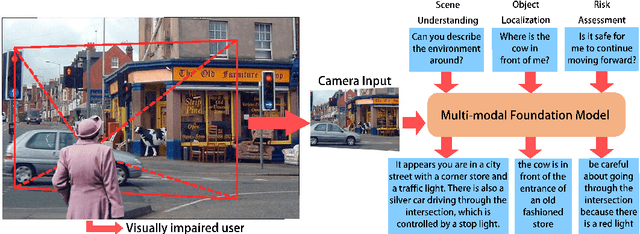
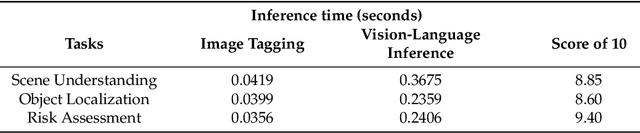
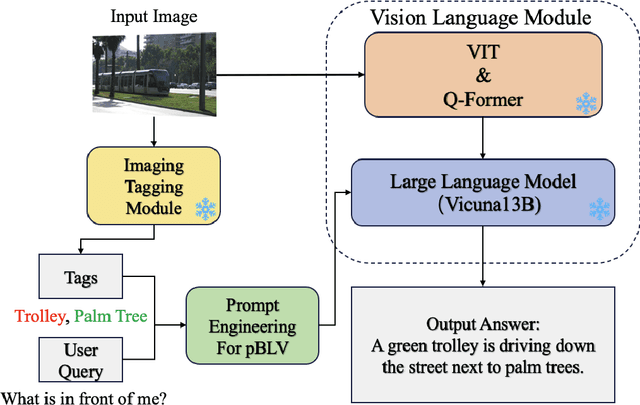

People with blindness and low vision (pBLV) encounter substantial challenges when it comes to comprehensive scene recognition and precise object identification in unfamiliar environments. Additionally, due to the vision loss, pBLV have difficulty in accessing and identifying potential tripping hazards on their own. In this paper, we present a pioneering approach that leverages a large vision-language model to enhance visual perception for pBLV, offering detailed and comprehensive descriptions of the surrounding environments and providing warnings about the potential risks. Our method begins by leveraging a large image tagging model (i.e., Recognize Anything (RAM)) to identify all common objects present in the captured images. The recognition results and user query are then integrated into a prompt, tailored specifically for pBLV using prompt engineering. By combining the prompt and input image, a large vision-language model (i.e., InstructBLIP) generates detailed and comprehensive descriptions of the environment and identifies potential risks in the environment by analyzing the environmental objects and scenes, relevant to the prompt. We evaluate our approach through experiments conducted on both indoor and outdoor datasets. Our results demonstrate that our method is able to recognize objects accurately and provide insightful descriptions and analysis of the environment for pBLV.

Lifting the Veil: Unlocking the Power of Depth in Q-learning
Oct 27, 2023With the help of massive data and rich computational resources, deep Q-learning has been widely used in operations research and management science and has contributed to great success in numerous applications, including recommender systems, supply chains, games, and robotic manipulation. However, the success of deep Q-learning lacks solid theoretical verification and interpretability. The aim of this paper is to theoretically verify the power of depth in deep Q-learning. Within the framework of statistical learning theory, we rigorously prove that deep Q-learning outperforms its traditional version by demonstrating its good generalization error bound. Our results reveal that the main reason for the success of deep Q-learning is the excellent performance of deep neural networks (deep nets) in capturing the special properties of rewards namely, spatial sparseness and piecewise constancy, rather than their large capacities. In this paper, we make fundamental contributions to the field of reinforcement learning by answering to the following three questions: Why does deep Q-learning perform so well? When does deep Q-learning perform better than traditional Q-learning? How many samples are required to achieve a specific prediction accuracy for deep Q-learning? Our theoretical assertions are verified by applying deep Q-learning in the well-known beer game in supply chain management and a simulated recommender system.
Distillation Improves Visual Place Recognition for Low-Quality Queries
Oct 10, 2023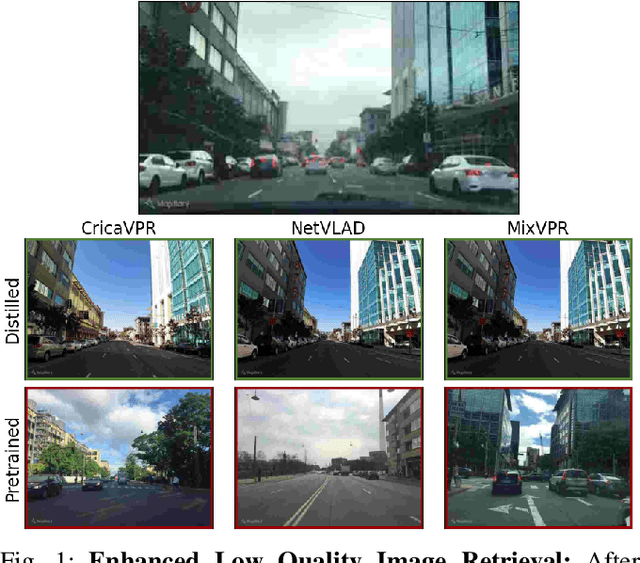
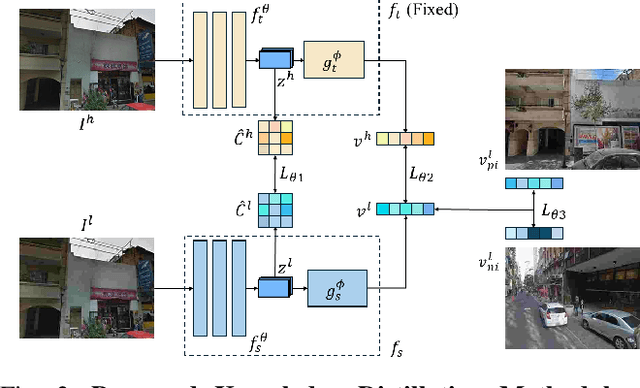
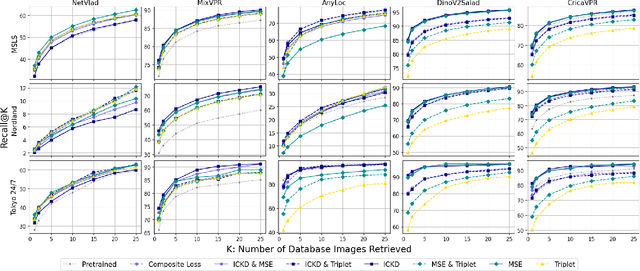
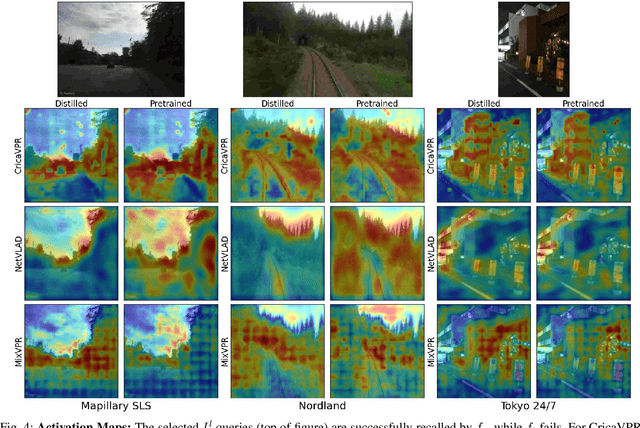
The shift to online computing for real-time visual localization often requires streaming query images/videos to a server for visual place recognition (VPR), where fast video transmission may result in reduced resolution or increased quantization. This compromises the quality of global image descriptors, leading to decreased VPR performance. To improve the low recall rate for low-quality query images, we present a simple yet effective method that uses high-quality queries only during training to distill better feature representations for deep-learning-based VPR, such as NetVLAD. Specifically, we use mean squared error (MSE) loss between the global descriptors of queries with different qualities, and inter-channel correlation knowledge distillation (ICKD) loss over their corresponding intermediate features. We validate our approach using the both Pittsburgh 250k dataset and our own indoor dataset with varying quantization levels. By fine-tuning NetVLAD parameters with our distillation-augmented losses, we achieve notable VPR recall-rate improvements over low-quality queries, as demonstrated in our extensive experimental results. We believe this work not only pushes forward the VPR research but also provides valuable insights for applications needing dependable place recognition under resource-limited conditions.
Provable Tensor Completion with Graph Information
Oct 04, 2023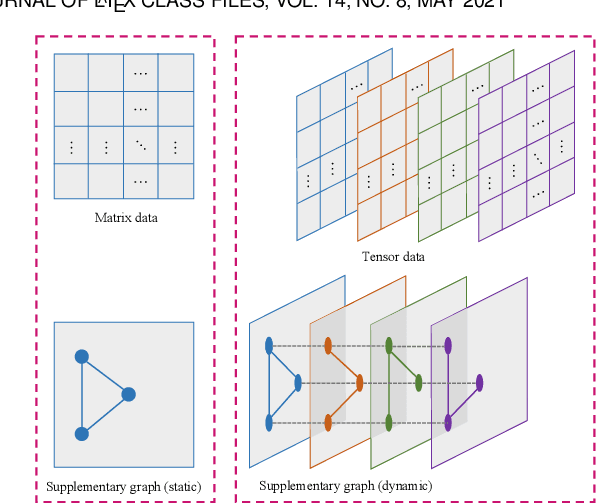
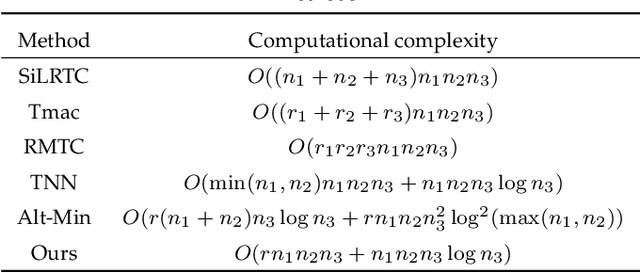

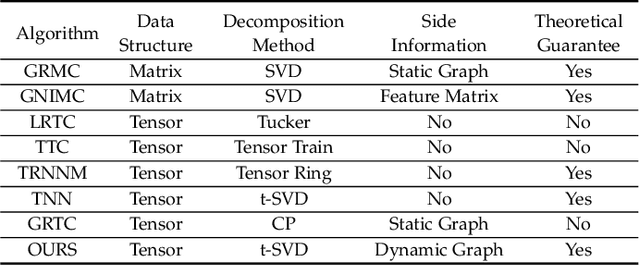
Graphs, depicting the interrelations between variables, has been widely used as effective side information for accurate data recovery in various matrix/tensor recovery related applications. In this paper, we study the tensor completion problem with graph information. Current research on graph-regularized tensor completion tends to be task-specific, lacking generality and systematic approaches. Furthermore, a recovery theory to ensure performance remains absent. Moreover, these approaches overlook the dynamic aspects of graphs, treating them as static akin to matrices, even though graphs could exhibit dynamism in tensor-related scenarios. To confront these challenges, we introduce a pioneering framework in this paper that systematically formulates a novel model, theory, and algorithm for solving the dynamic graph regularized tensor completion problem. For the model, we establish a rigorous mathematical representation of the dynamic graph, based on which we derive a new tensor-oriented graph smoothness regularization. By integrating this regularization into a tensor decomposition model based on transformed t-SVD, we develop a comprehensive model simultaneously capturing the low-rank and similarity structure of the tensor. In terms of theory, we showcase the alignment between the proposed graph smoothness regularization and a weighted tensor nuclear norm. Subsequently, we establish assurances of statistical consistency for our model, effectively bridging a gap in the theoretical examination of the problem involving tensor recovery with graph information. In terms of the algorithm, we develop a solution of high effectiveness, accompanied by a guaranteed convergence, to address the resulting model. To showcase the prowess of our proposed model in contrast to established ones, we provide in-depth numerical experiments encompassing synthetic data as well as real-world datasets.
Fast and Interpretable Nonlocal Neural Networks for Image Denoising via Group-Sparse Convolutional Dictionary Learning
Jun 02, 2023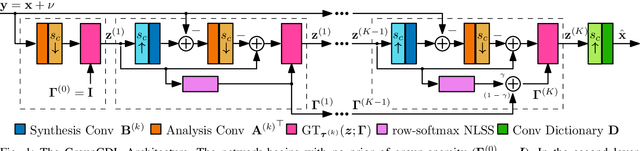
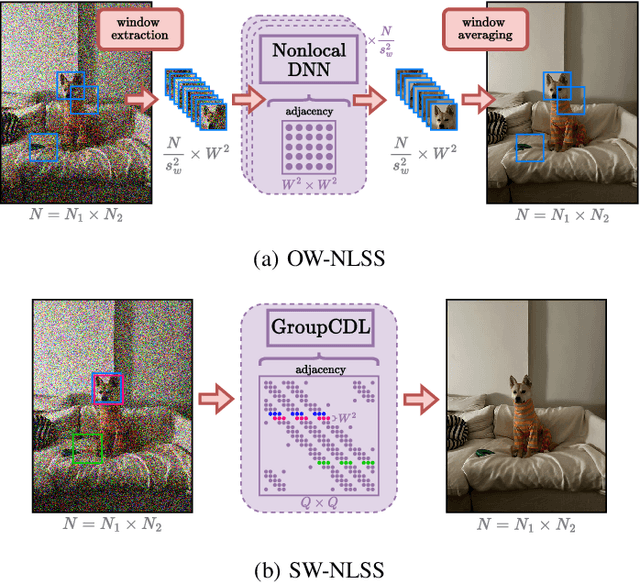
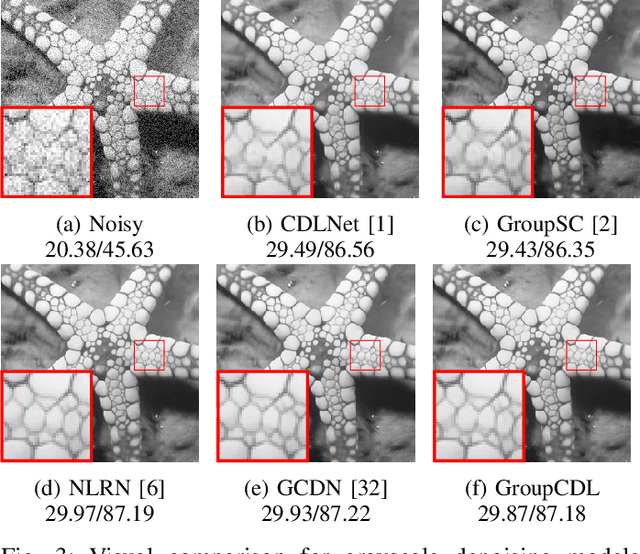
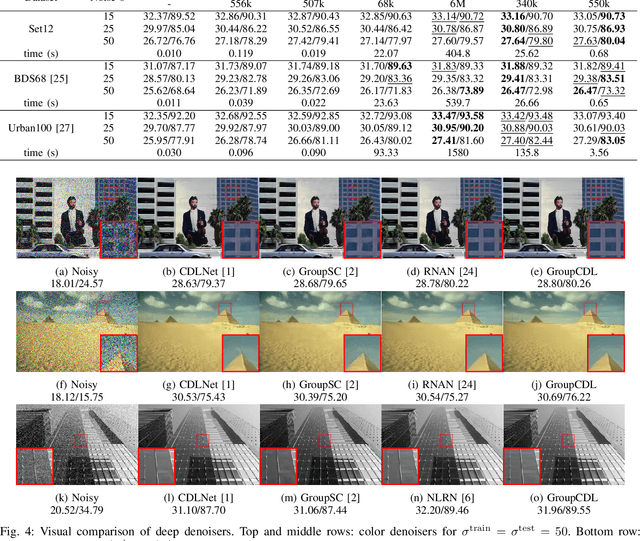
Nonlocal self-similarity within natural images has become an increasingly popular prior in deep-learning models. Despite their successful image restoration performance, such models remain largely uninterpretable due to their black-box construction. Our previous studies have shown that interpretable construction of a fully convolutional denoiser (CDLNet), with performance on par with state-of-the-art black-box counterparts, is achievable by unrolling a dictionary learning algorithm. In this manuscript, we seek an interpretable construction of a convolutional network with a nonlocal self-similarity prior that performs on par with black-box nonlocal models. We show that such an architecture can be effectively achieved by upgrading the $\ell 1$ sparsity prior of CDLNet to a weighted group-sparsity prior. From this formulation, we propose a novel sliding-window nonlocal operation, enabled by sparse array arithmetic. In addition to competitive performance with black-box nonlocal DNNs, we demonstrate the proposed sliding-window sparse attention enables inference speeds greater than an order of magnitude faster than its competitors.
Lightweight Estimation of Hand Mesh and Biomechanically Feasible Kinematic Parameters
Mar 26, 2023


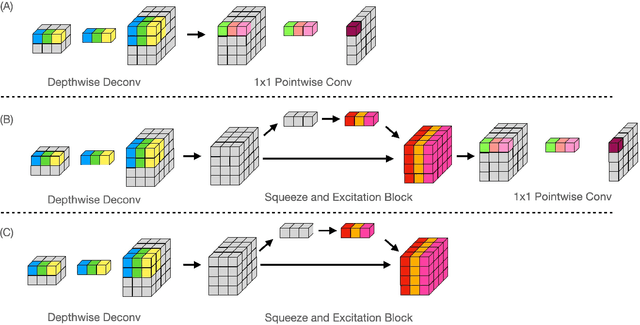
3D hand pose estimation is a long-standing challenge in both robotics and computer vision communities due to its implicit depth ambiguity and often strong self-occlusion. Recently, in addition to the hand skeleton, jointly estimating hand pose and shape has gained more attraction. State-of-the-art methods adopt a model-free approach, estimating the vertices of the hand mesh directly and providing superior accuracy compared to traditional model-based methods directly regressing the parameters of the parametric hand mesh. However, with the large number of mesh vertices to estimate, these methods are often slow in inference. We propose an efficient variation of the previously proposed image-to-lixel approach to efficiently estimate hand meshes from the images. Leveraging recent developments in efficient neural architectures, we significantly reduce the computation complexity without sacrificing the estimation accuracy. Furthermore, we introduce an inverted kinematic(IK) network to translate the estimated hand mesh to a biomechanically feasible set of joint rotation parameters, which is necessary for applications that leverage pose estimation for controlling robotic hands. Finally, an optional post-processing module is proposed to refine the rotation and shape parameters to compensate for the error introduced by the IK net. Our Lite I2L Mesh Net achieves state-of-the-art joint and mesh estimation accuracy with less than $13\%$ of the total computational complexity of the original I2L hand mesh estimator. Adding the IK net and post-optimization modules can improve the accuracy slightly at a small computation cost, but more importantly, provide the kinematic parameters required for robotic applications.
Progressive Frame Patching for FoV-based Point Cloud Video Streaming
Mar 15, 2023Immersive multimedia applications, such as Virtual, Augmented and Mixed Reality, have become more practical with advances in hardware and software for acquiring and rendering 3D media as well as 5G/6G wireless networks. Such applications require the delivery of volumetric video to users with six degrees of freedom (6-DoF) movements. Point Cloud has become a popular volumetric video format due to its flexibility and simplicity. A dense point cloud consumes much higher bandwidth than a 2D/360 degree video frame. User Field of View (FoV) is more dynamic with 6-DoF movement than 3-DoF movement. A user's view quality of a 3D object is affected by points occlusion and distance, which are constantly changing with user and object movements. To save bandwidth, FoV-adaptive streaming predicts user FoV and only downloads the data falling in the predicted FoV, but it is vulnerable to FoV prediction errors, which is significant when a long buffer is used for smoothed streaming. In this work, we propose a multi-round progressive refinement framework for point cloud-based volumetric video streaming. Instead of sequentially downloading frames, we simultaneously downloads/patches multiple frames falling into a sliding time-window, leveraging on the scalability of point-cloud coding. The rate allocation among all tiles of active frames are solved analytically using the heterogeneous tile utility functions calibrated by the predicted user FoV. Multi-frame patching takes advantage of the streaming smoothness resulted from long buffer and the FoV prediction accuracy at short buffer length. We evaluate our solution using simulations driven by real point cloud videos, bandwidth traces and 6-DoF FoV traces of real users. The experiments show that our solution is robust against bandwidth/FoV prediction errors, and can deliver high and smooth quality in the face of bandwidth variations and dynamic user movements.
Deep learning reveals the common spectrum underlying multiple brain disorders in youth and elders from brain functional networks
Feb 23, 2023
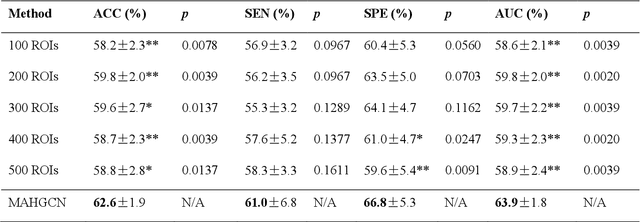
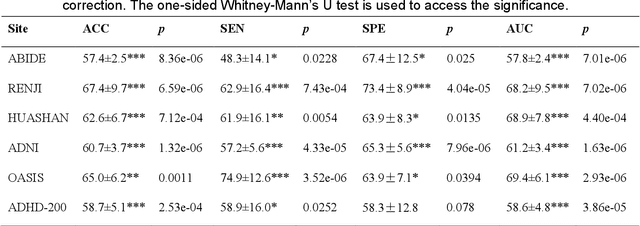

Brain disorders in the early and late life of humans potentially share pathological alterations in brain functions. However, the key evidence from neuroimaging data for pathological commonness remains unrevealed. To explore this hypothesis, we build a deep learning model, using multi-site functional magnetic resonance imaging data (N=4,410, 6 sites), for classifying 5 different brain disorders from healthy controls, with a set of common features. Our model achieves 62.6(1.9)% overall classification accuracy on data from the 6 investigated sites and detects a set of commonly affected functional subnetworks at different spatial scales, including default mode, executive control, visual, and limbic networks. In the deep-layer feature representation for individual data, we observe young and aging patients with disorders are continuously distributed, which is in line with the clinical concept of the "spectrum of disorders". The revealed spectrum underlying early- and late-life brain disorders promotes the understanding of disorder comorbidities in the lifespan.
Kernel-Based Distributed Q-Learning: A Scalable Reinforcement Learning Approach for Dynamic Treatment Regimes
Feb 21, 2023In recent years, large amounts of electronic health records (EHRs) concerning chronic diseases, such as cancer, diabetes, and mental disease, have been collected to facilitate medical diagnosis. Modeling the dynamic properties of EHRs related to chronic diseases can be efficiently done using dynamic treatment regimes (DTRs), which are a set of sequential decision rules. While Reinforcement learning (RL) is a widely used method for creating DTRs, there is ongoing research in developing RL algorithms that can effectively handle large amounts of data. In this paper, we present a novel approach, a distributed Q-learning algorithm, for generating DTRs. The novelties of our research are as follows: 1) From a methodological perspective, we present a novel and scalable approach for generating DTRs by combining distributed learning with Q-learning. The proposed approach is specifically designed to handle large amounts of data and effectively generate DTRs. 2) From a theoretical standpoint, we provide generalization error bounds for the proposed distributed Q-learning algorithm, which are derived within the framework of statistical learning theory. These bounds quantify the relationships between sample size, prediction accuracy, and computational burden, providing insights into the performance of the algorithm. 3) From an applied perspective, we demonstrate the effectiveness of our proposed distributed Q-learning algorithm for DTRs by applying it to clinical cancer treatments. The results show that our algorithm outperforms both traditional linear Q-learning and commonly used deep Q-learning in terms of both prediction accuracy and computation cost.
Dual-mode adaptive-SVD ghost imaging
Feb 14, 2023
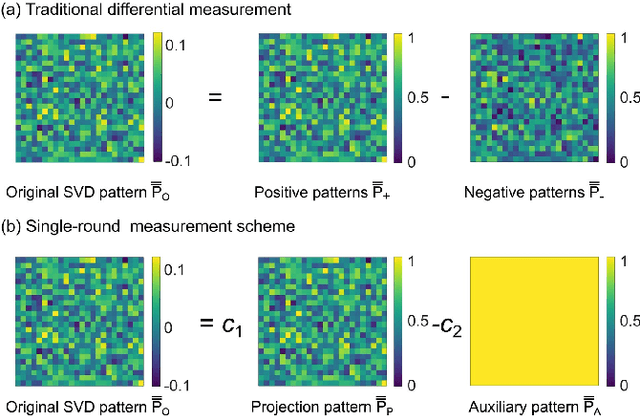
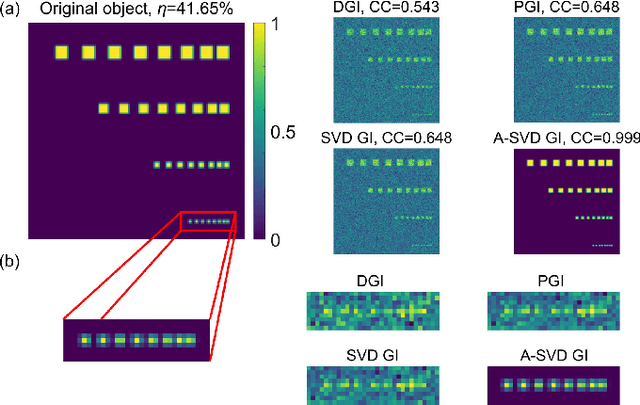
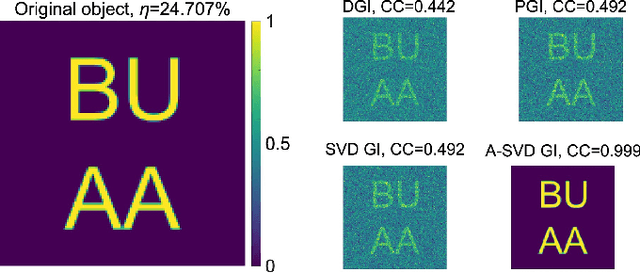
In this paper, we present a dual-mode adaptive singular value decomposition ghost imaging (A-SVD GI), which can be easily switched between the modes of imaging and edge detection. It can adaptively localize the foreground pixels via a threshold selection method. Then only the foreground region is illuminated by the singular value decomposition (SVD) - based patterns, consequently retrieving high-quality images with fewer sampling ratios. By changing the selecting range of foreground pixels, the A-SVD GI can be switched to the mode of edge detection to directly reveal the edge of objects, without needing the original image. We investigate the performance of these two modes through both numerical simulations and experiments. We also develop a single-round scheme to halve measurement numbers in experiments, instead of separately illuminating positive and negative patterns in traditional methods. The binarized SVD patterns, generated by the spatial dithering method, are modulated by a digital micromirror device (DMD) to speed up the data acquisition. This dual-mode A-SVD GI can be applied in various applications, such as remote sensing or target recognition, and could be further extended for multi-modality functional imaging/detection.