 Add to Chrome
 Add to Firefox
 Add to Edge
DynamicMem: A Long-Horizon Memory Benchmark in Real-World Settings
Jun 22, 2026
LLM agents increasingly act as personal assistants that must remember a user's profile over months: who they are (attributes), what they routinely do (habits), and what they prefer (preferences), and keep it updated as jobs, routines, and tastes drift. Existing benchmarks evaluate this "memory" ability through short, simplified interactions, missing three core properties of real behavior: the profile is heterogeneous, with attributes, habits, and preferences evolving on different timelines; changes are driven by external context such as seasons and life events; and evidence is rarely stated explicitly, instead scattered across many small actions in different apps that a memory system must infer from. We introduce DynamicMem, a synthetic benchmark that constructs 15 months of activity per user, providing long-term multi-app data that real users' privacy keeps out of reach. It provides user-consistent trajectories averaging 2.2M tokens and 1,772 grounded events per user across 16 applications such as e-commerce, fitness, and social platforms. The profile evolves over this period and is never given explicitly: each attribute, habit, or preference must be inferred from small signals scattered across apps. We evaluate at five quarterly checkpoints to track how systems scale as history grows. Benchmarking five representative systems exposes problems a single accuracy score hides: (i) profile reconstruction degrades with history length while service-task accuracy stays flat, despite both drawing on the same memory; (ii) no system both keeps facts that stay true and replaces facts that change, with errors clustering on preferences and on naming the exact referent; and (iii) over 93% of failures trace to what the memory retrieves, not to the model writing the answer, so the largest room for improvement lies in memory itself. Code: https://wenyaxie023.github.io/DynamicMem/

MOFI: Learning Image Representations from Noisy Entity Annotated Images
Jun 24, 2023We present MOFI, a new vision foundation model designed to learn image representations from noisy entity annotated images. MOFI differs from previous work in two key aspects: ($i$) pre-training data, and ($ii$) training recipe. Regarding data, we introduce a new approach to automatically assign entity labels to images from noisy image-text pairs. Our approach involves employing a named entity recognition model to extract entities from the alt-text, and then using a CLIP model to select the correct entities as labels of the paired image. The approach is simple, does not require costly human annotation, and can be readily scaled up to billions of image-text pairs mined from the web. Through this method, we have created Image-to-Entities (I2E), a new large-scale dataset with 1 billion images and 2 million distinct entities, covering rich visual concepts in the wild. Building upon the I2E dataset, we study different training recipes, including supervised pre-training, contrastive pre-training, and multi-task learning. For constrastive pre-training, we treat entity names as free-form text, and further enrich them with entity descriptions. Experiments show that supervised pre-training with large-scale fine-grained entity labels is highly effective for image retrieval tasks, and multi-task training further improves the performance. The final MOFI model achieves 86.66% mAP on the challenging GPR1200 dataset, surpassing the previous state-of-the-art performance of 72.19% from OpenAI's CLIP model. Further experiments on zero-shot and linear probe image classification also show that MOFI outperforms a CLIP model trained on the original image-text data, demonstrating the effectiveness of the I2E dataset in learning strong image representations.
Less is More: Removing Text-regions Improves CLIP Training Efficiency and Robustness
May 08, 2023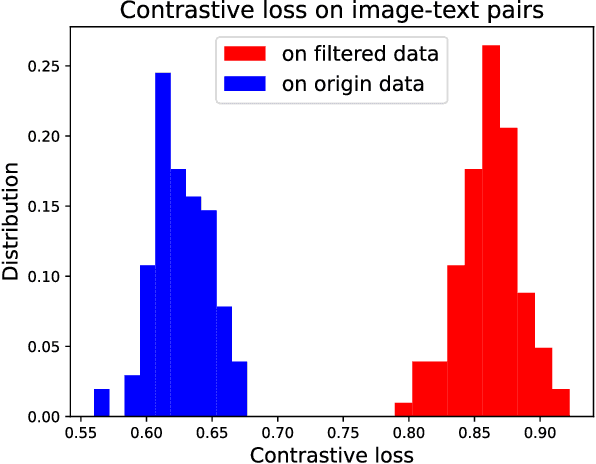
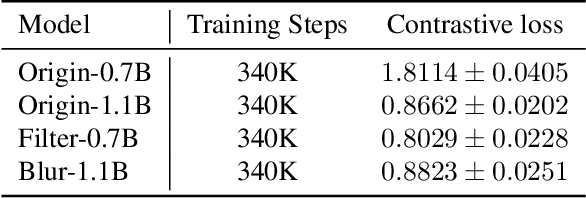
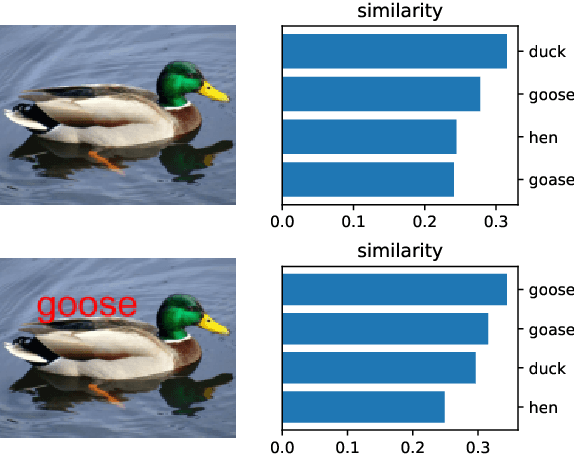
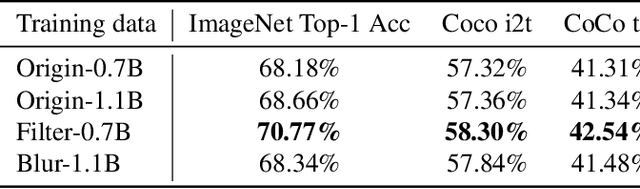
The CLIP (Contrastive Language-Image Pre-training) model and its variants are becoming the de facto backbone in many applications. However, training a CLIP model from hundreds of millions of image-text pairs can be prohibitively expensive. Furthermore, the conventional CLIP model doesn't differentiate between the visual semantics and meaning of text regions embedded in images. This can lead to non-robustness when the text in the embedded region doesn't match the image's visual appearance. In this paper, we discuss two effective approaches to improve the efficiency and robustness of CLIP training: (1) augmenting the training dataset while maintaining the same number of optimization steps, and (2) filtering out samples that contain text regions in the image. By doing so, we significantly improve the classification and retrieval accuracy on public benchmarks like ImageNet and CoCo. Filtering out images with text regions also protects the model from typographic attacks. To verify this, we build a new dataset named ImageNet with Adversarial Text Regions (ImageNet-Attr). Our filter-based CLIP model demonstrates a top-1 accuracy of 68.78\%, outperforming previous models whose accuracy was all below 50\%.