 Add to Chrome
 Add to Firefox
 Add to Edge
Joint Low-Dimensional Modeling and Sampling Design for Sparse On-Orbit Antenna Pattern Reconstruction
Jul 31, 2026
Accurately reconstructing satellite transmit-antenna patterns on orbit is difficult because only sparse directional measurements are available during normal mission operations. This paper develops a cooperative on-orbit pattern-reconstruction framework that converts received calibration power into normalized directional samples and represents the antenna power pattern using a truncated discrete cosine transform (DCT) basis. The resulting low-dimensional model transforms high-dimensional pattern recovery into coefficient estimation, for which a closed-form maximum-likelihood estimator and error characterization are derived. The analysis shows how DCT truncation error, measurement noise, and sampled-basis conditioning jointly affect reconstruction accuracy. For regularly accessible angular sectors, midpoint-uniform sampling provides an information-balanced baseline for the retained DCT modes. For constrained feasible opportunities, D-optimal sampling is used to select informative measurement directions. Simulations verify the accuracy of the angular discretization, the sample efficiency of the truncated-DCT model, and the reconstruction gain of D-optimal sampling under irregular orbit-generated opportunities.

Domain Adaptive Object Detection via Dual-Stream Bilevel-Cycle Optimization
Jun 30, 2026Cycle self-training (CST) breaks the shared classifier assumption of the standard self-training framework, which is effective for unsupervised domain adaptation and exploits unlabeled target data by training with target pseudo-labels. CST introduces a target classifier and employs an inner-outer loop updating strategy, addressing the issue of unreliable pseudo-labels and enabling pseudo-labels to generalize across domains. Despite its success in image classification, extending CST to object detection faces three main challenges. First, the upper bound of CST in object detection is constrained by three types of unreliable pseudo-labels, such as classification error alone, localization error alone, and their combination. Second, since object detection involves detecting multiple target objects, directly applying CST leads to training insta bility. Third, a wider numerical range of regression coordinates leads to exploding losses. To this end, we apply CST to both classification and regression and propose the Dual-Stream Bilevel-Cycle Optimization framework. Specifically, we construct CST upon Mean Teacher to prevent training instability and use extra normalization to map the regression bounding box into a standardized space, effectively addressing exploding losses. Also, we provide a theoretical derivation of the regression bound. Extensive experiments across four cross domain standard scenarios demonstrate that our framework achieves considerable results.
Did Models Sufficient Learn? Attribution-Guided Training via Subset-Selected Counterfactual Augmentation
Nov 15, 2025In current visual model training, models often rely on only limited sufficient causes for their predictions, which makes them sensitive to distribution shifts or the absence of key features. Attribution methods can accurately identify a model's critical regions. However, masking these areas to create counterfactuals often causes the model to misclassify the target, while humans can still easily recognize it. This divergence highlights that the model's learned dependencies may not be sufficiently causal. To address this issue, we propose Subset-Selected Counterfactual Augmentation (SS-CA), which integrates counterfactual explanations directly into the training process for targeted intervention. Building on the subset-selection-based LIMA attribution method, we develop Counterfactual LIMA to identify minimal spatial region sets whose removal can selectively alter model predictions. Leveraging these attributions, we introduce a data augmentation strategy that replaces the identified regions with natural background, and we train the model jointly on both augmented and original samples to mitigate incomplete causal learning. Extensive experiments across multiple ImageNet variants show that SS-CA improves generalization on in-distribution (ID) test data and achieves superior performance on out-of-distribution (OOD) benchmarks such as ImageNet-R and ImageNet-S. Under perturbations including noise, models trained with SS-CA also exhibit enhanced generalization, demonstrating that our approach effectively uses interpretability insights to correct model deficiencies and improve both performance and robustness.
Fast Fractional Programming for Multi-Cell Integrated Sensing and Communications
Jun 16, 2024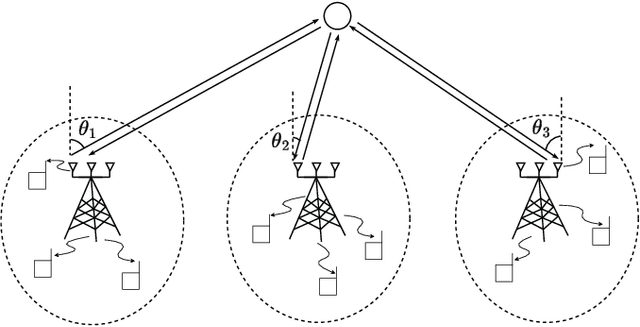
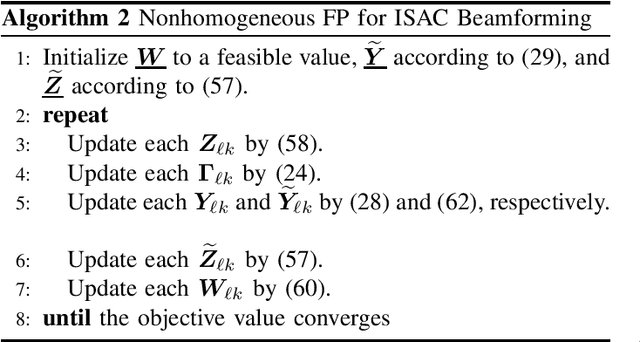
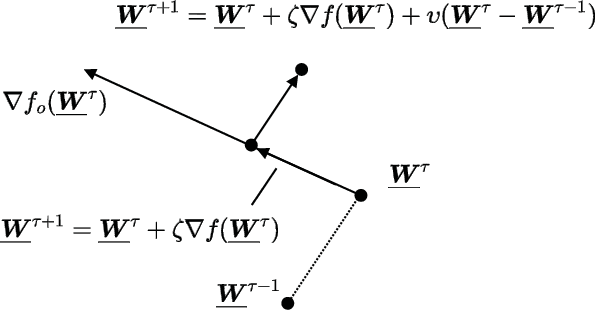
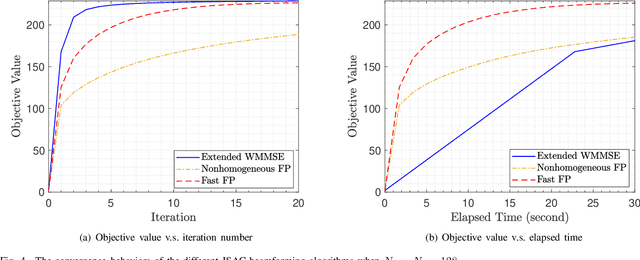
This paper concerns the coordinate multi-cell beamforming design for integrated sensing and communications (ISAC). In particular, we assume that each base station (BS) has massive antennas. The optimization objective is to maximize a weighted sum of the data rates (for communications) and the Fisher information (for sensing). We first show that the conventional beamforming method for the multiple-input multiple-output (MIMO) transmission, i.e., the weighted minimum mean square error (WMMSE) algorithm, has a natural extension to the ISAC problem scenario from a fractional programming (FP) perspective. However, the extended WMMSE algorithm requires computing the $N\times N$ matrix inverse extensively, where $N$ is proportional to the antenna array size, so the algorithm becomes quite costly when antennas are massively deployed. To address this issue, we develop a nonhomogeneous bound and use it in conjunction with the FP technique to solve the ISAC beamforming problem without the need to invert any large matrices. It is further shown that the resulting new FP algorithm has an intimate connection with gradient projection, based on which we can accelerate the convergence via Nesterov's gradient extrapolation.