 Add to Chrome
 Add to Firefox
 Add to Edge
Online Inference in Distributional Temporal-Difference Learning
Aug 14, 2026
We study online statistical inference for functionals of the return distribution under a fixed policy. The return distribution is estimated by nonparametric distributional temporal-difference learning from a single Markov trajectory. For the Polyak--Ruppert averaged estimator, we prove that its root-$T$ error converges weakly to a centered Gaussian random element in Cramér space. We also prove that, conditionally on the observed trajectory, the root-$T$ difference between the bootstrap and original averages converges weakly to the same Gaussian limit. These results justify bootstrap inference for smooth statistical functionals, including variance, CVaR, expected shortfall, and expectiles. For nonsmooth statistical functionals, we develop a local asymptotic theory for the estimated return CDF over $T^{-1/2}$-neighborhoods of finitely many thresholds, together with its bootstrap analogue. This theory allows us to conduct inference for nonsmooth statistical functionals characterized by CDF equations, including return quantiles.

Online Inference for Quantile Temporal Difference Learning in Distributional Reinforcement Learning
Aug 14, 2026In this paper, we study how to perform statistical inference for quantile temporal difference learning (QTD) in distributional reinforcement learning. Assuming access to a generative model, we first establish functional central limit theorems for both synchronous and asynchronous QTD, which show that the averaged iterates of QTD converge weakly to a rescaled Brownian motion. We next provide online inference methods. Based on random scaling, the inference procedure constructs an asymptotically pivotal statistic for inference by using the information along the whole QTD path. Meanwhile, the proposed statistic can be computed online without storing the entire trajectory of QTD iterates. This substantially reduces the memory requirement and enables efficient statistical inference in distributional reinforcement learning.
Statistical Efficiency and Inference of Quantile Distributional Reinforcement Learning
Jul 09, 2026In this paper, we study quantile-based distributional reinforcement learning from the perspective of statistical efficiency. We focus on distributional policy evaluation, whose goal is to characterize the return distribution, namely the distribution of discounted cumulative rewards under a given policy. To obtain a finite-dimensional representation of the return distribution, we consider the quantile fixed point $η_m$ induced by the quantile-projected distributional Bellman equation. Assuming access to a generative model, we construct an estimator $η_m^{(n)}$ based on an empirical Markov decision process. For a fixed number of quantiles $m$, we establish a non-asymptotic error bound for $η_m^{(n)}$ and $η_m$ under the supremum $W_\infty$ metric, showing that the estimation error scales as $\widetilde{O}(\sqrt{m/n})$ with respect to $m$ and $n$. This implies that the quantile-based distributional policy evaluation problem can be solved with sample efficiency, achieving the optimal parametric $\sqrt{n}$ convergence rate. We derive the asymptotic distribution of the quantile parameters $\sqrt{n}(θ_m^{(n)}-θ_m)$ and characterize the semiparametric efficiency bound, which is attained by our estimator. Beyond the fixed-dimensional setting, we investigate the asymptotic regime in which the number of quantiles diverges. We characterize the limit covariance structure and show that it matches the semiparametric efficiency bound of the nonparametric model for distributional policy evaluation, showing that quantile-based estimators remain asymptotically efficient in the infinite-dimensional limit. Finally, we establish a Berry--Esseen theorem for smooth functionals $\sqrt{n}(η_m^{(n)}(s)-η_m(s))f$, thereby providing a foundation for statistically valid inference on functionals of the quantile-projected return distribution.
Accelerated Distributional Temporal Difference Learning with Linear Function Approximation
Nov 16, 2025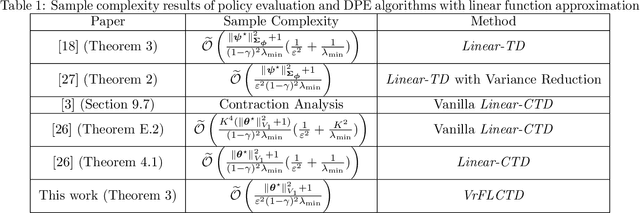
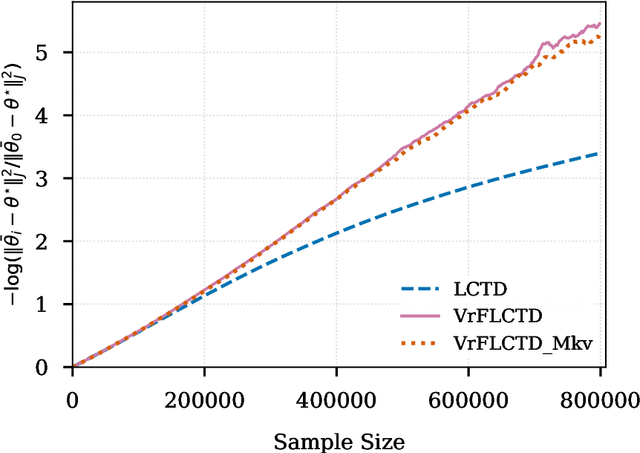
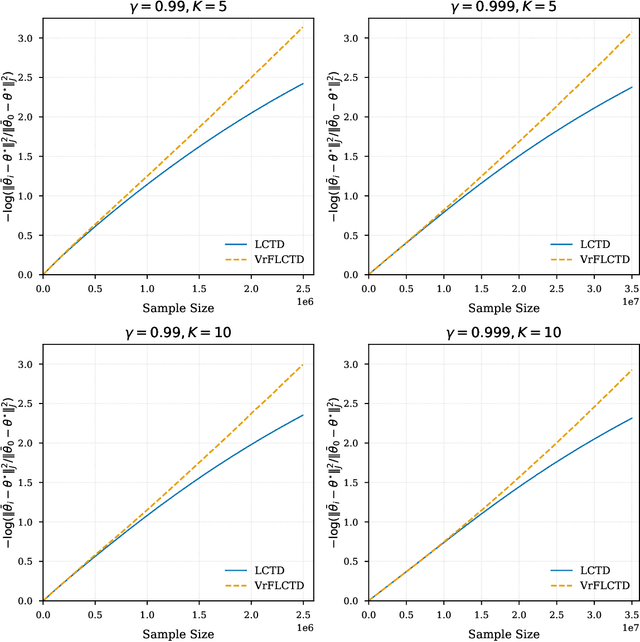
In this paper, we study the finite-sample statistical rates of distributional temporal difference (TD) learning with linear function approximation. The purpose of distributional TD learning is to estimate the return distribution of a discounted Markov decision process for a given policy. Previous works on statistical analysis of distributional TD learning focus mainly on the tabular case. We first consider the linear function approximation setting and conduct a fine-grained analysis of the linear-categorical Bellman equation. Building on this analysis, we further incorporate variance reduction techniques in our new algorithms to establish tight sample complexity bounds independent of the support size $K$ when $K$ is large. Our theoretical results imply that, when employing distributional TD learning with linear function approximation, learning the full distribution of the return function from streaming data is no more difficult than learning its expectation. This work provide new insights into the statistical efficiency of distributional reinforcement learning algorithms.
Finite Sample Analysis of Distributional TD Learning with Linear Function Approximation
Feb 20, 2025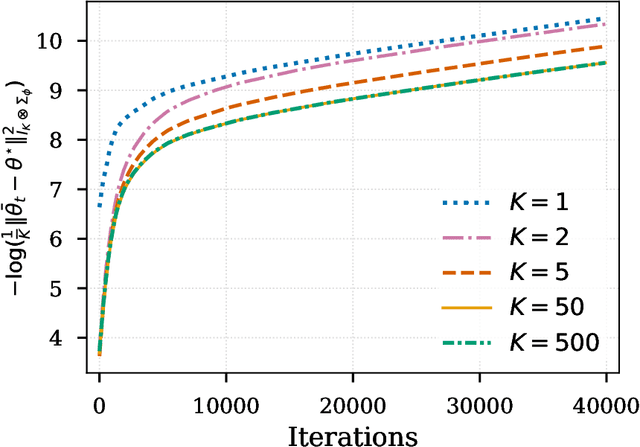
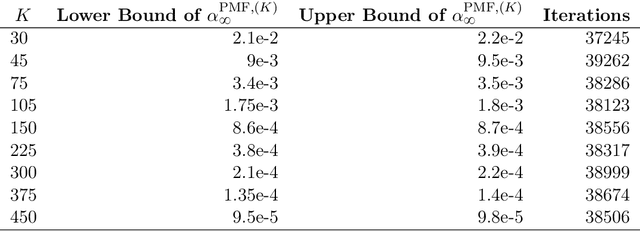
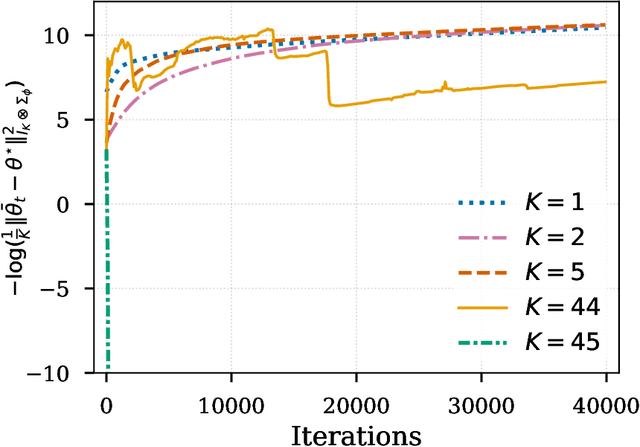
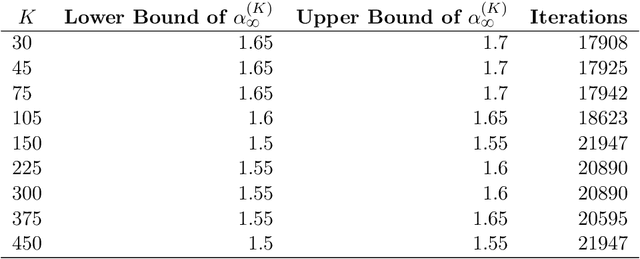
In this paper, we investigate the finite-sample statistical rates of distributional temporal difference (TD) learning with linear function approximation. The aim of distributional TD learning is to estimate the return distribution of a discounted Markov decision process for a given policy {\pi}. Prior works on statistical analysis of distributional TD learning mainly focus on the tabular case. In contrast, we first consider the linear function approximation setting and derive sharp finite-sample rates. Our theoretical results demonstrate that the sample complexity of linear distributional TD learning matches that of the classic linear TD learning. This implies that, with linear function approximation, learning the full distribution of the return using streaming data is no more difficult than learning its expectation (i.e. the value function). To derive tight sample complexity bounds, we conduct a fine-grained analysis of the linear-categorical Bellman equation, and employ the exponential stability arguments for products of random matrices. Our findings provide new insights into the statistical efficiency of distributional reinforcement learning algorithms.
SUSTechGAN: Image Generation for Object Recognition in Adverse Conditions of Autonomous Driving
Jul 18, 2024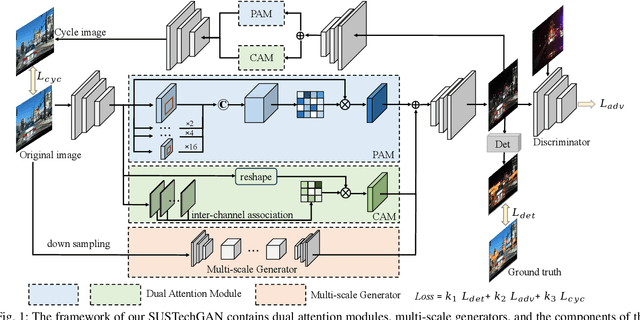
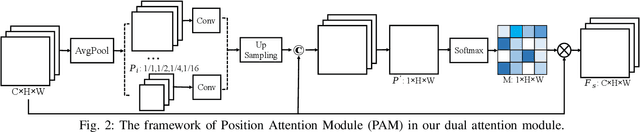
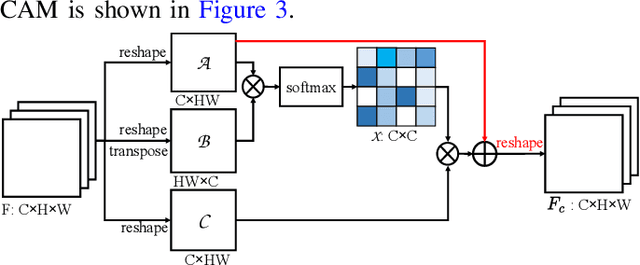

Autonomous driving significantly benefits from data-driven deep neural networks. However, the data in autonomous driving typically fits the long-tailed distribution, in which the critical driving data in adverse conditions is hard to collect. Although generative adversarial networks (GANs) have been applied to augment data for autonomous driving, generating driving images in adverse conditions is still challenging. In this work, we propose a novel SUSTechGAN with dual attention modules and multi-scale generators to generate driving images for improving object recognition of autonomous driving in adverse conditions. We test the SUSTechGAN and the existing well-known GANs to generate driving images in adverse conditions of rain and night and apply the generated images to retrain object recognition networks. Specifically, we add generated images into the training datasets to retrain the well-known YOLOv5 and evaluate the improvement of the retrained YOLOv5 for object recognition in adverse conditions. The experimental results show that the generated driving images by our SUSTechGAN significantly improved the performance of retrained YOLOv5 in rain and night conditions, which outperforms the well-known GANs. The open-source code, video description and datasets are available on the page 1 to facilitate image generation development in autonomous driving under adverse conditions.
Federated Control in Markov Decision Processes
May 07, 2024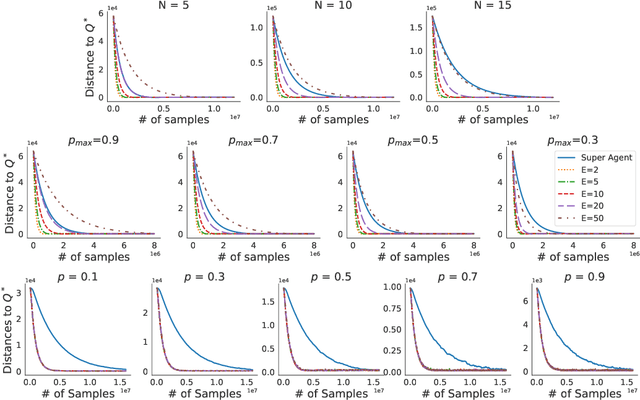


We study problems of federated control in Markov Decision Processes. To solve an MDP with large state space, multiple learning agents are introduced to collaboratively learn its optimal policy without communication of locally collected experience. In our settings, these agents have limited capabilities, which means they are restricted within different regions of the overall state space during the training process. In face of the difference among restricted regions, we firstly introduce concepts of leakage probabilities to understand how such heterogeneity affects the learning process, and then propose a novel communication protocol that we call Federated-Q protocol (FedQ), which periodically aggregates agents' knowledge of their restricted regions and accordingly modifies their learning problems for further training. In terms of theoretical analysis, we justify the correctness of FedQ as a communication protocol, then give a general result on sample complexity of derived algorithms FedQ-X with the RL oracle , and finally conduct a thorough study on the sample complexity of FedQ-SynQ. Specifically, FedQ-X has been shown to enjoy linear speedup in terms of sample complexity when workload is uniformly distributed among agents. Moreover, we carry out experiments in various environments to justify the efficiency of our methods.
Near Minimax-Optimal Distributional Temporal Difference Algorithms and The Freedman Inequality in Hilbert Spaces
Mar 14, 2024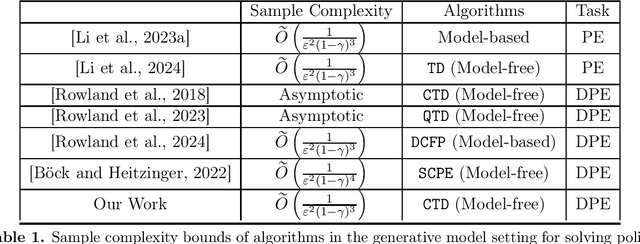
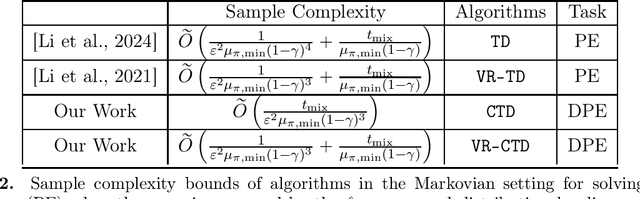
Distributional reinforcement learning (DRL) has achieved empirical success in various domains. One of the core tasks in the field of DRL is distributional policy evaluation, which involves estimating the return distribution $\eta^\pi$ for a given policy $\pi$. The distributional temporal difference (TD) algorithm has been accordingly proposed, which is an extension of the temporal difference algorithm in the classic RL literature. In the tabular case, \citet{rowland2018analysis} and \citet{rowland2023analysis} proved the asymptotic convergence of two instances of distributional TD, namely categorical temporal difference algorithm (CTD) and quantile temporal difference algorithm (QTD), respectively. In this paper, we go a step further and analyze the finite-sample performance of distributional TD. To facilitate theoretical analysis, we propose a non-parametric distributional TD algorithm (NTD). For a $\gamma$-discounted infinite-horizon tabular Markov decision process, we show that for NTD we need $\tilde{O}\left(\frac{1}{\varepsilon^{2p}(1-\gamma)^{2p+1}}\right)$ iterations to achieve an $\varepsilon$-optimal estimator with high probability, when the estimation error is measured by the $p$-Wasserstein distance. This sample complexity bound is minimax optimal (up to logarithmic factors) in the case of the $1$-Wasserstein distance. To achieve this, we establish a novel Freedman's inequality in Hilbert spaces, which would be of independent interest. In addition, we revisit CTD, showing that the same non-asymptotic convergence bounds hold for CTD in the case of the $p$-Wasserstein distance.
Deep learning for 3D Object Detection and Tracking in Autonomous Driving: A Brief Survey
Nov 10, 2023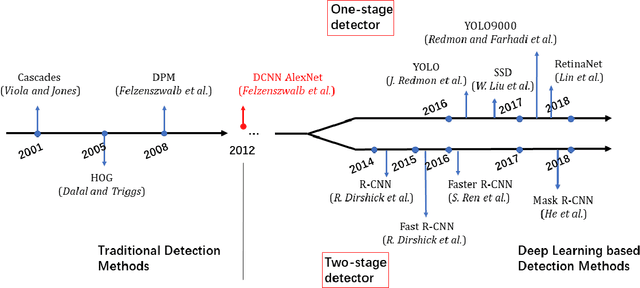
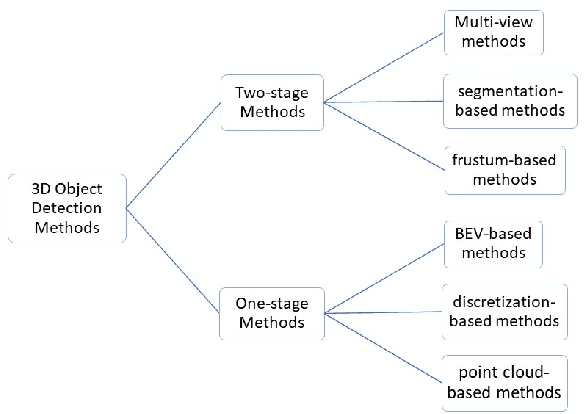
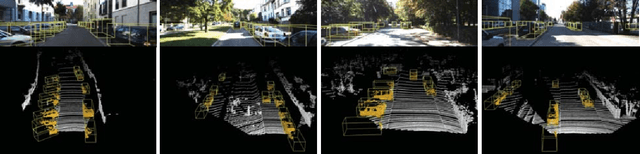
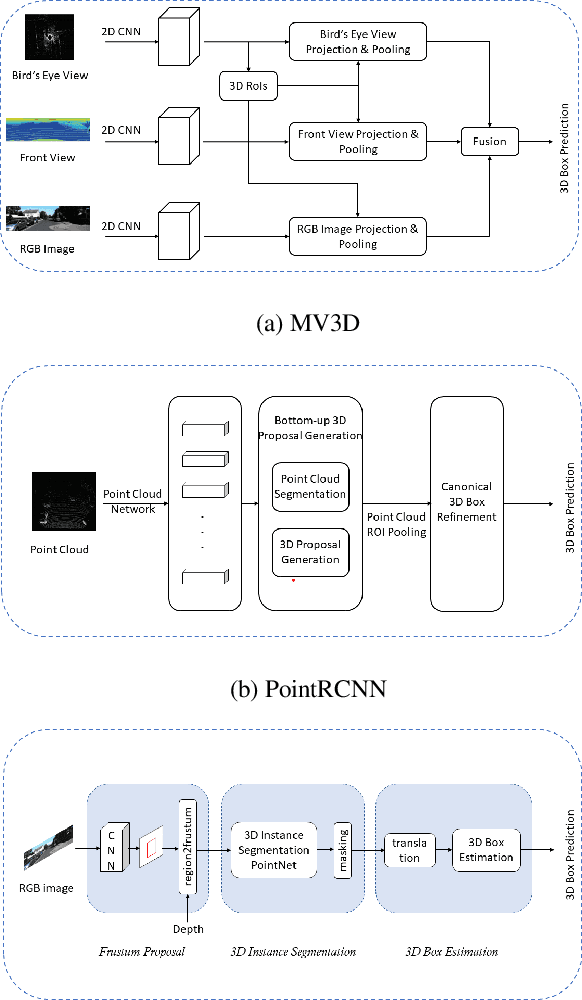
Object detection and tracking are vital and fundamental tasks for autonomous driving, aiming at identifying and locating objects from those predefined categories in a scene. 3D point cloud learning has been attracting more and more attention among all other forms of self-driving data. Currently, there are many deep learning methods for 3D object detection. However, the tasks of object detection and tracking for point clouds still need intensive study due to the unique characteristics of point cloud data. To help get a good grasp of the present situation of this research, this paper shows recent advances in deep learning methods for 3D object detection and tracking.
Estimation and Inference in Distributional Reinforcement Learning
Sep 29, 2023

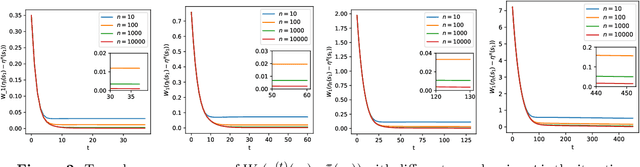

In this paper, we study distributional reinforcement learning from the perspective of statistical efficiency. We investigate distributional policy evaluation, aiming to estimate the complete distribution of the random return (denoted $\eta^\pi$) attained by a given policy $\pi$. We use the certainty-equivalence method to construct our estimator $\hat\eta^\pi$, given a generative model is available. We show that in this circumstance we need a dataset of size $\widetilde O\left(\frac{|\mathcal{S}||\mathcal{A}|}{\epsilon^{2p}(1-\gamma)^{2p+2}}\right)$ to guarantee a $p$-Wasserstein metric between $\hat\eta^\pi$ and $\eta^\pi$ is less than $\epsilon$ with high probability. This implies the distributional policy evaluation problem can be solved with sample efficiency. Also, we show that under different mild assumptions a dataset of size $\widetilde O\left(\frac{|\mathcal{S}||\mathcal{A}|}{\epsilon^{2}(1-\gamma)^{4}}\right)$ suffices to ensure the Kolmogorov metric and total variation metric between $\hat\eta^\pi$ and $\eta^\pi$ is below $\epsilon$ with high probability. Furthermore, we investigate the asymptotic behavior of $\hat\eta^\pi$. We demonstrate that the ``empirical process'' $\sqrt{n}(\hat\eta^\pi-\eta^\pi)$ converges weakly to a Gaussian process in the space of bounded functionals on Lipschitz function class $\ell^\infty(\mathcal{F}_{W_1})$, also in the space of bounded functionals on indicator function class $\ell^\infty(\mathcal{F}_{\mathrm{KS}})$ and bounded measurable function class $\ell^\infty(\mathcal{F}_{\mathrm{TV}})$ when some mild conditions hold. Our findings give rise to a unified approach to statistical inference of a wide class of statistical functionals of $\eta^\pi$.