 Add to Chrome
 Add to Firefox
 Add to Edge
Cognitive Chunking for Soft Prompts: Accelerating Compressor Learning via Block-wise Causal Masking
Feb 15, 2026
Providing extensive context via prompting is vital for leveraging the capabilities of Large Language Models (LLMs). However, lengthy contexts significantly increase inference latency, as the computational cost of self-attention grows quadratically with sequence length. To mitigate this issue, context compression-particularly soft prompt compressio-has emerged as a widely studied solution, which converts long contexts into shorter memory embeddings via a trained compressor. Existing methods typically compress the entire context indiscriminately into a set of memory tokens, requiring the compressor to capture global dependencies and necessitating extensive pre-training data to learn effective patterns. Inspired by the chunking mechanism in human working memory and empirical observations of the spatial specialization of memory embeddings relative to original tokens, we propose Parallelized Iterative Compression (PIC). By simply modifying the Transformer's attention mask, PIC explicitly restricts the receptive field of memory tokens to sequential local chunks, thereby lowering the difficulty of compressor training. Experiments across multiple downstream tasks demonstrate that PIC consistently outperforms competitive baselines, with superiority being particularly pronounced in high compression scenarios (e.g., achieving relative improvements of 29.8\% in F1 score and 40.7\% in EM score on QA tasks at the $64\times$ compression ratio). Furthermore, PIC significantly expedites the training process. Specifically, when training the 16$\times$ compressor, it surpasses the peak performance of the competitive baseline while effectively reducing the training time by approximately 40\%.

Fast Flow Matching based Conditional Independence Tests for Causal Discovery
Feb 09, 2026Constraint-based causal discovery methods require a large number of conditional independence (CI) tests, which severely limits their practical applicability due to high computational complexity. Therefore, it is crucial to design an algorithm that accelerates each individual test. To this end, we propose the Flow Matching-based Conditional Independence Test (FMCIT). The proposed test leverages the high computational efficiency of flow matching and requires the model to be trained only once throughout the entire causal discovery procedure, substantially accelerating causal discovery. According to numerical experiments, FMCIT effectively controls type-I error and maintains high testing power under the alternative hypothesis, even in the presence of high-dimensional conditioning sets. In addition, we further integrate FMCIT into a two-stage guided PC skeleton learning framework, termed GPC-FMCIT, which combines fast screening with guided, budgeted refinement using FMCIT. This design yields explicit bounds on the number of CI queries while maintaining high statistical power. Experiments on synthetic and real-world causal discovery tasks demonstrate favorable accuracy-efficiency trade-offs over existing CI testing methods and PC variants.
Diffusion Models with Double Guidance: Generate with aggregated datasets
May 19, 2025Creating large-scale datasets for training high-performance generative models is often prohibitively expensive, especially when associated attributes or annotations must be provided. As a result, merging existing datasets has become a common strategy. However, the sets of attributes across datasets are often inconsistent, and their naive concatenation typically leads to block-wise missing conditions. This presents a significant challenge for conditional generative modeling when the multiple attributes are used jointly as conditions, thereby limiting the model's controllability and applicability. To address this issue, we propose a novel generative approach, Diffusion Model with Double Guidance, which enables precise conditional generation even when no training samples contain all conditions simultaneously. Our method maintains rigorous control over multiple conditions without requiring joint annotations. We demonstrate its effectiveness in molecular and image generation tasks, where it outperforms existing baselines both in alignment with target conditional distributions and in controllability under missing condition settings.
Conditional Diffusion Models Based Conditional Independence Testing
Dec 16, 2024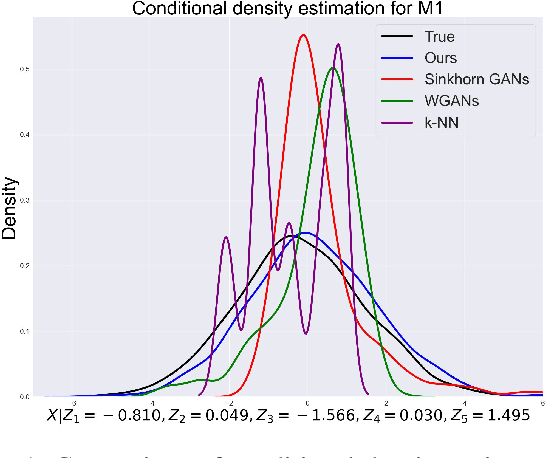


Conditional independence (CI) testing is a fundamental task in modern statistics and machine learning. The conditional randomization test (CRT) was recently introduced to test whether two random variables, $X$ and $Y$, are conditionally independent given a potentially high-dimensional set of random variables, $Z$. The CRT operates exceptionally well under the assumption that the conditional distribution $X|Z$ is known. However, since this distribution is typically unknown in practice, accurately approximating it becomes crucial. In this paper, we propose using conditional diffusion models (CDMs) to learn the distribution of $X|Z$. Theoretically and empirically, it is shown that CDMs closely approximate the true conditional distribution. Furthermore, CDMs offer a more accurate approximation of $X|Z$ compared to GANs, potentially leading to a CRT that performs better than those based on GANs. To accommodate complex dependency structures, we utilize a computationally efficient classifier-based conditional mutual information (CMI) estimator as our test statistic. The proposed testing procedure performs effectively without requiring assumptions about specific distribution forms or feature dependencies, and is capable of handling mixed-type conditioning sets that include both continuous and discrete variables. Theoretical analysis shows that our proposed test achieves a valid control of the type I error. A series of experiments on synthetic data demonstrates that our new test effectively controls both type-I and type-II errors, even in high dimensional scenarios.
Confidence interval estimation of mixed oil length with conditional diffusion model
Jun 19, 2024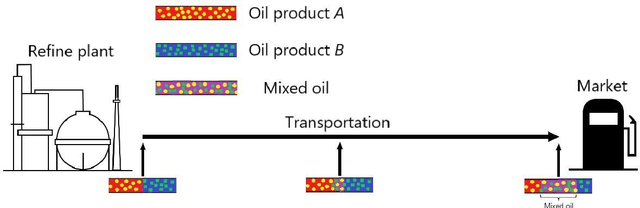

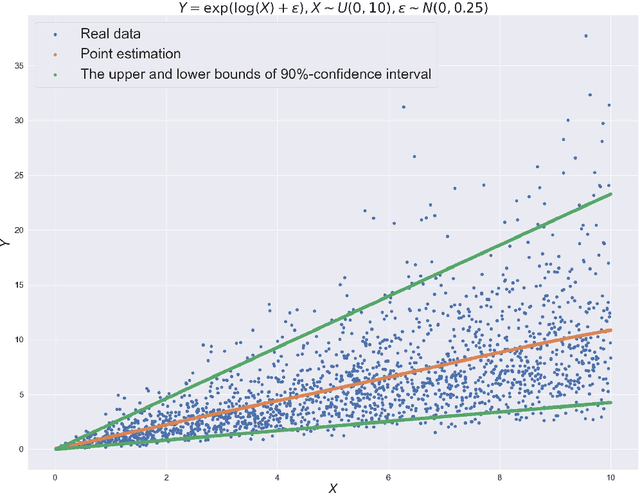
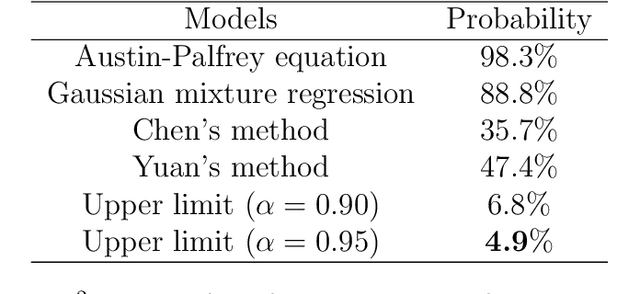
Accurately estimating the mixed oil length plays a big role in the economic benefit for oil pipeline network. While various proposed methods have tried to predict the mixed oil length, they often exhibit an extremely high probability (around 50\%) of underestimating it. This is attributed to their failure to consider the statistical variability inherent in the estimated length of mixed oil. To address such issues, we propose to use the conditional diffusion model to learn the distribution of the mixed oil length given pipeline features. Subsequently, we design a confidence interval estimation for the length of the mixed oil based on the pseudo-samples generated by the learned diffusion model. To our knowledge, we are the first to present an estimation scheme for confidence interval of the oil-mixing length that considers statistical variability, thereby reducing the possibility of underestimating it. When employing the upper bound of the interval as a reference for excluding the mixed oil, the probability of underestimation can be as minimal as 5\%, a substantial reduction compared to 50\%. Furthermore, utilizing the mean of the generated pseudo samples as the estimator for the mixed oil length enhances prediction accuracy by at least 10\% compared to commonly used methods.