 Add to Chrome
 Add to Firefox
 Add to Edge
BUFF: Bayesian Uncertainty Guided Diffusion Probabilistic Model for Single Image Super-Resolution
Apr 04, 2025
Super-resolution (SR) techniques are critical for enhancing image quality, particularly in scenarios where high-resolution imagery is essential yet limited by hardware constraints. Existing diffusion models for SR have relied predominantly on Gaussian models for noise generation, which often fall short when dealing with the complex and variable texture inherent in natural scenes. To address these deficiencies, we introduce the Bayesian Uncertainty Guided Diffusion Probabilistic Model (BUFF). BUFF distinguishes itself by incorporating a Bayesian network to generate high-resolution uncertainty masks. These masks guide the diffusion process, allowing for the adjustment of noise intensity in a manner that is both context-aware and adaptive. This novel approach not only enhances the fidelity of super-resolved images to their original high-resolution counterparts but also significantly mitigates artifacts and blurring in areas characterized by complex textures and fine details. The model demonstrates exceptional robustness against complex noise patterns and showcases superior adaptability in handling textures and edges within images. Empirical evidence, supported by visual results, illustrates the model's robustness, especially in challenging scenarios, and its effectiveness in addressing common SR issues such as blurring. Experimental evaluations conducted on the DIV2K dataset reveal that BUFF achieves a notable improvement, with a +0.61 increase compared to baseline in SSIM on BSD100, surpassing traditional diffusion approaches by an average additional +0.20dB PSNR gain. These findings underscore the potential of Bayesian methods in enhancing diffusion processes for SR, paving the way for future advancements in the field.

Conversational Agents for Older Adults' Health: A Systematic Literature Review
Mar 29, 2025There has been vast literature that studies Conversational Agents (CAs) in facilitating older adults' health. The vast and diverse studies warrants a comprehensive review that concludes the main findings and proposes research directions for future studies, while few literature review did it from human-computer interaction (HCI) perspective. In this study, we present a survey of existing studies on CAs for older adults' health. Through a systematic review of 72 papers, this work reviewed previously studied older adults' characteristics and analyzed participants' experiences and expectations of CAs for health. We found that (1) Past research has an increasing interest on chatbots and voice assistants and applied CA as multiple roles in older adults' health. (2) Older adults mainly showed low acceptance CAs for health due to various reasons, such as unstable effects, harm to independence, and privacy concerns. (3) Older adults expect CAs to be able to support multiple functions, to communicate using natural language, to be personalized, and to allow users full control. We also discuss the implications based on the findings.
Improving Equivariant Networks with Probabilistic Symmetry Breaking
Mar 27, 2025Equivariance encodes known symmetries into neural networks, often enhancing generalization. However, equivariant networks cannot break symmetries: the output of an equivariant network must, by definition, have at least the same self-symmetries as the input. This poses an important problem, both (1) for prediction tasks on domains where self-symmetries are common, and (2) for generative models, which must break symmetries in order to reconstruct from highly symmetric latent spaces. This fundamental limitation can be addressed by considering equivariant conditional distributions, instead of equivariant functions. We present novel theoretical results that establish necessary and sufficient conditions for representing such distributions. Concretely, this representation provides a practical framework for breaking symmetries in any equivariant network via randomized canonicalization. Our method, SymPE (Symmetry-breaking Positional Encodings), admits a simple interpretation in terms of positional encodings. This approach expands the representational power of equivariant networks while retaining the inductive bias of symmetry, which we justify through generalization bounds. Experimental results demonstrate that SymPE significantly improves performance of group-equivariant and graph neural networks across diffusion models for graphs, graph autoencoders, and lattice spin system modeling.
Energy-Efficient Federated Learning and Migration in Digital Twin Edge Networks
Mar 20, 2025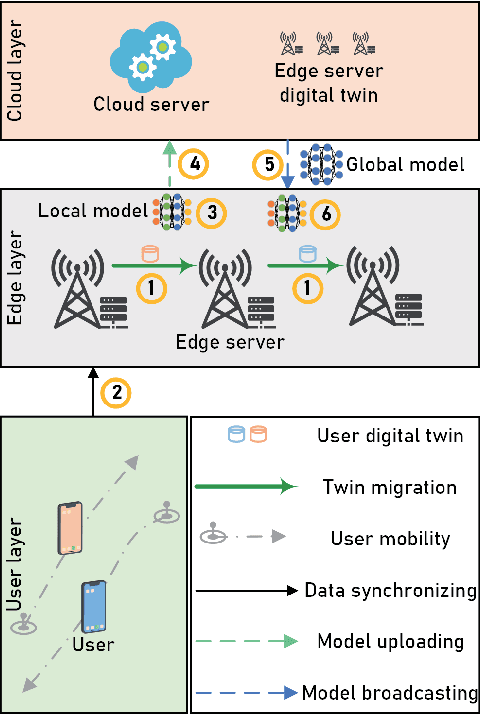
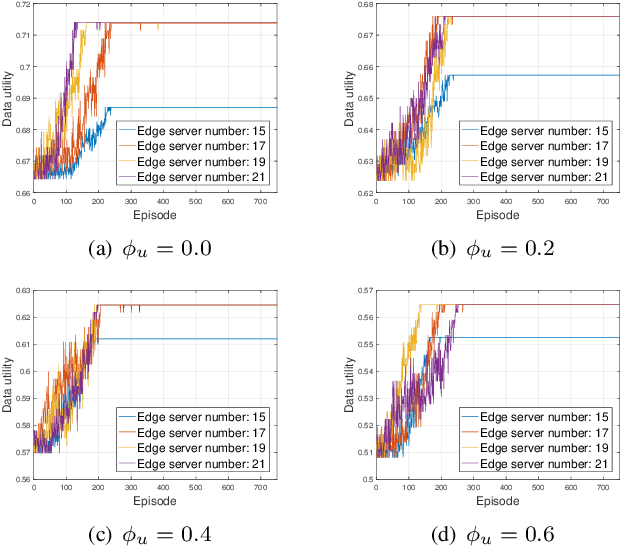
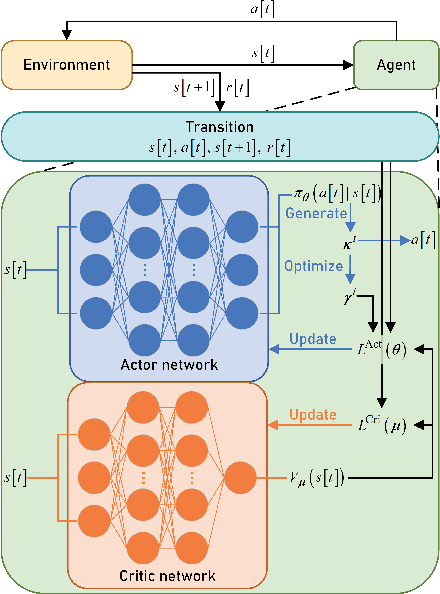
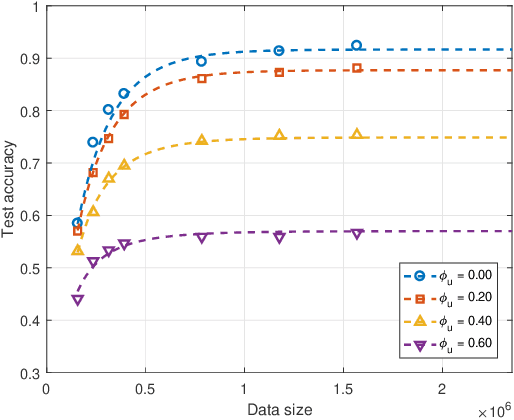
The digital twin edge network (DITEN) is a significant paradigm in the sixth-generation wireless system (6G) that aims to organize well-developed infrastructures to meet the requirements of evolving application scenarios. However, the impact of the interaction between the long-term DITEN maintenance and detailed digital twin tasks, which often entail privacy considerations, is commonly overlooked in current research. This paper addresses this issue by introducing a problem of digital twin association and historical data allocation for a federated learning (FL) task within DITEN. To achieve this goal, we start by introducing a closed-form function to predict the training accuracy of the FL task, referring to it as the data utility. Subsequently, we carry out comprehensive convergence analyses on the proposed FL methodology. Our objective is to jointly optimize the data utility of the digital twin-empowered FL task and the energy costs incurred by the long-term DITEN maintenance, encompassing FL model training, data synchronization, and twin migration. To tackle the aforementioned challenge, we present an optimization-driven learning algorithm that effectively identifies optimized solutions for the formulated problem. Numerical results demonstrate that our proposed algorithm outperforms various baseline approaches.
Gamma: Toward Generic Image Assessment with Mixture of Assessment Experts
Mar 09, 2025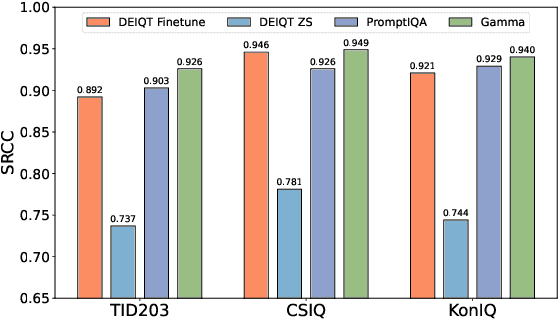
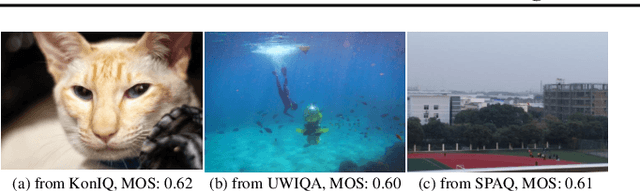
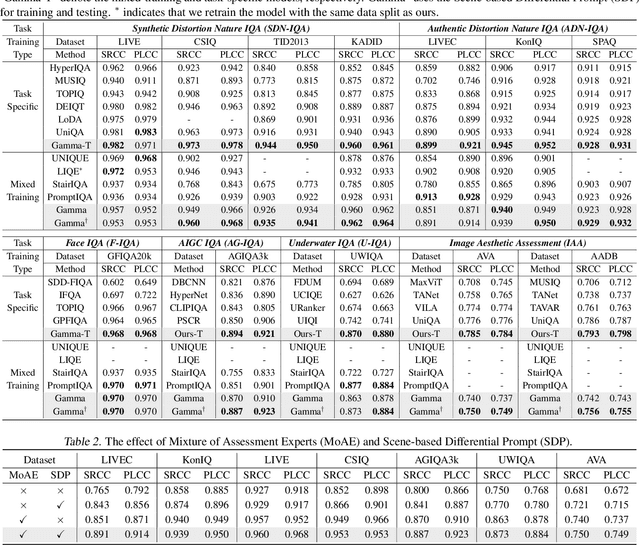
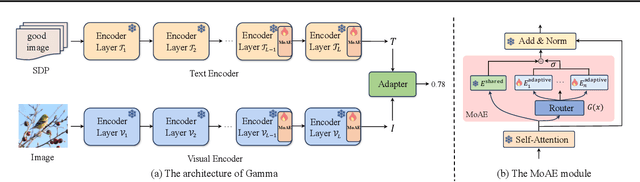
Image assessment aims to evaluate the quality and aesthetics of images and has been applied across various scenarios, such as natural and AIGC scenes. Existing methods mostly address these sub-tasks or scenes individually. While some works attempt to develop unified image assessment models, they have struggled to achieve satisfactory performance or cover a broad spectrum of assessment scenarios. In this paper, we present \textbf{Gamma}, a \textbf{G}eneric im\textbf{A}ge assess\textbf{M}ent model using \textbf{M}ixture of \textbf{A}ssessment Experts, which can effectively assess images from diverse scenes through mixed-dataset training. Achieving unified training in image assessment presents significant challenges due to annotation biases across different datasets. To address this issue, we first propose a Mixture of Assessment Experts (MoAE) module, which employs shared and adaptive experts to dynamically learn common and specific knowledge for different datasets, respectively. In addition, we introduce a Scene-based Differential Prompt (SDP) strategy, which uses scene-specific prompts to provide prior knowledge and guidance during the learning process, further boosting adaptation for various scenes. Our Gamma model is trained and evaluated on 12 datasets spanning 6 image assessment scenarios. Extensive experiments show that our unified Gamma outperforms other state-of-the-art mixed-training methods by significant margins while covering more scenes. Code: https://github.com/zht8506/Gamma.
A Comparative Study of Diabetes Prediction Based on Lifestyle Factors Using Machine Learning
Mar 06, 2025Diabetes is a prevalent chronic disease with significant health and economic burdens worldwide. Early prediction and diagnosis can aid in effective management and prevention of complications. This study explores the use of machine learning models to predict diabetes based on lifestyle factors using data from the Behavioral Risk Factor Surveillance System (BRFSS) 2015 survey. The dataset consists of 21 lifestyle and health-related features, capturing aspects such as physical activity, diet, mental health, and socioeconomic status. Three classification models, Decision Tree, K-Nearest Neighbors (KNN), and Logistic Regression, are implemented and evaluated to determine their predictive performance. The models are trained and tested using a balanced dataset, and their performances are assessed based on accuracy, precision, recall, and F1-score. The results indicate that the Decision Tree, KNN, and Logistic Regression achieve an accuracy of 0.74, 0.72, and 0.75, respectively, with varying strengths in precision and recall. The findings highlight the potential of machine learning in diabetes prediction and suggest future improvements through feature selection and ensemble learning techniques.
Underlying Semantic Diffusion for Effective and Efficient In-Context Learning
Mar 06, 2025


Diffusion models has emerged as a powerful framework for tasks like image controllable generation and dense prediction. However, existing models often struggle to capture underlying semantics (e.g., edges, textures, shapes) and effectively utilize in-context learning, limiting their contextual understanding and image generation quality. Additionally, high computational costs and slow inference speeds hinder their real-time applicability. To address these challenges, we propose Underlying Semantic Diffusion (US-Diffusion), an enhanced diffusion model that boosts underlying semantics learning, computational efficiency, and in-context learning capabilities on multi-task scenarios. We introduce Separate & Gather Adapter (SGA), which decouples input conditions for different tasks while sharing the architecture, enabling better in-context learning and generalization across diverse visual domains. We also present a Feedback-Aided Learning (FAL) framework, which leverages feedback signals to guide the model in capturing semantic details and dynamically adapting to task-specific contextual cues. Furthermore, we propose a plug-and-play Efficient Sampling Strategy (ESS) for dense sampling at time steps with high-noise levels, which aims at optimizing training and inference efficiency while maintaining strong in-context learning performance. Experimental results demonstrate that US-Diffusion outperforms the state-of-the-art method, achieving an average reduction of 7.47 in FID on Map2Image tasks and an average reduction of 0.026 in RMSE on Image2Map tasks, while achieving approximately 9.45 times faster inference speed. Our method also demonstrates superior training efficiency and in-context learning capabilities, excelling in new datasets and tasks, highlighting its robustness and adaptability across diverse visual domains.
A Method for Evaluating the Interpretability of Machine Learning Models in Predicting Bond Default Risk Based on LIME and SHAP
Feb 26, 2025Interpretability analysis methods for artificial intelligence models, such as LIME and SHAP, are widely used, though they primarily serve as post-model for analyzing model outputs. While it is commonly believed that the transparency and interpretability of AI models diminish as their complexity increases, currently there is no standardized method for assessing the inherent interpretability of the models themselves. This paper uses bond market default prediction as a case study, applying commonly used machine learning algorithms within AI models. First, the classification performance of these algorithms in default prediction is evaluated. Then, leveraging LIME and SHAP to assess the contribution of sample features to prediction outcomes, the paper proposes a novel method for evaluating the interpretability of the models themselves. The results of this analysis are consistent with the intuitive understanding and logical expectations regarding the interpretability of these models.
Generating $π$-Functional Molecules Using STGG+ with Active Learning
Feb 20, 2025Generating novel molecules with out-of-distribution properties is a major challenge in molecular discovery. While supervised learning methods generate high-quality molecules similar to those in a dataset, they struggle to generalize to out-of-distribution properties. Reinforcement learning can explore new chemical spaces but often conducts 'reward-hacking' and generates non-synthesizable molecules. In this work, we address this problem by integrating a state-of-the-art supervised learning method, STGG+, in an active learning loop. Our approach iteratively generates, evaluates, and fine-tunes STGG+ to continuously expand its knowledge. We denote this approach STGG+AL. We apply STGG+AL to the design of organic $\pi$-functional materials, specifically two challenging tasks: 1) generating highly absorptive molecules characterized by high oscillator strength and 2) designing absorptive molecules with reasonable oscillator strength in the near-infrared (NIR) range. The generated molecules are validated and rationalized in-silico with time-dependent density functional theory. Our results demonstrate that our method is highly effective in generating novel molecules with high oscillator strength, contrary to existing methods such as reinforcement learning (RL) methods. We open-source our active-learning code along with our Conjugated-xTB dataset containing 2.9 million $\pi$-conjugated molecules and the function for approximating the oscillator strength and absorption wavelength (based on sTDA-xTB).
A Theory for Conditional Generative Modeling on Multiple Data Sources
Feb 20, 2025The success of large generative models has driven a paradigm shift, leveraging massive multi-source data to enhance model capabilities. However, the interaction among these sources remains theoretically underexplored. This paper takes the first step toward a rigorous analysis of multi-source training in conditional generative modeling, where each condition represents a distinct data source. Specifically, we establish a general distribution estimation error bound in average total variation distance for conditional maximum likelihood estimation based on the bracketing number. Our result shows that when source distributions share certain similarities and the model is expressive enough, multi-source training guarantees a sharper bound than single-source training. We further instantiate the general theory on conditional Gaussian estimation and deep generative models including autoregressive and flexible energy-based models, by characterizing their bracketing numbers. The results highlight that the number of sources and similarity among source distributions improve the advantage of multi-source training. Simulations and real-world experiments validate our theory. Code is available at: \url{https://github.com/ML-GSAI/Multi-Source-GM}.