 Add to Chrome
 Add to Firefox
 Add to Edge
MiniMax Sparse Attention
Jun 11, 2026
Ultra-long-context capability is becoming indispensable for frontier LLMs: agentic workflows, repository-scale code reasoning, and persistent memory all require the model to jointly attend over hundreds of thousands to millions of tokens, yet the quadratic cost of softmax attention makes this untenable at deployment scale. We introduce MiniMax Sparse Attention (MSA), a blockwise sparse attention built upon Grouped Query Attention (GQA). A lightweight Index Branch scores key-value blocks and independently selects a Top-k subset for each GQA group, enabling group-specific sparse retrieval while maintaining efficient block-level execution; the Main Branch then performs exact block-sparse attention over only the selected blocks. Designed around a principle of simplicity and scalability, MSA is deliberately streamlined, making it straightforward to deploy efficiently across a broad range of GPUs. To translate sparsity into practical speedups, we co-design MSA with a GPU execution path that uses exp-free Top-k selection and KV-outer sparse attention to improve tensor-core utilization under block-granular access. On a 109B-parameter model with native multimodal training, MSA performs on par with GQA while reducing per-token attention compute by 28.4x at 1M context. Paired with our co-designed kernel, MSA achieves 14.2x prefill and 7.6x decoding wall-clock speedups on H800. Our inference kernel is available at: https://github.com/MiniMax-AI/MSA. A production-grade natively multimodal model powered by MSA has been publicly released at: https://huggingface.co/MiniMaxAI/MiniMax-M3.

The MiniMax-M2 Series: Mini Activations Unleashing Max Real-World Intelligence
May 26, 2026We introduce the MiniMax-M2 series, a family of Mixture-of-Experts language models built around the principle that mini activations can unleash maximum real-world intelligence. The flagship M2 contains 229.9B total parameters with only 9.8B activated per token. Designed end-to-end for agentic deployment, the M2 series rests on three components: (i) agent-driven data pipelines producing large-scale, verifiable trajectories across agentic coding and agentic cowork, each grounded in an executable workspace and an artifact-aligned reward; (ii) Forge, a scalable agent-native RL system that adapts to long-horizon agent trajectories, paired with windowed-FIFO scheduling, prefix-tree merging, inference optimization, and a clean training-inference-agent decoupling that supports both white-box and black-box agents; (iii) the latest M2.7 checkpoint takes an early step toward self-evolution -- autonomously debugging training runs and modifying its own scaffold. Across M2 through M2.7, this combination translates a mini-activation footprint into frontier-tier performance on agentic coding, deep search, office-task, and reasoning benchmarks.
Model Merging in Pre-training of Large Language Models
May 17, 2025Model merging has emerged as a promising technique for enhancing large language models, though its application in large-scale pre-training remains relatively unexplored. In this paper, we present a comprehensive investigation of model merging techniques during the pre-training process. Through extensive experiments with both dense and Mixture-of-Experts (MoE) architectures ranging from millions to over 100 billion parameters, we demonstrate that merging checkpoints trained with constant learning rates not only achieves significant performance improvements but also enables accurate prediction of annealing behavior. These improvements lead to both more efficient model development and significantly lower training costs. Our detailed ablation studies on merging strategies and hyperparameters provide new insights into the underlying mechanisms while uncovering novel applications. Through comprehensive experimental analysis, we offer the open-source community practical pre-training guidelines for effective model merging.
FlexPrefill: A Context-Aware Sparse Attention Mechanism for Efficient Long-Sequence Inference
Feb 28, 2025


Large language models (LLMs) encounter computational challenges during long-sequence inference, especially in the attention pre-filling phase, where the complexity grows quadratically with the prompt length. Previous efforts to mitigate these challenges have relied on fixed sparse attention patterns or identifying sparse attention patterns based on limited cases. However, these methods lacked the flexibility to efficiently adapt to varying input demands. In this paper, we introduce FlexPrefill, a Flexible sparse Pre-filling mechanism that dynamically adjusts sparse attention patterns and computational budget in real-time to meet the specific requirements of each input and attention head. The flexibility of our method is demonstrated through two key innovations: 1) Query-Aware Sparse Pattern Determination: By measuring Jensen-Shannon divergence, this component adaptively switches between query-specific diverse attention patterns and predefined attention patterns. 2) Cumulative-Attention Based Index Selection: This component dynamically selects query-key indexes to be computed based on different attention patterns, ensuring the sum of attention scores meets a predefined threshold. FlexPrefill adaptively optimizes the sparse pattern and sparse ratio of each attention head based on the prompt, enhancing efficiency in long-sequence inference tasks. Experimental results show significant improvements in both speed and accuracy over prior methods, providing a more flexible and efficient solution for LLM inference.
Fira: Can We Achieve Full-rank Training of LLMs Under Low-rank Constraint?
Oct 02, 2024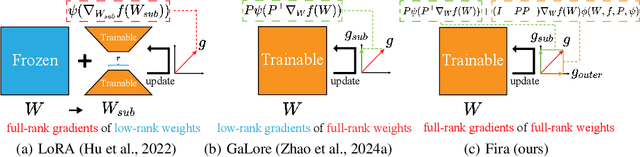
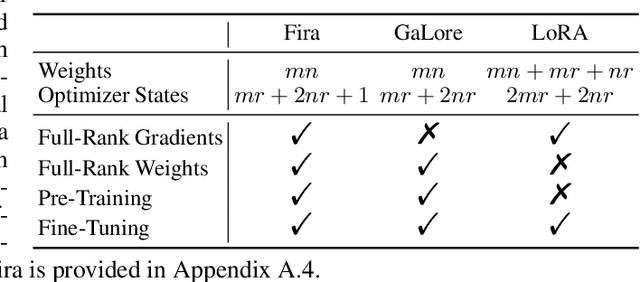
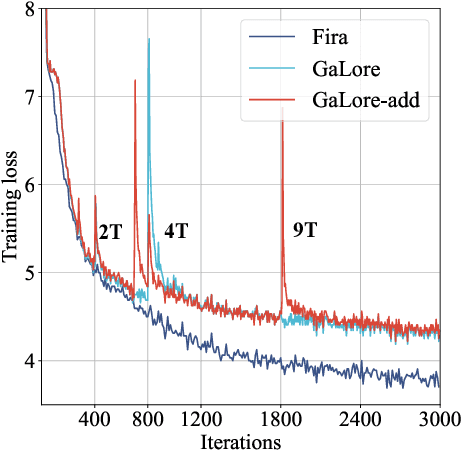
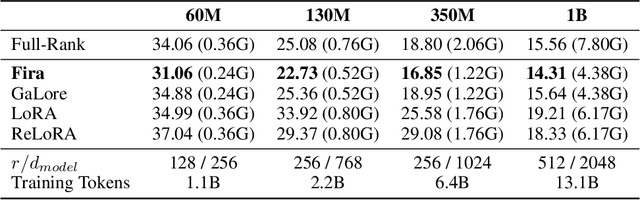
Low-rank training has emerged as a promising approach for reducing memory usage in training Large Language Models (LLMs). Previous methods either rely on decomposing weight matrices (e.g., LoRA), or seek to decompose gradient matrices (e.g., GaLore) to ensure reduced memory consumption. However, both of them constrain the training in a low-rank subspace, thus inevitably leading to sub-optimal performance. This raises a question: whether it is possible to consistently preserve the low-rank constraint for memory efficiency, while achieving full-rank training (i.e., training with full-rank gradients of full-rank weights) to avoid inferior outcomes? In this paper, we propose a new plug-and-play training framework for LLMs called Fira, as the first attempt to achieve this goal. First, we observe an interesting phenomenon during LLM training: the scaling impact of adaptive optimizers (e.g., Adam) on the gradient norm remains similar from low-rank to full-rank training. Based on this observation, we propose a norm-based scaling method, which utilizes the scaling impact of low-rank optimizers as substitutes for that of original full-rank optimizers to enable full-rank training. In this way, we can preserve the low-rank constraint in the optimizer while achieving full-rank training for better performance. Moreover, we find that there are sudden gradient rises during the optimization process, potentially causing loss spikes. To address this, we further put forward a norm-growth limiter to smooth the gradient via regulating the relative increase of gradient norms. Extensive experiments on the pre-training and fine-tuning of LLMs show that Fira outperforms both LoRA and GaLore, achieving performance that is comparable to or even better than full-rank training.