 Add to Chrome
 Add to Firefox
 Add to Edge
Post-Training Pruning for Diffusion Transformers
Jul 01, 2026
Diffusion Transformers (DiTs) have demonstrated impressive performance in image generation but suffer from substantial computational overhead and resource consumption. Post-training pruning offers a promising solution; however, due to DiTs' unique architectural design and parameter distribution, traditional pruning methods are inapplicable, leading to significant performance degradation. Specifically, prior methods developed for LLMs, which derive metrics through a series of approximations, amplify the relative contribution of weights in the saliency metric. In addition, weights in DiTs exhibit significantly larger magnitudes than those in LLMs. Moreover, existing pruning granularity overlooks variations in model structures. In this paper, we propose DiT-Pruning, which improves pruning performance by introducing customized saliency criteria and pruning granularity. We design a novel metric that balances the contributions of weights and activations from an energy-based perspective, enabling more effective identification of important elements. Furthermore, we observe distinct clustering patterns in the two-dimensional weight space. Accordingly, we adopt a clustering-aware pruning granularity, enabling effective sparse allocation. Extensive evaluations on various DiTs show that our method consistently preserves image quality, especially under high sparsity. For FLUX.1-dev at 512x512 resolution on MJHQ, DiT-Pruning achieves only a 0.001 loss in CLIP score at 50% sparsity, dramatically outperforming recent pruning methods.

Arena as Offline Reward: Efficient Fine-Grained Preference Optimization for Diffusion Models
May 07, 2026Reinforcement learning from human feedback (RLHF) effectively promotes preference alignment of text-to-image (T2I) diffusion models. To improve computational efficiency, direct preference optimization (DPO), which avoids explicit reward modeling, has been widely studied. However, its reliance on binary feedback limits it to coarse-grained modeling on chosen-rejected pairs, resulting in suboptimal optimization. In this paper, we propose ArenaPO, which leverages Arena scores as offline rewards to provide refined feedback, thus achieving efficient and fine-grained optimization without a reward model. This enables ArenaPO to benefit from both the rich rewards of traditional RLHF and the efficiency of DPO. Specifically, we first construct a model Arena in which each model's capability is represented as a Gaussian distribution, and infer these capabilities by traversing the annotated pairwise preferences. Each output image is treated as a sample from the corresponding capability distribution. Then, for a image pair, conditioned on the two capability distributions and the observed pairwise preference, the absolute quality gap is estimated using latent-variable inference based on truncated normal distribution, which serves as fine-grained feedback during training. It does not require a reward model and can be computed offline, thus introducing no additional training overhead. We conduct ArenaPO training on Pick-a-Pic v2 and HPD v3 datasets, showing that ArenaPO consistently outperforms existing baselines.
OSAQ: Outlier Self-Absorption for Accurate Low-bit LLM Quantization
May 06, 2026Large Language Models (LLMs) have demonstrated remarkable capabilities. However, their massive parameter scale leads to significant resource consumption and latency during inference. Post-training weight-only quantization offers a promising solution by reducing model size and accelerating token generation through alleviating the memory-bound issue. Nevertheless, the presence of inherent systematic outliers in weights continues to be a major obstacle. While existing methods, such as scaling and rotation, attempt to address this issue, the performance remains unsatisfactory. In this paper, we propose Outlier Self-Absorption Quantization (OSAQ), which performs additive weight suppression guided by the second-order low-rank property for low-bit weight-only quantization of LLMs. Specifically, we observe that the Hessian exhibits low-rank consistency across different inputs, with certain directions consistently showing vanishing curvature. Leveraging this property, we identify a stable null space of the Hessian and then construct an additive weight transformation by linearly combining the vectors within this null space, thereby suppressing weight outliers without affecting the task loss. This additive transformation can be absorbed into the weights offline, requiring no inter-layer transformations and introducing no inference overhead. Moreover, the construction is efficiently achieved by a closed-form solution, without resource-intensive training or iterative procedures. Extensive experiments demonstrate that OSAQ effectively suppresses outliers and enhances low-bit quantization performance. For instance, in 2-bit quantization, OSAQ, when integrated with GPTQ, achieves over 40% lower perplexity compared to vanilla GPTQ.
Sparsity Induction for Accurate Post-Training Pruning of Large Language Models
Feb 25, 2026Large language models have demonstrated capabilities in text generation, while their increasing parameter scales present challenges in computational and memory efficiency. Post-training sparsity (PTS), which reduces model cost by removing weights from dense networks, is an effective approach. However, native dense matrices lack high sparsity, making existing approaches that directly remove weights disrupt model states, resulting in unsatisfactory performance recovery even with post-tuning. We propose Sparsity Induction, which promotes models toward higher sparsity at both distribution and feature levels before pruning, to push the limits of PTS. At the distribution level, we enhance distributional sparsity through mathematically equivalent scaling transformations, which are fully absorbable and incur no extra parameters or inference-time overhead. At the feature level, we introduce Spectral Norm Loss to promote feature sparsity from a low-rank perspective. Experiments across diverse model architectures and tasks demonstrate that our method further enhances sparsity-friendliness, achieving superior pruning performance over existing approaches.
K-Sort Eval: Efficient Preference Evaluation for Visual Generation via Corrected VLM-as-a-Judge
Feb 10, 2026The rapid development of visual generative models raises the need for more scalable and human-aligned evaluation methods. While the crowdsourced Arena platforms offer human preference assessments by collecting human votes, they are costly and time-consuming, inherently limiting their scalability. Leveraging vision-language model (VLMs) as substitutes for manual judgments presents a promising solution. However, the inherent hallucinations and biases of VLMs hinder alignment with human preferences, thus compromising evaluation reliability. Additionally, the static evaluation approach lead to low efficiency. In this paper, we propose K-Sort Eval, a reliable and efficient VLM-based evaluation framework that integrates posterior correction and dynamic matching. Specifically, we curate a high-quality dataset from thousands of human votes in K-Sort Arena, with each instance containing the outputs and rankings of K models. When evaluating a new model, it undergoes (K+1)-wise free-for-all comparisons with existing models, and the VLM provide the rankings. To enhance alignment and reliability, we propose a posterior correction method, which adaptively corrects the posterior probability in Bayesian updating based on the consistency between the VLM prediction and human supervision. Moreover, we propose a dynamic matching strategy, which balances uncertainty and diversity to maximize the expected benefit of each comparison, thus ensuring more efficient evaluation. Extensive experiments show that K-Sort Eval delivers evaluation results consistent with K-Sort Arena, typically requiring fewer than 90 model runs, demonstrating both its efficiency and reliability.
Efficient-SAM2: Accelerating SAM2 with Object-Aware Visual Encoding and Memory Retrieval
Feb 09, 2026Segment Anything Model 2 (SAM2) shows excellent performance in video object segmentation tasks; however, the heavy computational burden hinders its application in real-time video processing. Although there have been efforts to improve the efficiency of SAM2, most of them focus on retraining a lightweight backbone, with little exploration into post-training acceleration. In this paper, we observe that SAM2 exhibits sparse perception pattern as biological vision, which provides opportunities for eliminating redundant computation and acceleration: i) In mask decoder, the attention primarily focuses on the foreground objects, whereas the image encoder in the earlier stage exhibits a broad attention span, which results in unnecessary computation to background regions. ii) In memory bank, only a small subset of tokens in each frame contribute significantly to memory attention, and the salient regions exhibit temporal consistency, making full-token computation redundant. With these insights, we propose Efficient-SAM2, which promotes SAM2 to adaptively focus on object regions while eliminating task-irrelevant computations, thereby significantly improving inference efficiency. Specifically, for image encoder, we propose object-aware Sparse Window Routing (SWR), a window-level computation allocation mechanism that leverages the consistency and saliency cues from the previous-frame decoder to route background regions into a lightweight shortcut branch. Moreover, for memory attention, we propose object-aware Sparse Memory Retrieval (SMR), which allows only the salient memory tokens in each frame to participate in computation, with the saliency pattern reused from their first recollection. With negligible additional parameters and minimal training overhead, Efficient-SAM2 delivers 1.68x speedup on SAM2.1-L model with only 1.0% accuracy drop on SA-V test set.
PTQ4ARVG: Post-Training Quantization for AutoRegressive Visual Generation Models
Jan 29, 2026AutoRegressive Visual Generation (ARVG) models retain an architecture compatible with language models, while achieving performance comparable to diffusion-based models. Quantization is commonly employed in neural networks to reduce model size and computational latency. However, applying quantization to ARVG remains largely underexplored, and existing quantization methods fail to generalize effectively to ARVG models. In this paper, we explore this issue and identify three key challenges: (1) severe outliers at channel-wise level, (2) highly dynamic activations at token-wise level, and (3) mismatched distribution information at sample-wise level. To these ends, we propose PTQ4ARVG, a training-free post-training quantization (PTQ) framework consisting of: (1) Gain-Projected Scaling (GPS) mitigates the channel-wise outliers, which expands the quantization loss via a Taylor series to quantify the gain of scaling for activation-weight quantization, and derives the optimal scaling factor through differentiation.(2) Static Token-Wise Quantization (STWQ) leverages the inherent properties of ARVG, fixed token length and position-invariant distribution across samples, to address token-wise variance without incurring dynamic calibration overhead.(3) Distribution-Guided Calibration (DGC) selects samples that contribute most to distributional entropy, eliminating the sample-wise distribution mismatch. Extensive experiments show that PTQ4ARVG can effectively quantize the ARVG family models to 8-bit and 6-bit while maintaining competitive performance. Code is available at http://github.com/BienLuky/PTQ4ARVG .
CacheQuant: Comprehensively Accelerated Diffusion Models
Mar 03, 2025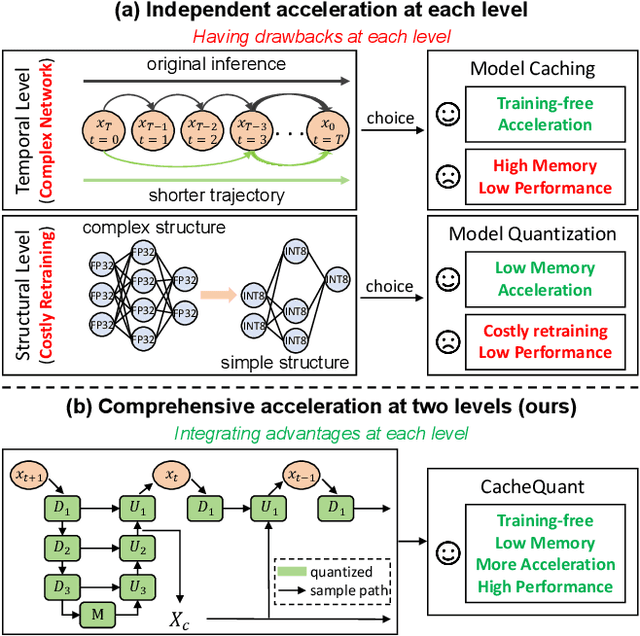
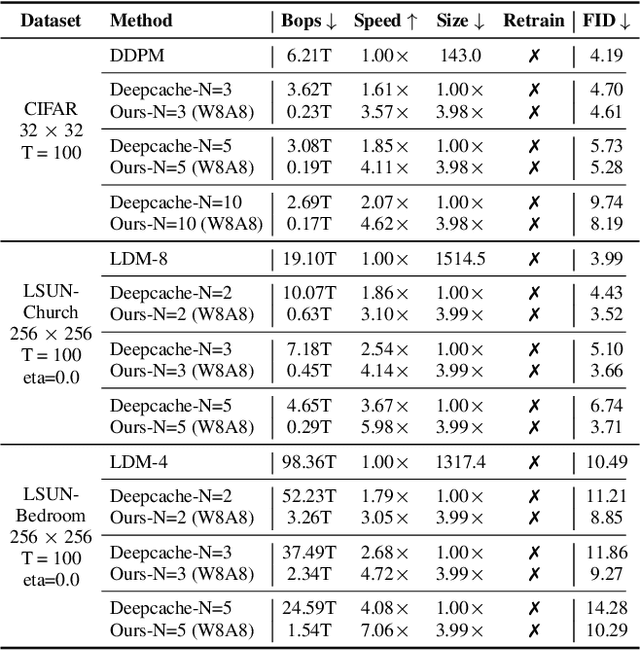
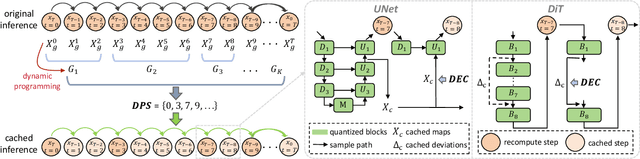
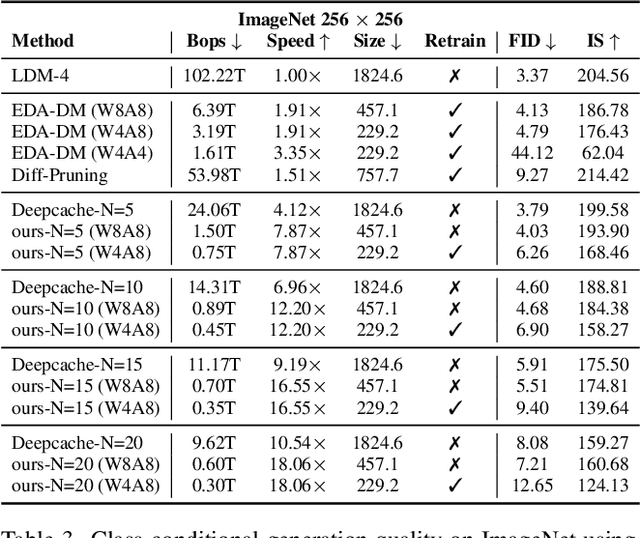
Diffusion models have gradually gained prominence in the field of image synthesis, showcasing remarkable generative capabilities. Nevertheless, the slow inference and complex networks, resulting from redundancy at both temporal and structural levels, hinder their low-latency applications in real-world scenarios. Current acceleration methods for diffusion models focus separately on temporal and structural levels. However, independent optimization at each level to further push the acceleration limits results in significant performance degradation. On the other hand, integrating optimizations at both levels can compound the acceleration effects. Unfortunately, we find that the optimizations at these two levels are not entirely orthogonal. Performing separate optimizations and then simply integrating them results in unsatisfactory performance. To tackle this issue, we propose CacheQuant, a novel training-free paradigm that comprehensively accelerates diffusion models by jointly optimizing model caching and quantization techniques. Specifically, we employ a dynamic programming approach to determine the optimal cache schedule, in which the properties of caching and quantization are carefully considered to minimize errors. Additionally, we propose decoupled error correction to further mitigate the coupled and accumulated errors step by step. Experimental results show that CacheQuant achieves a 5.18 speedup and 4 compression for Stable Diffusion on MS-COCO, with only a 0.02 loss in CLIP score. Our code are open-sourced: https://github.com/BienLuky/CacheQuant .
DilateQuant: Accurate and Efficient Diffusion Quantization via Weight Dilation
Sep 25, 2024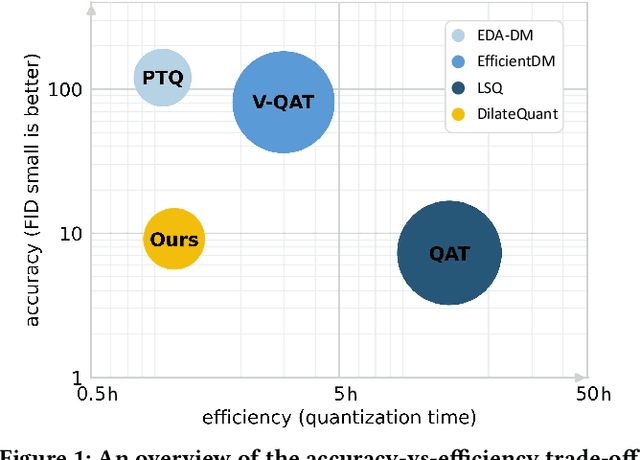
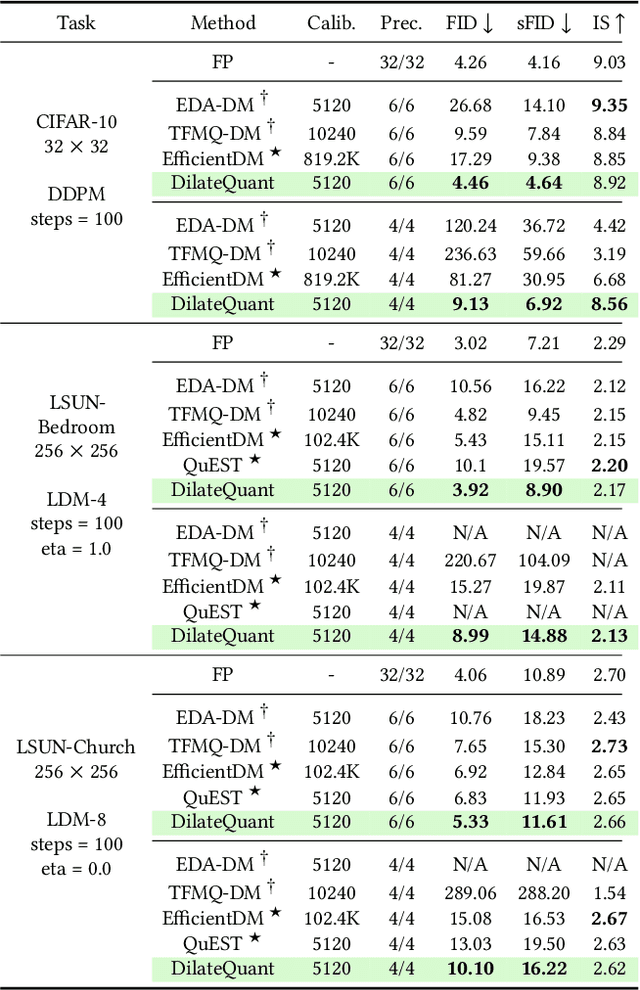
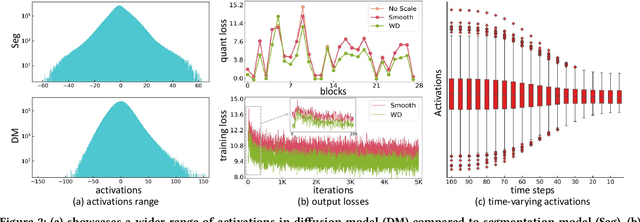
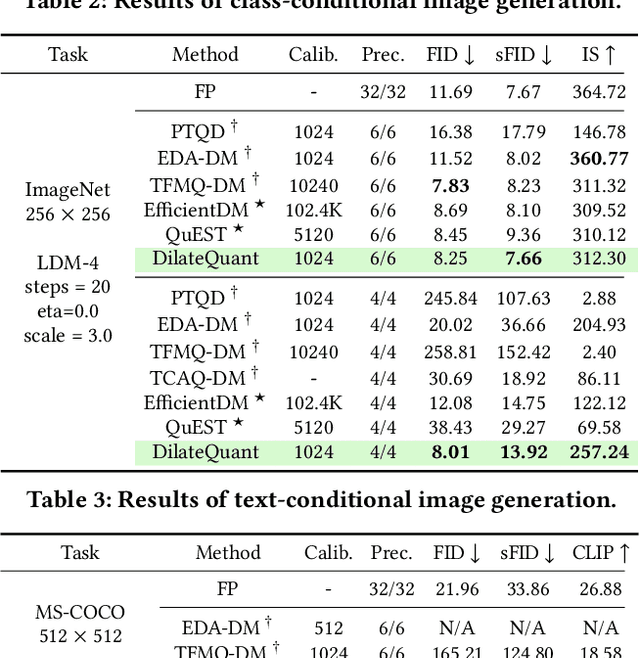
Diffusion models have shown excellent performance on various image generation tasks, but the substantial computational costs and huge memory footprint hinder their low-latency applications in real-world scenarios. Quantization is a promising way to compress and accelerate models. Nevertheless, due to the wide range and time-varying activations in diffusion models, existing methods cannot maintain both accuracy and efficiency simultaneously for low-bit quantization. To tackle this issue, we propose DilateQuant, a novel quantization framework for diffusion models that offers comparable accuracy and high efficiency. Specifically, we keenly aware of numerous unsaturated in-channel weights, which can be cleverly exploited to reduce the range of activations without additional computation cost. Based on this insight, we propose Weight Dilation (WD) that maximally dilates the unsaturated in-channel weights to a constrained range through a mathematically equivalent scaling. WD costlessly absorbs the activation quantization errors into weight quantization. The range of activations decreases, which makes activations quantization easy. The range of weights remains constant, which makes model easy to converge in training stage. Considering the temporal network leads to time-varying activations, we design a Temporal Parallel Quantizer (TPQ), which sets time-step quantization parameters and supports parallel quantization for different time steps, significantly improving the performance and reducing time cost. To further enhance performance while preserving efficiency, we introduce a Block-wise Knowledge Distillation (BKD) to align the quantized models with the full-precision models at a block level. The simultaneous training of time-step quantization parameters and weights minimizes the time required, and the shorter backpropagation paths decreases the memory footprint of the quantization process.
K-Sort Arena: Efficient and Reliable Benchmarking for Generative Models via K-wise Human Preferences
Aug 26, 2024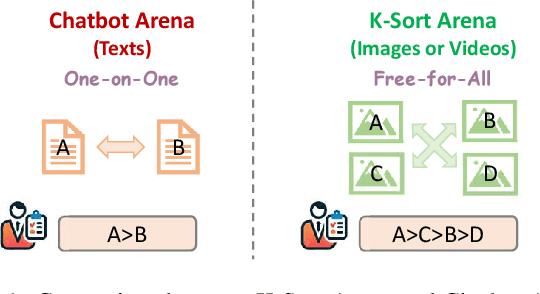

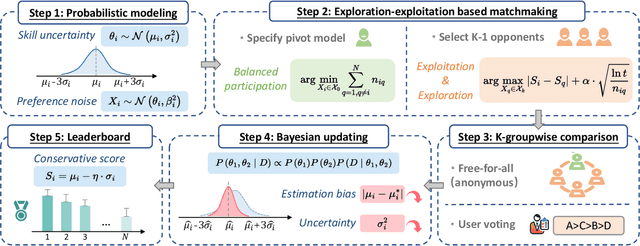
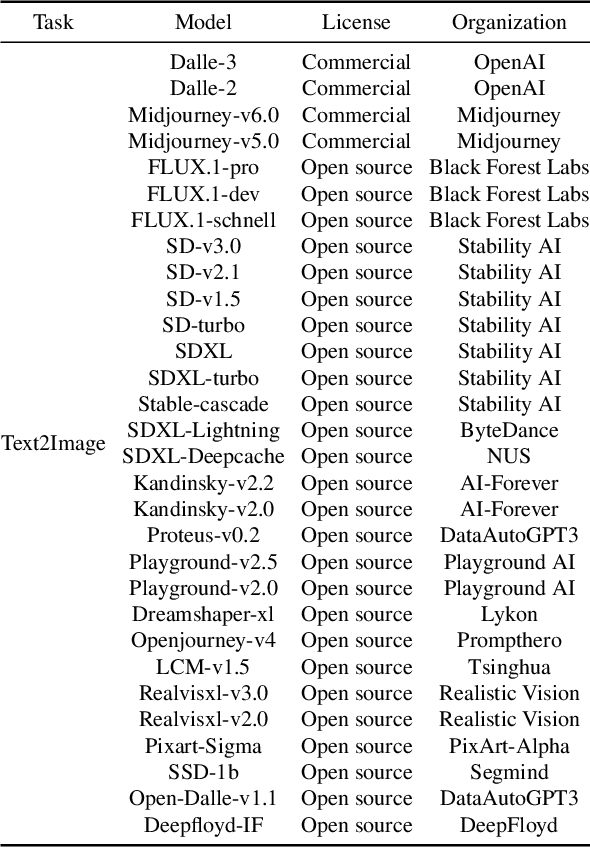
The rapid advancement of visual generative models necessitates efficient and reliable evaluation methods. Arena platform, which gathers user votes on model comparisons, can rank models with human preferences. However, traditional Arena methods, while established, require an excessive number of comparisons for ranking to converge and are vulnerable to preference noise in voting, suggesting the need for better approaches tailored to contemporary evaluation challenges. In this paper, we introduce K-Sort Arena, an efficient and reliable platform based on a key insight: images and videos possess higher perceptual intuitiveness than texts, enabling rapid evaluation of multiple samples simultaneously. Consequently, K-Sort Arena employs K-wise comparisons, allowing K models to engage in free-for-all competitions, which yield much richer information than pairwise comparisons. To enhance the robustness of the system, we leverage probabilistic modeling and Bayesian updating techniques. We propose an exploration-exploitation-based matchmaking strategy to facilitate more informative comparisons. In our experiments, K-Sort Arena exhibits 16.3x faster convergence compared to the widely used ELO algorithm. To further validate the superiority and obtain a comprehensive leaderboard, we collect human feedback via crowdsourced evaluations of numerous cutting-edge text-to-image and text-to-video models. Thanks to its high efficiency, K-Sort Arena can continuously incorporate emerging models and update the leaderboard with minimal votes. Our project has undergone several months of internal testing and is now available at https://huggingface.co/spaces/ksort/K-Sort-Arena