 Add to Chrome
 Add to Firefox
 Add to Edge
GRLoc: Geometric Representation Regression for Visual Localization
Nov 17, 2025
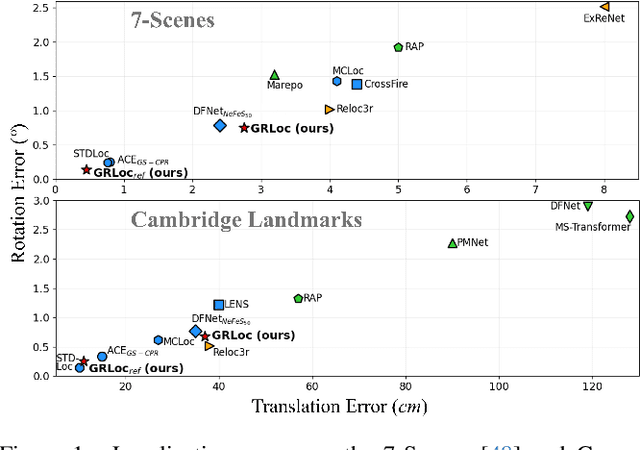
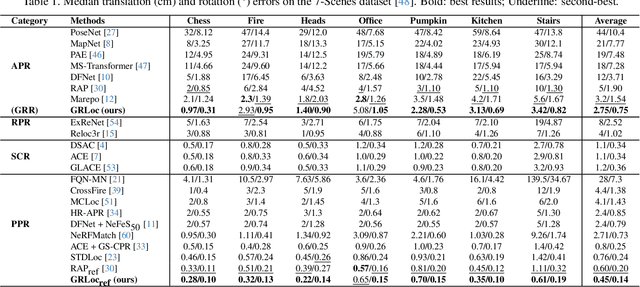
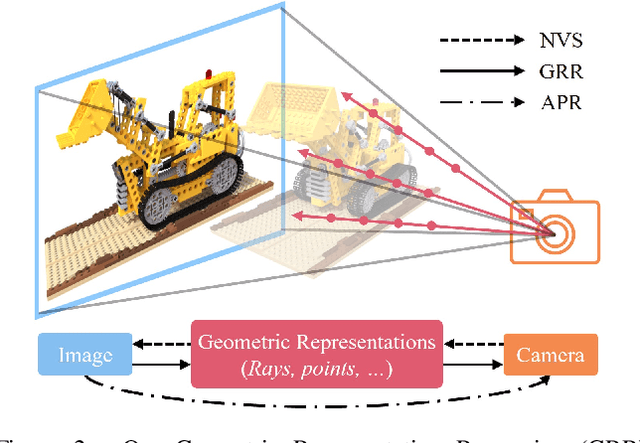
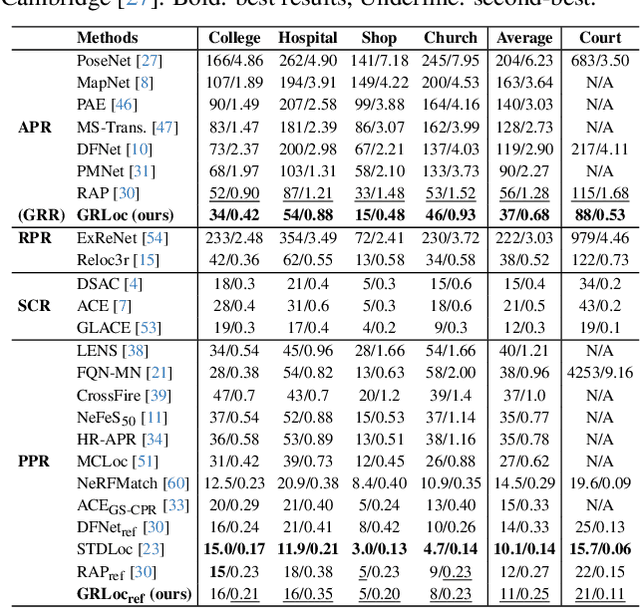
Absolute Pose Regression (APR) has emerged as a compelling paradigm for visual localization. However, APR models typically operate as black boxes, directly regressing a 6-DoF pose from a query image, which can lead to memorizing training views rather than understanding 3D scene geometry. In this work, we propose a geometrically-grounded alternative. Inspired by novel view synthesis, which renders images from intermediate geometric representations, we reformulate APR as its inverse that regresses the underlying 3D representations directly from the image, and we name this paradigm Geometric Representation Regression (GRR). Our model explicitly predicts two disentangled geometric representations in the world coordinate system: (1) a ray bundle's directions to estimate camera rotation, and (2) a corresponding pointmap to estimate camera translation. The final 6-DoF camera pose is then recovered from these geometric components using a differentiable deterministic solver. This disentangled approach, which separates the learned visual-to-geometry mapping from the final pose calculation, introduces a strong geometric prior into the network. We find that the explicit decoupling of rotation and translation predictions measurably boosts performance. We demonstrate state-of-the-art performance on 7-Scenes and Cambridge Landmarks datasets, validating that modeling the inverse rendering process is a more robust path toward generalizable absolute pose estimation.

User Feedback Alignment for LLM-powered Exploration in Large-scale Recommendation Systems
Apr 07, 2025Exploration, the act of broadening user experiences beyond their established preferences, is challenging in large-scale recommendation systems due to feedback loops and limited signals on user exploration patterns. Large Language Models (LLMs) offer potential by leveraging their world knowledge to recommend novel content outside these loops. A key challenge is aligning LLMs with user preferences while preserving their knowledge and reasoning. While using LLMs to plan for the next novel user interest, this paper introduces a novel approach combining hierarchical planning with LLM inference-time scaling to improve recommendation relevancy without compromising novelty. We decouple novelty and user-alignment, training separate LLMs for each objective. We then scale up the novelty-focused LLM's inference and select the best-of-n predictions using the user-aligned LLM. Live experiments demonstrate efficacy, showing significant gains in both user satisfaction (measured by watch activity and active user counts) and exploration diversity.