 Add to Chrome
 Add to Firefox
 Add to Edge
Discovering Efficient and Explainable Communication Topologies for LLM-based Multi-Agent Systems via Causal Inference
Aug 14, 2026
The performance of large language model (LLM)-based multi-agent systems (MAS) largely depends on effective communication topologies. Existing topology generation methods, however, typically learn communication topologies through black-box optimization driven solely by task-level rewards. While effective, such optimization provides little insight into why particular communication edges are selected, making it difficult to identify the critical communication subgraphs responsible for successful collaboration. To address this limitation, we propose E2-Explainer, a model-agnostic framework for providing interpretable explanations of communication topologies produced by arbitrary topology generators. Specifically, we formulate topology explanation as a causal attribution problem that identifies compact communication subgraphs supported by edge-level evidence of task preservation. We obtain this evidence with a Granger-style objective that measures how masking each communication channel changes the task outcome and the stability of the final response. The resulting budgeted subgraphs are then distilled into an amortized explainer, enabling efficient post-hoc explanation without repeated edge-level evaluations at deployment. Extensive experiments on multiple reasoning and coding benchmarks demonstrate that E2-Explainer identifies critical communication subgraphs that preserve successful collaboration. These subgraphs can also be executed directly to prune redundant communication edges, substantially reducing communication costs while maintaining competitive task performance.

Generalizing Graph Foundation Models via Hyperbolic Retrieval-Augmented Generation
Jun 03, 2026Graph foundation models (GFMs) emerged as a dominant paradigm in graph representation learning by leveraging large-scale pre-training for cross-domain inference. However, the parameterized knowledge encoded within these models is insufficient to cope with distribution shifts, limiting their generalization ability. To mitigate this issue, retrieval-augmented generation (RAG) has been introduced to incorporate external knowledge at inference time. Nevertheless, existing RAG frameworks operating in Euclidean space suffer from a fundamental geometric limitation: the polynomial volume growth of Euclidean space is inherently mismatched with the tree-structured external knowledge bases. This mismatch leads to the loss of semantic granularity in retrieval and gives rise to the hubness phenomenon.To address this limitation, we propose a Hyperbolic Retrieval-Augmented Generation (HyRAG) framework designed to enhance the generalization capabilities of GFMs. Specifically, the introduced Hyperbolic Knowledge Indexing module retains the tree-like hierarchies of the external knowledge base by modeling them within hyperbolic space. The Multi-granularity Retrieval module then provides GFMs with the global semantic anchors and local semantic nuances through coarse-grained and fine-grained knowledge retrieval, respectively. Finally, the Dual-path Fusion module achieves effective knowledge integration for graph tasks at both the feature and structural levels. Experiments on multiple graph benchmarks demonstrate significant improvements in the zero-shot setting, highlighting the generalization of our method for robust GFMs inference.
GRLoc: Geometric Representation Regression for Visual Localization
Nov 17, 2025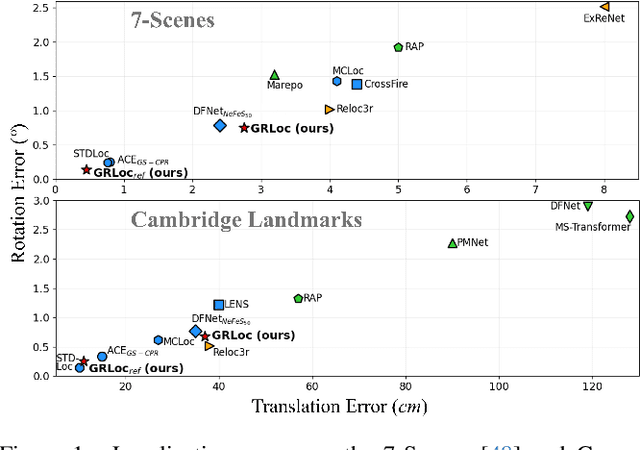
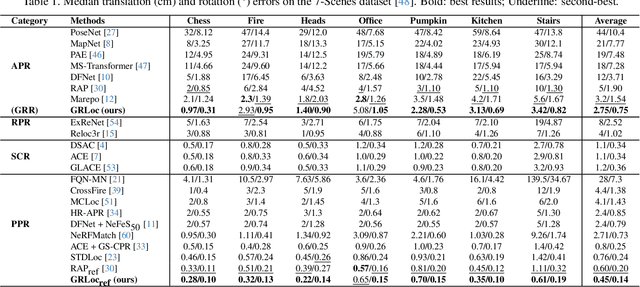
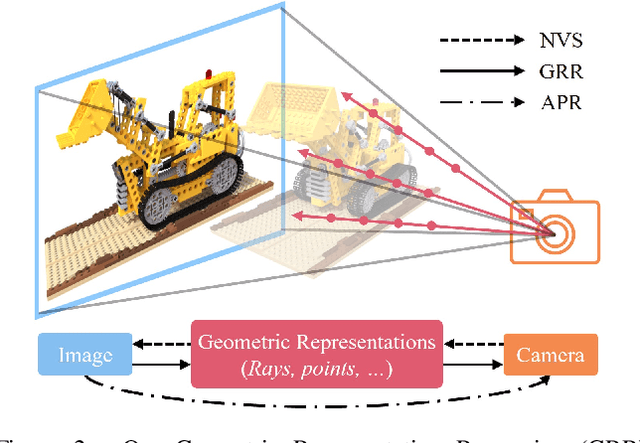
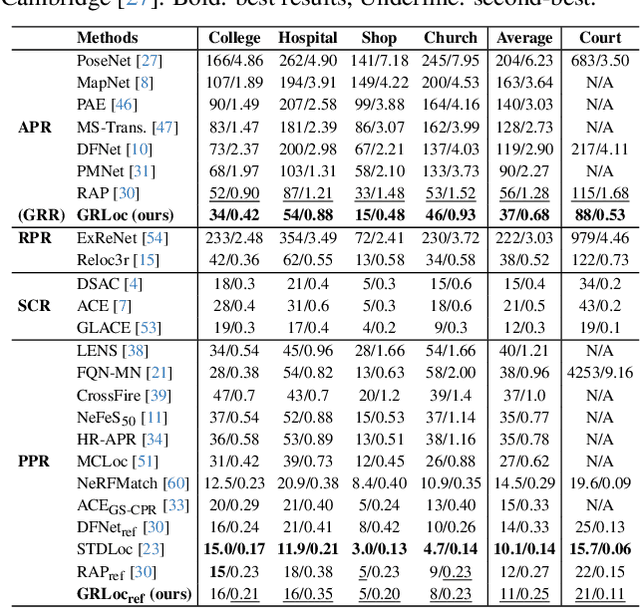
Absolute Pose Regression (APR) has emerged as a compelling paradigm for visual localization. However, APR models typically operate as black boxes, directly regressing a 6-DoF pose from a query image, which can lead to memorizing training views rather than understanding 3D scene geometry. In this work, we propose a geometrically-grounded alternative. Inspired by novel view synthesis, which renders images from intermediate geometric representations, we reformulate APR as its inverse that regresses the underlying 3D representations directly from the image, and we name this paradigm Geometric Representation Regression (GRR). Our model explicitly predicts two disentangled geometric representations in the world coordinate system: (1) a ray bundle's directions to estimate camera rotation, and (2) a corresponding pointmap to estimate camera translation. The final 6-DoF camera pose is then recovered from these geometric components using a differentiable deterministic solver. This disentangled approach, which separates the learned visual-to-geometry mapping from the final pose calculation, introduces a strong geometric prior into the network. We find that the explicit decoupling of rotation and translation predictions measurably boosts performance. We demonstrate state-of-the-art performance on 7-Scenes and Cambridge Landmarks datasets, validating that modeling the inverse rendering process is a more robust path toward generalizable absolute pose estimation.
Unsupervised Social Event Detection via Hybrid Graph Contrastive Learning and Reinforced Incremental Clustering
Dec 15, 2023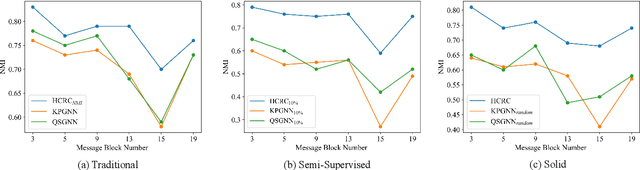


Detecting events from social media data streams is gradually attracting researchers. The innate challenge for detecting events is to extract discriminative information from social media data thereby assigning the data into different events. Due to the excessive diversity and high updating frequency of social data, using supervised approaches to detect events from social messages is hardly achieved. To this end, recent works explore learning discriminative information from social messages by leveraging graph contrastive learning (GCL) and embedding clustering in an unsupervised manner. However, two intrinsic issues exist in benchmark methods: conventional GCL can only roughly explore partial attributes, thereby insufficiently learning the discriminative information of social messages; for benchmark methods, the learned embeddings are clustered in the latent space by taking advantage of certain specific prior knowledge, which conflicts with the principle of unsupervised learning paradigm. In this paper, we propose a novel unsupervised social media event detection method via hybrid graph contrastive learning and reinforced incremental clustering (HCRC), which uses hybrid graph contrastive learning to comprehensively learn semantic and structural discriminative information from social messages and reinforced incremental clustering to perform efficient clustering in a solidly unsupervised manner. We conduct comprehensive experiments to evaluate HCRC on the Twitter and Maven datasets. The experimental results demonstrate that our approach yields consistent significant performance boosts. In traditional incremental setting, semi-supervised incremental setting and solidly unsupervised setting, the model performance has achieved maximum improvements of 53%, 45%, and 37%, respectively.