 Add to Chrome
 Add to Firefox
 Add to Edge
Density-aware Hierarchical Clustering Based on Element-Categorized Connection Subgraphs
Aug 07, 2026
Clustering is a fundamental data mining technique for pattern recognition through unsupervised learning. Among various clustering methods, hierarchical clustering, density-based clustering, and graph clustering stand out as representative approaches. For hierarchical clustering, it can be categorized into agglomerative and divisive modes to construct clusters in a recursive manner. The key aspect of both modes is the calculation of inter-cluster similarity, which determines whether to merge the sub-clusters into one cluster or divide a current cluster into sub-clusters. Traditionally, the similarity is derived from pairwise distances, often overlooking density variations and structural connectivity in graphs. To address this, we propose a density-aware hierarchical clustering method based on element-categorized connection subgraphs (DHC-ECS), which effectively integrates the hierarchical clustering, density-based clustering, and graph clustering. Particularly, a novel inter-cluster similarity metric is introduced that considers not only distances but also the element categorization in the KNN connection subgraphs, kernel density estimation, and local connectivity within sub-clusters. Extensive evaluations on heterogeneous benchmark datasets demonstrate that DHC-ECS exhibits superior overall performance in terms of clustering accuracy and parameter robustness compared with the baseline methods (including AChameleon, RNN-DBSCAN, McDPC, and G-RMS). The work indicates the great potential of the proposed clustering algorithm for low-dimensional datasets by leveraging local density and graph-structured connectivity (i.e., the duality of vertices and edges), as well as the possibility to determine an intrinsic threshold, reducing the reliance on manual parameter tuning.

Antenna Optimization for Decode-and-Forward Relay in Magnetic Induction Communications
Jul 06, 2026Magnetic Induction (MI) communication is effective in underground tunnels for emergency rescue vehicle due to the small-size antenna. It can highly benefit from a cooperative decode-and-forward (DF) relay to achieve a higher data rate. However, its channel gain is extremely position-and-orientation-selective. The unreachable space increases the complexity of the antenna deployment. To find the best antenna position and orientation (PO) of the relay achieving the higher data rate, this paper formulates the optimization problem of the relay MI antenna PO with tunnel constraints. To solve the problem more quickly, we propose to use geometric modeling to eliminate the tunnel constraints and develop a random-search algorithm achieving a fast convergence and excellent global search ability. Simulations show that the proposed algorithm can quickly converge to one optimum which signifies a noticeable improvement of data rate for vehicle MI systems with weak signals.
* This is the author's accepted manuscript, which has been published in IEEE Transactions on Vehicular Technology. The final published version can be accessed at https://doi.org/10.1109/TVT.2019.2963357
Integrated Channel Sounding and Communication: Requirements, Architecture, Challenges, and Key Technologies
Mar 16, 2026Channel models are essential for the design, evaluation, and optimization of wireless communication systems. The emerging space-air-ground-sea integrated network (SAGSIN), characterized by diverse service applications and extended-spectrum operations, places even greater demands on highly accurate channel models. However, conventional channel sounding is limited by generalized measurement campaigns, inadequate cross-band consistency, and insufficient real-time adaptability, making it unable to meet the needs of SAGSIN for scenario-specific and high-precision channel modeling. To address this challenge, we propose a novel technological framework, termed integrated channel sounding and communication (ICSC). By deeply integrating sounding and communication, the ICSC enables efficient and real-time acquisition of dynamic channel characteristics during communication processes, supporting fine-grained site- and scenario-specific measurements. Furthermore, leveraging artificial intelligence techniques, ICSC can identify channel conditions and adapt waveform parameters in real-time according to scenario variations, which in turn enhances communication performance. This article first introduces the fundamental principles of the ICSC framework, elaborates on its core concepts and key advantages, and demonstrates its feasibility through the development of an integrated verification system (IVS). Subsequently, the potential applications and opportunities of the ICSC are analyzed in depth, followed by a discussion of its future development directions and remaining challenges.
Alzheimer's Disease Detection from Spontaneous Speech through Combining Linguistic Complexity and Fluency Features with Pretrained Language Models
Jun 16, 2021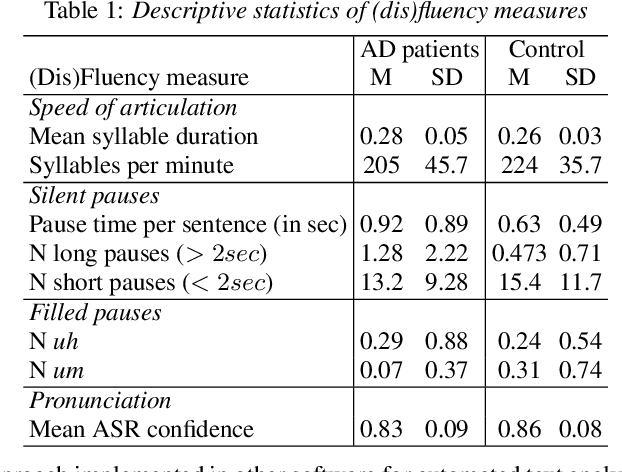
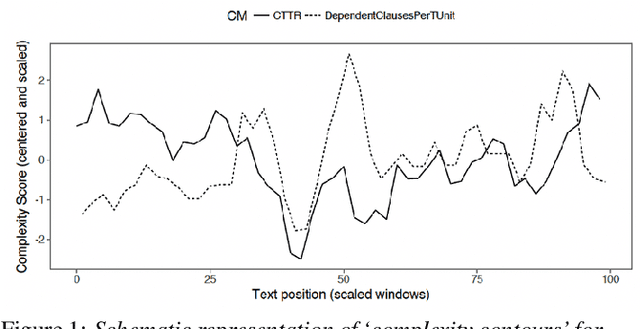
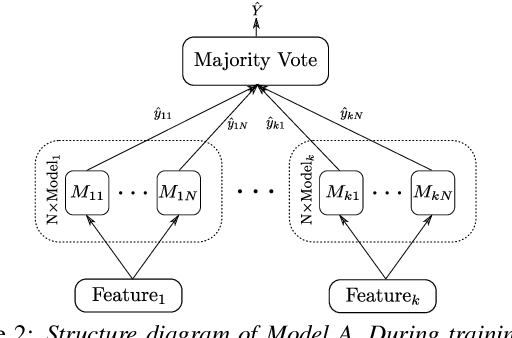
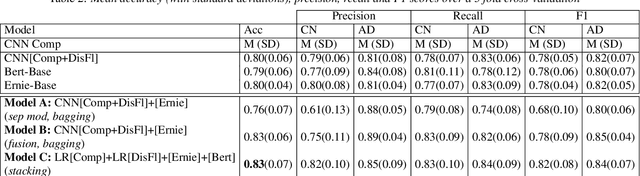
In this paper, we combined linguistic complexity and (dis)fluency features with pretrained language models for the task of Alzheimer's disease detection of the 2021 ADReSSo (Alzheimer's Dementia Recognition through Spontaneous Speech) challenge. An accuracy of 83.1% was achieved on the test set, which amounts to an improvement of 4.23% over the baseline model. Our best-performing model that integrated component models using a stacking ensemble technique performed equally well on cross-validation and test data, indicating that it is robust against overfitting.