 Add to Chrome
 Add to Firefox
 Add to Edge
Integrated Channel Sounding and Communication: Requirements, Architecture, Challenges, and Key Technologies
Mar 16, 2026
Channel models are essential for the design, evaluation, and optimization of wireless communication systems. The emerging space-air-ground-sea integrated network (SAGSIN), characterized by diverse service applications and extended-spectrum operations, places even greater demands on highly accurate channel models. However, conventional channel sounding is limited by generalized measurement campaigns, inadequate cross-band consistency, and insufficient real-time adaptability, making it unable to meet the needs of SAGSIN for scenario-specific and high-precision channel modeling. To address this challenge, we propose a novel technological framework, termed integrated channel sounding and communication (ICSC). By deeply integrating sounding and communication, the ICSC enables efficient and real-time acquisition of dynamic channel characteristics during communication processes, supporting fine-grained site- and scenario-specific measurements. Furthermore, leveraging artificial intelligence techniques, ICSC can identify channel conditions and adapt waveform parameters in real-time according to scenario variations, which in turn enhances communication performance. This article first introduces the fundamental principles of the ICSC framework, elaborates on its core concepts and key advantages, and demonstrates its feasibility through the development of an integrated verification system (IVS). Subsequently, the potential applications and opportunities of the ICSC are analyzed in depth, followed by a discussion of its future development directions and remaining challenges.

GI-Free Pilot-Aided Channel Estimation for Affine Frequency Division Multiplexing Systems
Apr 01, 2024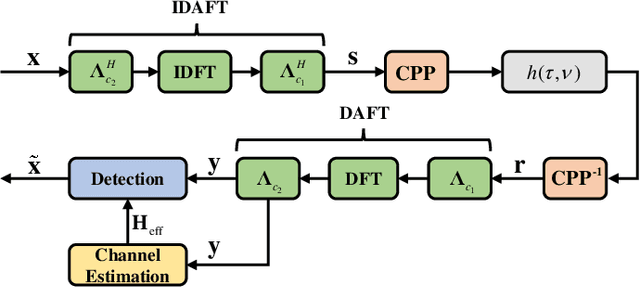

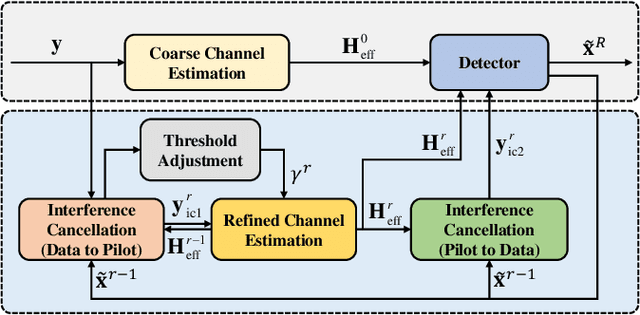
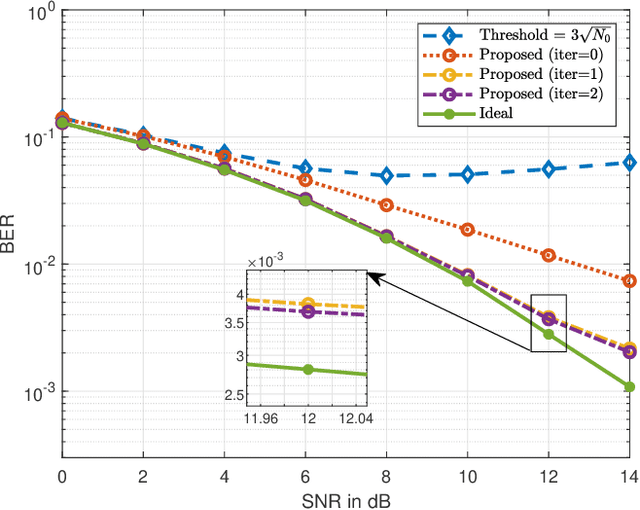
The recently developed affine frequency division multiplexing (AFDM) can achieve full diversity in doubly selective channels, providing a comprehensive sparse representation of the delay-Doppler domain channel. Thus, accurate channel estimation is feasible by using just one pilot symbol. However, traditional AFDM channel estimation schemes necessitate the use of guard intervals (GI) to mitigate data-pilot interference, leading to spectral efficiency degradation. In this paper, we propose a GI-free pilot-aided channel estimation algorithm for AFDM systems, which improves spectral efficiency significantly. To mitigate the interference between the pilot and data symbols caused by the absence of GI, we perform joint interference cancellation, channel estimation, and signal detection iterately. Simulation results show that the bit error rate (BER) performance of the proposed method can approach the ideal case with perfect channel estimation.