 Add to Chrome
 Add to Firefox
 Add to Edge
DecoyFace: Beyond Obfuscation via Controllable and Imperceptible Identity Misdirection for Privacy-Preserving Face Recognition
Jul 20, 2026
Split face recognition reduces client-side computation but exposes intermediate features to feature inversion attacks and unauthorized analysis by honest-but-curious (HBC) servers. Existing privacy-preserving face recognition methods mainly aim to resist unauthorized reconstruction, typically producing features whose inversion yields visibly degraded results, which may reveal the existence of protection and motivate adaptive attacks. To address this issue, we propose DecoyFace, an imperceptible decoy-oriented framework that steers unauthorized reconstruction toward a plausible but incorrect identity while preserving recognition utility. The key idea is to decompose the intermediate representation into a reconstruction-sensitive subspace and its complementary subspace. The client injects decoy identity cues into the reconstruction-sensitive subspace, while limited recognition-relevant evidence from the true sample is retained in the complementary subspace. On the server side, an authorized canonicalization module suppresses decoy-dominant components and recovers a recognition-friendly representation. This design addresses both attacker-side inversion from intercepted features and HBC server-side reconstruction from canonicalized representations. Experiments show that DecoyFace preserves competitive recognition accuracy while substantially reducing identity leakage to 2.93% under U-Net attacks and 0.74% under Flow-Matching attacks while yielding visually plausible and imperceptible reconstructions, with over 99.78% face validity on LFW dataset.

What Your Features Reveal: Data-Efficient Black-Box Feature Inversion Attack for Split DNNs
Nov 19, 2025Split DNNs enable edge devices by offloading intensive computation to a cloud server, but this paradigm exposes privacy vulnerabilities, as the intermediate features can be exploited to reconstruct the private inputs via Feature Inversion Attack (FIA). Existing FIA methods often produce limited reconstruction quality, making it difficult to assess the true extent of privacy leakage. To reveal the privacy risk of the leaked features, we introduce FIA-Flow, a black-box FIA framework that achieves high-fidelity image reconstruction from intermediate features. To exploit the semantic information within intermediate features, we design a Latent Feature Space Alignment Module (LFSAM) to bridge the semantic gap between the intermediate feature space and the latent space. Furthermore, to rectify distributional mismatch, we develop Deterministic Inversion Flow Matching (DIFM), which projects off-manifold features onto the target manifold with one-step inference. This decoupled design simplifies learning and enables effective training with few image-feature pairs. To quantify privacy leakage from a human perspective, we also propose two metrics based on a large vision-language model. Experiments show that FIA-Flow achieves more faithful and semantically aligned feature inversion across various models (AlexNet, ResNet, Swin Transformer, DINO, and YOLO11) and layers, revealing a more severe privacy threat in Split DNNs than previously recognized.
Ego-Exo4D: Understanding Skilled Human Activity from First- and Third-Person Perspectives
Nov 30, 2023
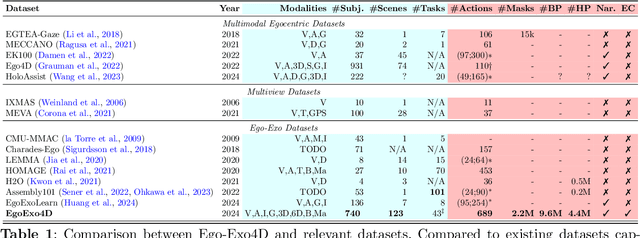

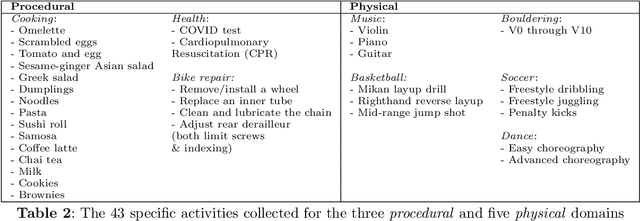
We present Ego-Exo4D, a diverse, large-scale multimodal multiview video dataset and benchmark challenge. Ego-Exo4D centers around simultaneously-captured egocentric and exocentric video of skilled human activities (e.g., sports, music, dance, bike repair). More than 800 participants from 13 cities worldwide performed these activities in 131 different natural scene contexts, yielding long-form captures from 1 to 42 minutes each and 1,422 hours of video combined. The multimodal nature of the dataset is unprecedented: the video is accompanied by multichannel audio, eye gaze, 3D point clouds, camera poses, IMU, and multiple paired language descriptions -- including a novel "expert commentary" done by coaches and teachers and tailored to the skilled-activity domain. To push the frontier of first-person video understanding of skilled human activity, we also present a suite of benchmark tasks and their annotations, including fine-grained activity understanding, proficiency estimation, cross-view translation, and 3D hand/body pose. All resources will be open sourced to fuel new research in the community.