 Add to Chrome
 Add to Firefox
 Add to Edge
A Perception-Manipulation Robotics System for Food Cutting
Jul 05, 2026
In the development of cooking robots, mastering the task of cutting is crucial. A significant challenge lies in the diverse properties of food, which necessitate distinct cutting policies and even different knives for optimal processing. This paper presents a perception-manipulation framework for food-cutting tasks. Our system features a knife selection module that utilizes force data from a preliminary fixed trial cut to select the appropriate knife for the given food. This is followed by an adaptive cutting phase using reinforcement learning (RL) to balance cutting speed and energy efficiency. In our experiments, the knife selection module achieved 100% successful rate on unseen food, and we compared the performances of fixed policy, RL policy, with human operators. Our method not only achieves high performance but also demonstrates comparable results to those of human participants.

CEER: Compliant End-Effector and Root Control as a Unified Interface for Hierarchical Humanoid Loco-Manipulation
May 19, 2026Humanoid robots have achieved impressive locomotion performance, yet contact-rich and long-horizon manipulation remains a major bottleneck. Manipulation is inherently contact-rich and demands compliant whole-body control for stable interaction, while its diversity and long-horizon nature favor modular, planner-compatible interfaces over joint-space tracking. We propose CEER, a compliant end-effector-root (EE-root) control abstraction for modular humanoid loco-manipulation within a hierarchical planning framework. CEER enables compliance-aware whole-body control in an interpretable task space defined by root motion commands and end-effector pose targets, and supports plug-and-play integration with heterogeneous high-level planners. A teacher-student framework is adopted to distill a general motion-tracking controller into a low-level policy that consumes only EE-root commands. We further construct a hierarchical system that integrates heterogeneous planners and task modules through the EE-root interface, enabling diverse manipulation tasks without retraining the underlying whole-body policy. Experiments in simulation and on hardware demonstrate 3.3 cm end-effector tracking accuracy with substantially reduced jerk compared to baselines, stable contact-rich manipulation under teleoperation, and up to 70% success in simulated single-object loco-manipulation tasks within a room-scale environment. These results indicate that compliant EE-root control provides a practical abstraction for humanoid loco-manipulation, enabling modular and scalable integration of diverse skills.
Multimodal Peer Review Simulation with Actionable To-Do Recommendations for Community-Aware Manuscript Revisions
Nov 14, 2025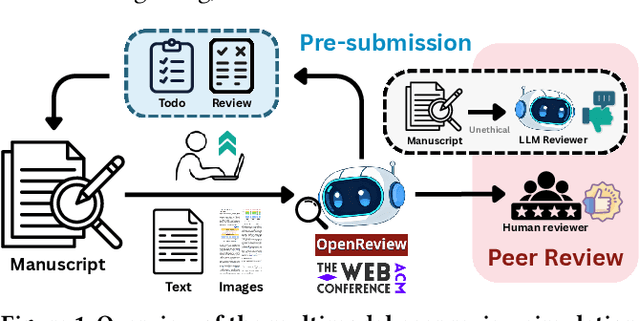
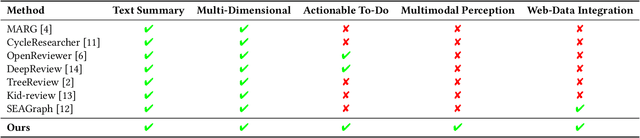
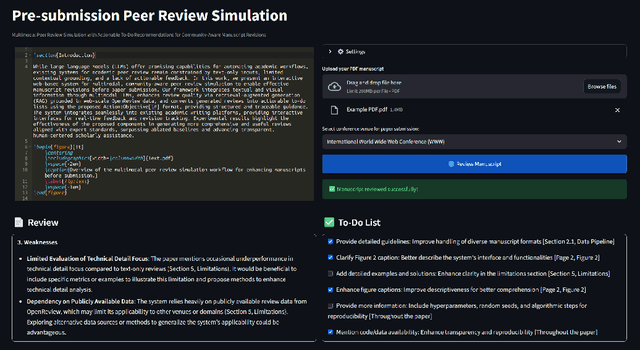
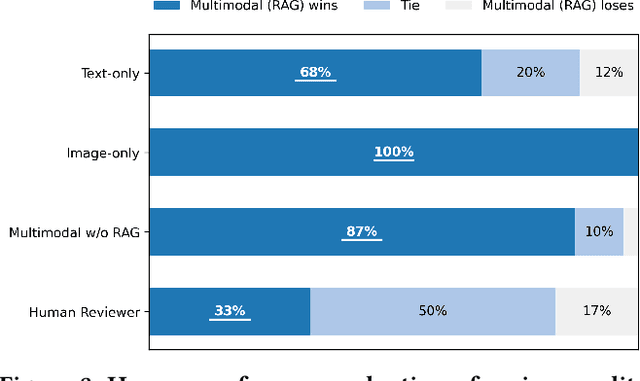
While large language models (LLMs) offer promising capabilities for automating academic workflows, existing systems for academic peer review remain constrained by text-only inputs, limited contextual grounding, and a lack of actionable feedback. In this work, we present an interactive web-based system for multimodal, community-aware peer review simulation to enable effective manuscript revisions before paper submission. Our framework integrates textual and visual information through multimodal LLMs, enhances review quality via retrieval-augmented generation (RAG) grounded in web-scale OpenReview data, and converts generated reviews into actionable to-do lists using the proposed Action:Objective[\#] format, providing structured and traceable guidance. The system integrates seamlessly into existing academic writing platforms, providing interactive interfaces for real-time feedback and revision tracking. Experimental results highlight the effectiveness of the proposed system in generating more comprehensive and useful reviews aligned with expert standards, surpassing ablated baselines and advancing transparent, human-centered scholarly assistance.
An Intelligent Robotic System for Perceptive Pancake Batter Stirring and Precise Pouring
Jul 01, 2024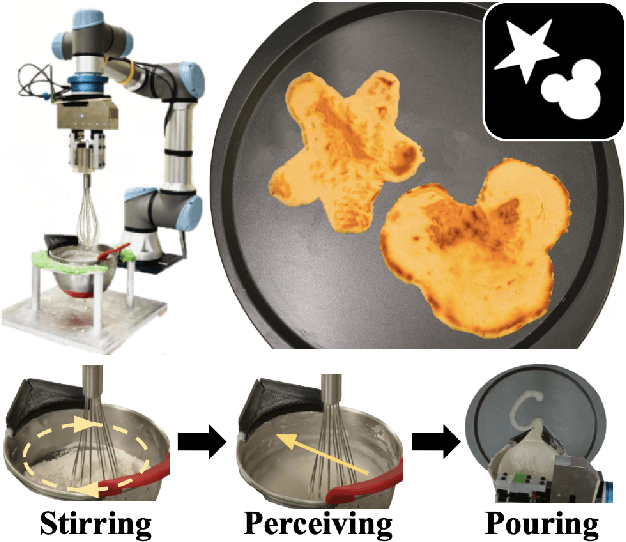

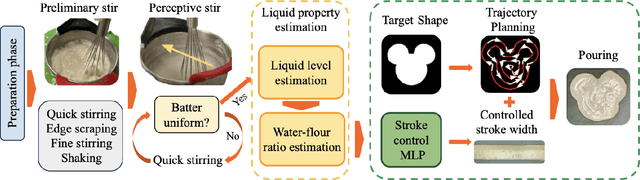
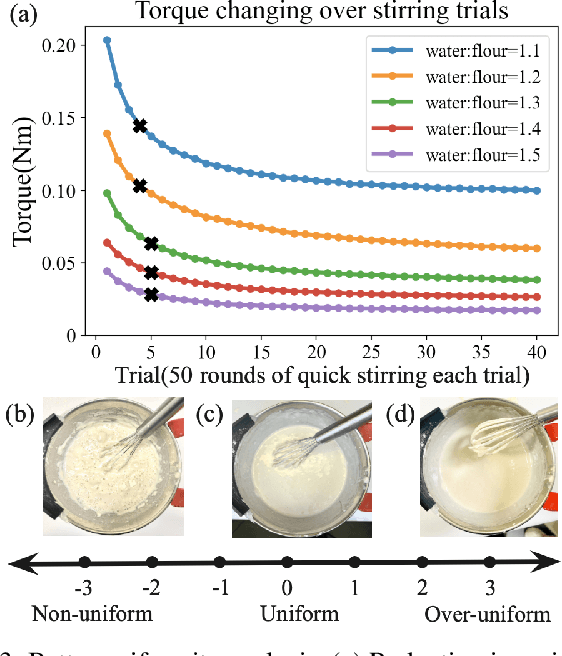
Cooking robots have long been desired by the commercial market, while the technical challenge is still significant. A major difficulty comes from the demand of perceiving and handling liquid with different properties. This paper presents a robot system that mixes batter and makes pancakes out of it, where understanding and handling the viscous liquid is an essential component. The system integrates Haptic Sensing and control algorithms to autonomously stir flour and water to achieve the desired batter uniformity, estimate the batter's properties such as the water-flour ratio and liquid level, as well as perform precise manipulations to pour the batter into any specified shape. Experimental results show the system's capability to always produce batter of desired uniformity, estimate water-flour ratio and liquid level precisely, and accurately pour it into complex shapes. This research showcases the potential for robots to assist in kitchens and step towards commercial culinary automation.