 Add to Chrome
 Add to Firefox
 Add to Edge
Test-Time Training for Zero-Resource Dense Retrieval Reranking
May 31, 2026
Dense retrievers excel at first-stage candidate generation but lack effective reranking in zero-resource settings. Existing approaches face a fundamental dilemma: cross-encoders deliver strong reranking quality but require costly supervised training and incur high latency, while unsupervised BM25 reranking consistently degrades dense retrieval performance on most of BEIR benchmarks. We propose DART (Dense Adaptive Reranking at Test-time), which resolves this dilemma by adapting the scoring function at inference time. For each query, the top-ranked documents serve as pseudo-positive examples and the bottom-ranked as pseudo-negative examples, providing noisy but readily available supervision to adapt a bilinear scoring matrix $W$ via a small number of gradient updates. We further introduce a confidence-weighted margin loss and a cross-query momentum buffer that warm-starts adaptation across queries. On six BEIR benchmarks, DART achieves a mean per-dataset relative NDCG@10 gain of +2.1% over the dense retrieval baseline with under 10ms additional latency per query, demonstrating a powerful capability for zero-shot performance enhancement and cross-domain generalization.

MViewRouter: Internalizing Geometric Equivariance via Multi-view Alternating Attention for Combinatorial Routing
May 31, 2026Combinatorial routing problems such as the Traveling Salesman Problem (TSP) and the Capacitated Vehicle Routing Problem (CVRP) are fundamental NP-hard problems with broad real-world applications. While recent deep reinforcement learning methods have shown promising performance, they typically handle geometric symmetries only through data augmentation, resulting in inconsistent decisions and limited generalization. To address this issue, we propose MViewRouter, a multi-view framework that internalizes geometric equivariance as a structural inductive bias to achieve invariant decision-making across routing problem variants. Our approach introduces a Multi-view Alternating Attention (MAA) mechanism that enables parallel processing over the $D_4$ symmetry group, alternating between intra-view relational modeling and inter-view feature alignment. Furthermore, we optimize the policy via Collective Policy Gradient Aggregation (CPGA), leveraging consensus gradients from multiple symmetric views to stabilize training and accelerate convergence. Experiments on TSP and CVRP benchmarks, as well as real-world TSPLIB instances, demonstrate that MViewRouter achieves competitive solution quality and strong zero-shot generalization.
Reflection in the Dark: Exposing and Escaping the Black Box in Reflective Prompt Optimization
Mar 19, 2026Automatic prompt optimization (APO) has emerged as a powerful paradigm for improving LLM performance without manual prompt engineering. Reflective APO methods such as GEPA iteratively refine prompts by diagnosing failure cases, but the optimization process remains black-box and label-free, leading to uninterpretable trajectories and systematic failure. We identify and empirically demonstrate four limitations: on GSM8K with a defective seed, GEPA degrades accuracy from 23.81% to 13.50%. We propose VISTA, a multi-agent APO framework that decouples hypothesis generation from prompt rewriting, enabling semantically labeled hypotheses, parallel minibatch verification, and interpretable optimization trace. A two-layer explore-exploit mechanism combining random restart and epsilon-greedy sampling further escapes local optima. VISTA recovers accuracy to 87.57% on the same defective seed and consistently outperforms baselines across all conditions on GSM8K and AIME2025.
DICE: Discrete Interpretable Comparative Evaluation with Probabilistic Scoring for Retrieval-Augmented Generation
Dec 27, 2025As Retrieval-Augmented Generation (RAG) systems evolve toward more sophisticated architectures, ensuring their trustworthiness through explainable and robust evaluation becomes critical. Existing scalar metrics suffer from limited interpretability, inadequate uncertainty quantification, and computational inefficiency in multi-system comparisons, hindering responsible deployment of RAG technologies. We introduce DICE (Discrete Interpretable Comparative Evaluation), a two-stage, evidence-coupled framework that advances explainability and robustness in RAG evaluation. DICE combines deep analytical reasoning with probabilistic $\{A, B, Tie\}$ scoring to produce transparent, confidence-aware judgments that support accountable system improvement through interpretable reasoning traces, enabling systematic error diagnosis and actionable insights. To address efficiency challenges at scale, DICE employs a Swiss-system tournament that reduces computational complexity from $O(N^2)$ to $O(N \log N)$, achieving a 42.9% reduction in our eight-system evaluation while preserving ranking fidelity. Validation on a curated Chinese financial QA dataset demonstrates that DICE achieves 85.7% agreement with human experts, substantially outperforming existing LLM-based metrics such as RAGAS. Our results establish DICE as a responsible, explainable, and efficient paradigm for trustworthy RAG system assessment.
FluentLip: A Phonemes-Based Two-stage Approach for Audio-Driven Lip Synthesis with Optical Flow Consistency
Apr 06, 2025Generating consecutive images of lip movements that align with a given speech in audio-driven lip synthesis is a challenging task. While previous studies have made strides in synchronization and visual quality, lip intelligibility and video fluency remain persistent challenges. This work proposes FluentLip, a two-stage approach for audio-driven lip synthesis, incorporating three featured strategies. To improve lip synchronization and intelligibility, we integrate a phoneme extractor and encoder to generate a fusion of audio and phoneme information for multimodal learning. Additionally, we employ optical flow consistency loss to ensure natural transitions between image frames. Furthermore, we incorporate a diffusion chain during the training of Generative Adversarial Networks (GANs) to improve both stability and efficiency. We evaluate our proposed FluentLip through extensive experiments, comparing it with five state-of-the-art (SOTA) approaches across five metrics, including a proposed metric called Phoneme Error Rate (PER) that evaluates lip pose intelligibility and video fluency. The experimental results demonstrate that our FluentLip approach is highly competitive, achieving significant improvements in smoothness and naturalness. In particular, it outperforms these SOTA approaches by approximately $\textbf{16.3%}$ in Fr\'echet Inception Distance (FID) and $\textbf{35.2%}$ in PER.
SNAP: Stopping Catastrophic Forgetting in Hebbian Learning with Sigmoidal Neuronal Adaptive Plasticity
Oct 20, 2024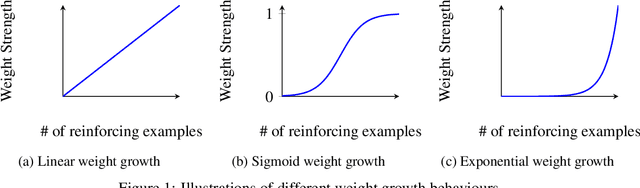

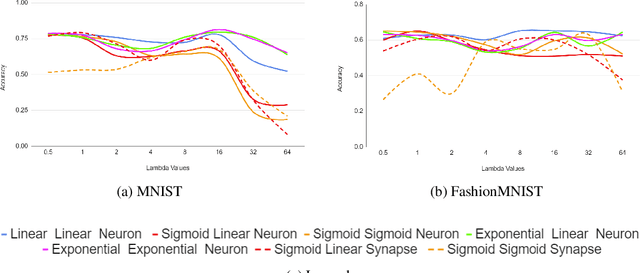
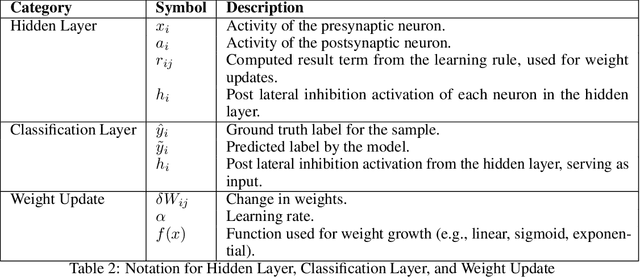
Artificial Neural Networks (ANNs) suffer from catastrophic forgetting, where the learning of new tasks causes the catastrophic forgetting of old tasks. Existing Machine Learning (ML) algorithms, including those using Stochastic Gradient Descent (SGD) and Hebbian Learning typically update their weights linearly with experience i.e., independently of their current strength. This contrasts with biological neurons, which at intermediate strengths are very plastic, but consolidate with Long-Term Potentiation (LTP) once they reach a certain strength. We hypothesize this mechanism might help mitigate catastrophic forgetting. We introduce Sigmoidal Neuronal Adaptive Plasticity (SNAP) an artificial approximation to Long-Term Potentiation for ANNs by having the weights follow a sigmoidal growth behaviour allowing the weights to consolidate and stabilize when they reach sufficiently large or small values. We then compare SNAP to linear weight growth and exponential weight growth and see that SNAP completely prevents the forgetting of previous tasks for Hebbian Learning but not for SGD-base learning.