 Add to Chrome
 Add to Firefox
 Add to Edge
SubtleTalk: Generating Controllable Weakly-correlated Facial Dynamics for 3D Talking Heads via Residual Flow Matching
Aug 03, 2026
Audio-driven 3D facial animation aims to synthesize realistic and temporally coherent motions from speech. Despite notable progress in lip synchronization, weakly correlated dynamics, including eyebrow movements, eye blinks, and head motion, which are essential to photorealistic facial animation, remain difficult to model faithfully and often appear static or unnaturally repetitive. We attribute this limitation to three factors: (a) insufficient conditioning for weakly correlated dynamics; (b) the limited ability of deterministic regression to capture diverse motion patterns; (c) data bottlenecks from unreliable upper-face pseudo-labels and limited dataset diversity. To address these issues, we propose SubtleTalk, a framework for generating natural and controllable weakly correlated facial dynamics via multi-condition modeling and residual flow matching. First, to compensate for the limited guidance of speech alone, we introduce interpretable controls, including prosody, regional intensity, and Valence-Arousal signals, to explicitly capture the timing, magnitude, and affective variation of weakly correlated dynamics. Second, to overcome the limited expressiveness of deterministic regression, we build residual flow matching based on a stable speech-driven motion prior, allowing the model to capture stochastic deviations beyond deterministic prediction. Third, to alleviate the data bottleneck, we construct SubtleTalk-Face, a large-scale 3D facial animation dataset comprising about 3,900 identities and 74 hours of data, built via a simple and scalable pseudo-labeling pipeline and featuring improved upper-face tracking and frame-level VA annotations. Extensive experiments demonstrate that our method significantly improves the realism and diversity of weakly correlated facial dynamics while preserving accurate lip synchronization.

A Locality-based Neural Solver for Optical Motion Capture
Sep 04, 2023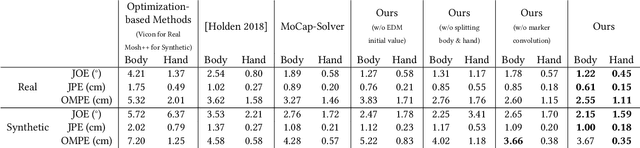
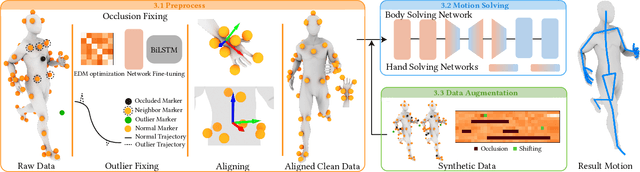
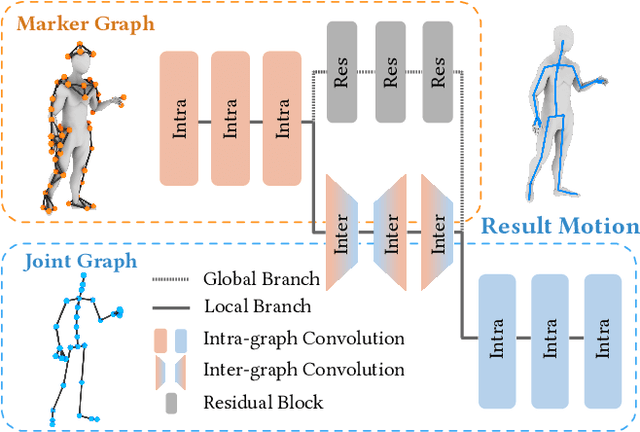
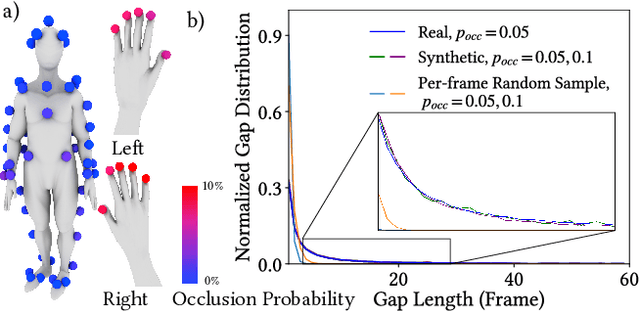
We present a novel locality-based learning method for cleaning and solving optical motion capture data. Given noisy marker data, we propose a new heterogeneous graph neural network which treats markers and joints as different types of nodes, and uses graph convolution operations to extract the local features of markers and joints and transform them to clean motions. To deal with anomaly markers (e.g. occluded or with big tracking errors), the key insight is that a marker's motion shows strong correlations with the motions of its immediate neighboring markers but less so with other markers, a.k.a. locality, which enables us to efficiently fill missing markers (e.g. due to occlusion). Additionally, we also identify marker outliers due to tracking errors by investigating their acceleration profiles. Finally, we propose a training regime based on representation learning and data augmentation, by training the model on data with masking. The masking schemes aim to mimic the occluded and noisy markers often observed in the real data. Finally, we show that our method achieves high accuracy on multiple metrics across various datasets. Extensive comparison shows our method outperforms state-of-the-art methods in terms of prediction accuracy of occluded marker position error by approximately 20%, which leads to a further error reduction on the reconstructed joint rotations and positions by 30%. The code and data for this paper are available at https://github.com/non-void/LocalMoCap.
Predicting Loose-Fitting Garment Deformations Using Bone-Driven Motion Networks
May 06, 2022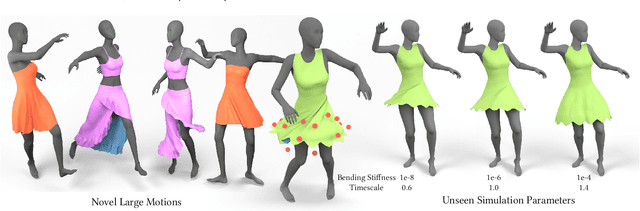
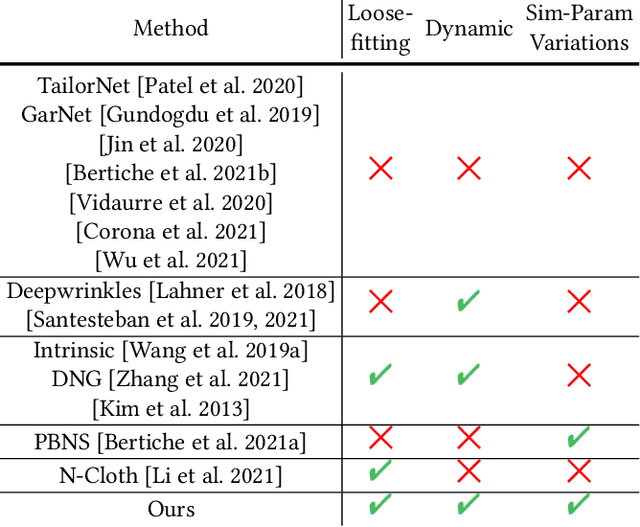
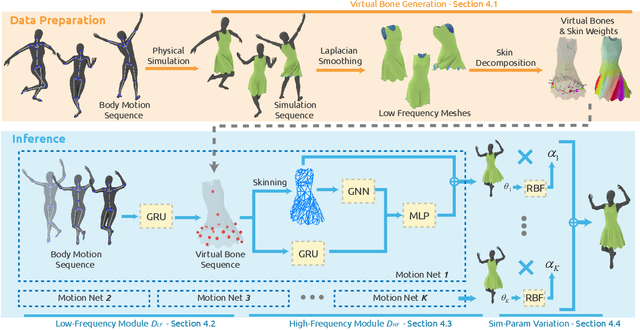
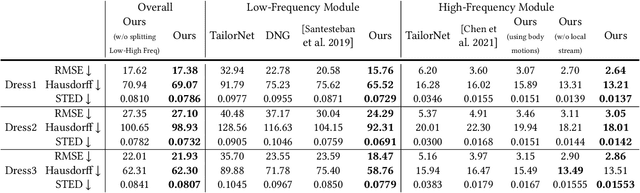
We present a learning algorithm that uses bone-driven motion networks to predict the deformation of loose-fitting garment meshes at interactive rates. Given a garment, we generate a simulation database and extract virtual bones from simulated mesh sequences using skin decomposition. At runtime, we separately compute low- and high-frequency deformations in a sequential manner. The low-frequency deformations are predicted by transferring body motions to virtual bones' motions, and the high-frequency deformations are estimated leveraging the global information of virtual bones' motions and local information extracted from low-frequency meshes. In addition, our method can estimate garment deformations caused by variations of the simulation parameters (e.g., fabric's bending stiffness) using an RBF kernel ensembling trained networks for different sets of simulation parameters. Through extensive comparisons, we show that our method outperforms state-of-the-art methods in terms of prediction accuracy of mesh deformations by about 20% in RMSE and 10% in Hausdorff distance and STED. The code and data are available at https://github.com/non-void/VirtualBones.
High-Fidelity 3D Digital Human Creation from RGB-D Selfies
Oct 12, 2020
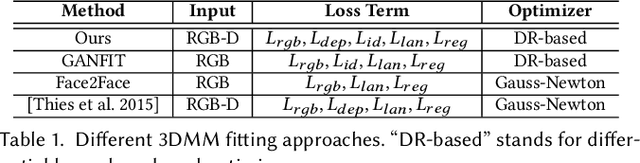
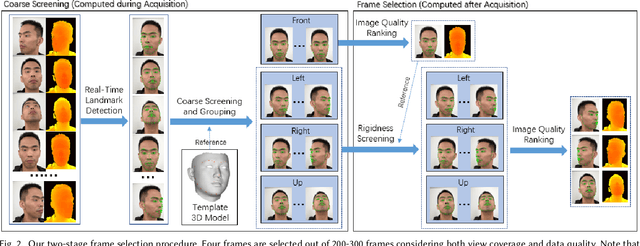
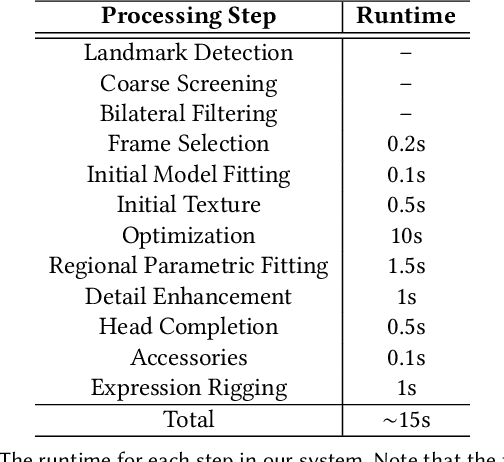
We present a fully automatic system that can produce high-fidelity, photo-realistic 3D digital human characters with a consumer RGB-D selfie camera. The system only needs the user to take a short selfie RGB-D video while rotating his/her head, and can produce a high quality reconstruction in less than 30 seconds. Our main contribution is a new facial geometry modeling and reflectance synthesis procedure that significantly improves the state-of-the-art. Specifically, given the input video a two-stage frame selection algorithm is first employed to select a few high-quality frames for reconstruction. A novel, differentiable renderer based 3D Morphable Model (3DMM) fitting method is then applied to recover facial geometries from multiview RGB-D data, which takes advantages of extensive data generation and perturbation. Our 3DMM has much larger expressive capacities than conventional 3DMM, allowing us to recover more accurate facial geometry using merely linear bases. For reflectance synthesis, we present a hybrid approach that combines parametric fitting and CNNs to synthesize high-resolution albedo/normal maps with realistic hair/pore/wrinkle details. Results show that our system can produce faithful 3D characters with extremely realistic details. Code and the constructed 3DMM is publicly available.
Graph Convolutional Subspace Clustering: A Robust Subspace Clustering Framework for Hyperspectral Image
Apr 22, 2020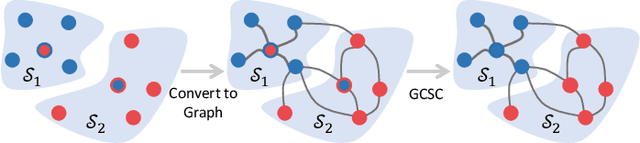
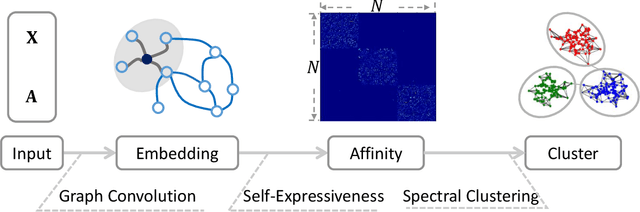
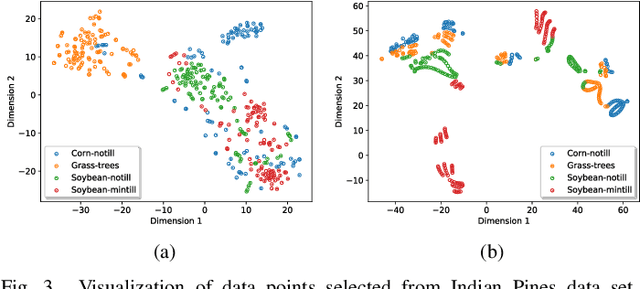

Hyperspectral image (HSI) clustering is a challenging task due to the high complexity of HSI data. Subspace clustering has been proven to be powerful for exploiting the intrinsic relationship between data points. Despite the impressive performance in the HSI clustering, traditional subspace clustering methods often ignore the inherent structural information among data. In this paper, we revisit the subspace clustering with graph convolution and present a novel subspace clustering framework called Graph Convolutional Subspace Clustering (GCSC) for robust HSI clustering. Specifically, the framework recasts the self-expressiveness property of the data into the non-Euclidean domain, which results in a more robust graph embedding dictionary. We show that traditional subspace clustering models are the special forms of our framework with the Euclidean data. Basing on the framework, we further propose two novel subspace clustering models by using the Frobenius norm, namely Efficient GCSC (EGCSC) and Efficient Kernel GCSC (EKGCSC). Both models have a globally optimal closed-form solution, which makes them easier to implement, train, and apply in practice. Extensive experiments on three popular HSI datasets demonstrate that EGCSC and EKGCSC can achieve state-of-the-art clustering performance and dramatically outperforms many existing methods with significant margins.