 Add to Chrome
 Add to Firefox
 Add to Edge
AdaClearGrasp: Learning Adaptive Clearing for Zero-Shot Robust Dexterous Grasping in Densely Cluttered Environments
Mar 11, 2026
In densely cluttered environments, physical interference, visual occlusions, and unstable contacts often cause direct dexterous grasping to fail, while aggressive singulation strategies may compromise safety. Enabling robots to adaptively decide whether to clear surrounding objects or directly grasp the target is therefore crucial for robust manipulation. We propose AdaClearGrasp, a closed-loop decision-execution framework for adaptive clearing and zero-shot dexterous grasping in densely cluttered environments. The framework formulates manipulation as a controllable high-level decision process that determines whether to directly grasp the target or first clear surrounding objects. A pretrained vision-language model (VLM) interprets visual observations and language task descriptions to reason about grasp interference and generate a high-level planning skeleton, which invokes structured atomic skills through a unified action interface. For dexterous grasping, we train a reinforcement learning policy with a relative hand-object distance representation, enabling zero-shot generalization across diverse object geometries and physical properties. During execution, visual feedback monitors outcomes and triggers replanning upon failures, forming a closed-loop correction mechanism. To evaluate language-conditioned dexterous grasping in clutter, we introduce Clutter-Bench, the first simulation benchmark with graded clutter complexity. It includes seven target objects across three clutter levels, yielding 210 task scenarios. We further perform sim-to-real experiments on three objects under three clutter levels (18 scenarios). Results demonstrate that AdaClearGrasp significantly improves grasp success rates in densely cluttered environments. For more videos and code, please visit our project website: https://chenzixuan99.github.io/adaclear-grasp.github.io/.

Joint Spatial-Temporal Modeling and Contrastive Learning for Self-supervised Heart Rate Measurement
Jun 07, 2024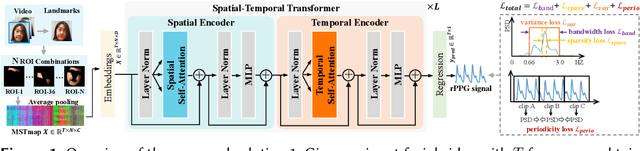
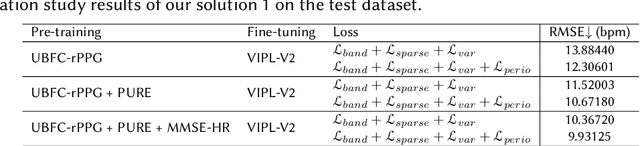
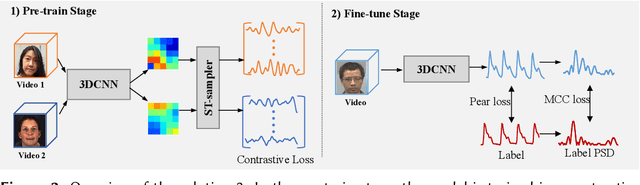
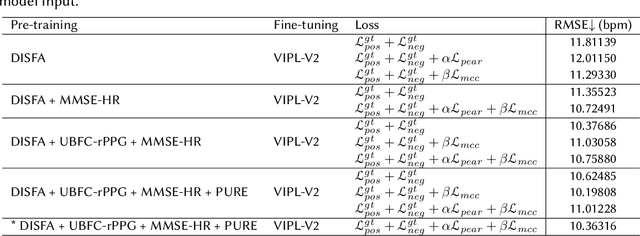
This paper briefly introduces the solutions developed by our team, HFUT-VUT, for Track 1 of self-supervised heart rate measurement in the 3rd Vision-based Remote Physiological Signal Sensing (RePSS) Challenge hosted at IJCAI 2024. The goal is to develop a self-supervised learning algorithm for heart rate (HR) estimation using unlabeled facial videos. To tackle this task, we present two self-supervised HR estimation solutions that integrate spatial-temporal modeling and contrastive learning, respectively. Specifically, we first propose a non-end-to-end self-supervised HR measurement framework based on spatial-temporal modeling, which can effectively capture subtle rPPG clues and leverage the inherent bandwidth and periodicity characteristics of rPPG to constrain the model. Meanwhile, we employ an excellent end-to-end solution based on contrastive learning, aiming to generalize across different scenarios from complementary perspectives. Finally, we combine the strengths of the above solutions through an ensemble strategy to generate the final predictions, leading to a more accurate HR estimation. As a result, our solutions achieved a remarkable RMSE score of 8.85277 on the test dataset, securing \textbf{2nd place} in Track 1 of the challenge.
Mutilmodal Feature Extraction and Attention-based Fusion for Emotion Estimation in Videos
Mar 18, 2023
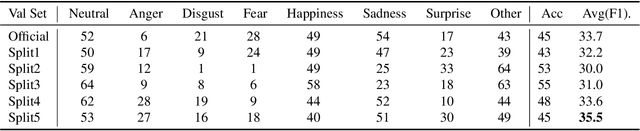

The continuous improvement of human-computer interaction technology makes it possible to compute emotions. In this paper, we introduce our submission to the CVPR 2023 Competition on Affective Behavior Analysis in-the-wild (ABAW). Sentiment analysis in human-computer interaction should, as far as possible Start with multiple dimensions, fill in the single imperfect emotion channel, and finally determine the emotion tendency by fitting multiple results. Therefore, We exploited multimodal features extracted from video of different lengths from the competition dataset, including audio, pose and images. Well-informed emotion representations drive us to propose a Attention-based multimodal framework for emotion estimation. Our system achieves the performance of 0.361 on the validation dataset. The code is available at [https://github.com/xkwangcn/ABAW-5th-RT-IAI].