 Add to Chrome
 Add to Firefox
 Add to Edge
Degraded Infrared Small Object Detection via Degradation-Adapted Physics-Guided Restoration
Aug 10, 2026
Infrared small object detection has made significant progress in recent years. However, degradations such as fog and nonuniformity can suppress target-background contrast, substantially increasing detection difficulty. Existing methods mainly rely on image restoration as preprocessing, but they are typically designed for specific degradation types and fail to generalize to varying degradations. To alleviate this, we propose DAISOD, a degradation-adapted infrared small object detection framework for robust detection under different degradations. DAISOD first identifies the type and severity of degradations, then adapts the processing via dedicated branches, and finally fuses the results for subsequent detection. Moreover, a physics-guided restoration mechanism is incorporated to explicitly estimate degradation parameters and remove degradation effects through physical models, avoiding excessive restoration that may erase small targets. Moreover, we construct a degraded infrared small object detection dataset covering diverse degradation types and levels. Extensive experiments show that DAISOD outperforms state-of-the-art methods under various degradation conditions.

Video Object Segmentation with Episodic Graph Memory Networks
Jul 19, 2020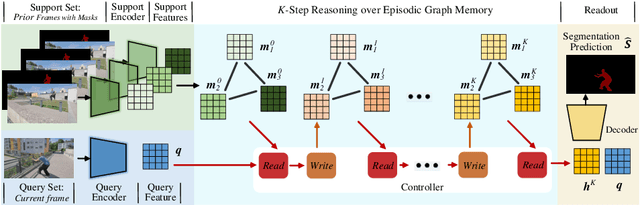
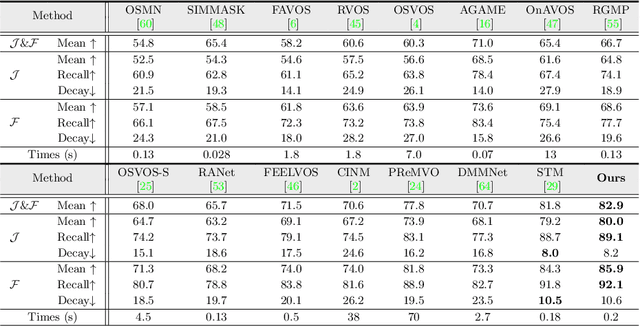
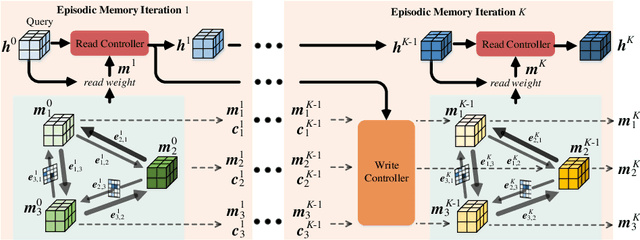
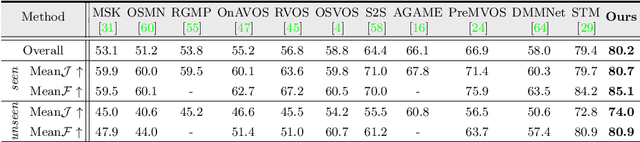
How to make a segmentation model efficiently adapt to a specific video and to online target appearance variations are fundamentally crucial issues in the field of video object segmentation. In this work, a graph memory network is developed to address the novel idea of "learning to update the segmentation model". Specifically, we exploit an episodic memory network, organized as a fully connected graph, to store frames as nodes and capture cross-frame correlations by edges. Further, learnable controllers are embedded to ease memory reading and writing, as well as maintain a fixed memory scale. The structured, external memory design enables our model to comprehensively mine and quickly store new knowledge, even with limited visual information, and the differentiable memory controllers slowly learn an abstract method for storing useful representations in the memory and how to later use these representations for prediction, via gradient descent. In addition, the proposed graph memory network yields a neat yet principled framework, which can generalize well both one-shot and zero-shot video object segmentation tasks. Extensive experiments on four challenging benchmark datasets verify that our graph memory network is able to facilitate the adaptation of the segmentation network for case-by-case video object segmentation.