 Add to Chrome
 Add to Firefox
 Add to Edge
Degraded Infrared Small Object Detection via Degradation-Adapted Physics-Guided Restoration
Aug 10, 2026
Infrared small object detection has made significant progress in recent years. However, degradations such as fog and nonuniformity can suppress target-background contrast, substantially increasing detection difficulty. Existing methods mainly rely on image restoration as preprocessing, but they are typically designed for specific degradation types and fail to generalize to varying degradations. To alleviate this, we propose DAISOD, a degradation-adapted infrared small object detection framework for robust detection under different degradations. DAISOD first identifies the type and severity of degradations, then adapts the processing via dedicated branches, and finally fuses the results for subsequent detection. Moreover, a physics-guided restoration mechanism is incorporated to explicitly estimate degradation parameters and remove degradation effects through physical models, avoiding excessive restoration that may erase small targets. Moreover, we construct a degraded infrared small object detection dataset covering diverse degradation types and levels. Extensive experiments show that DAISOD outperforms state-of-the-art methods under various degradation conditions.

Differential 6-DOF Pose Estimation with Provable First-Order Immunity to Camera Calibration Errors
Aug 05, 2026Accurate six-degree-of-freedom (6-DOF) motion estimation is essential for robotic manipulation, autonomous systems, and structural displacement monitoring. Conventional 3D-2D methods estimate absolute camera poses independently at each time and recover platform motion through camera-to-platform extrinsics, making them sensitive to extrinsic calibration errors, especially for micromotion. We present a differential pose estimation method that directly recovers platform motion from inter-frame image displacements and known 3D control points. By differencing perspective projection equations, using a depth-invariance approximation, and modeling motion on SE(3), the method avoids independent absolute-pose estimation and supports both monocular and multi-camera systems. We prove that translational extrinsic errors cancel exactly, while rotational errors induce a bounded perturbation determined by calibration error, motion magnitude, and observation geometry. We also derive generic observability conditions, a Cramer-Rao lower bound, and a bias-eliminated consistent estimator, and characterize the validity limits of the approximations. Extensive synthetic and real-world experiments establish a new state of the art for 6-DOF platform micromotion estimation, outperforming representative PnP and generalized-PnP methods in accuracy, calibration robustness, and computational efficiency. With five control points and 0.5-pixel image noise, the monocular solver obtains a combined pitch-yaw rotation RMSE of 10.09 arcsec, a translation RMSE of 3.70 mm, and a runtime of 0.34 ms. The binocular solver achieves a rotation RMSE of 10.58 arcsec, a translation RMSE of 3.91 mm, and a runtime of 0.27 ms. Code will be released upon publication at https://github.com/zyoungszu/pami2026.
Multimodal Laryngoscopic Video Analysis for Assisted Diagnosis of Vocal Cord Paralysis
Sep 05, 2024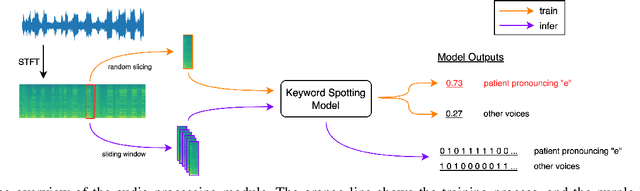
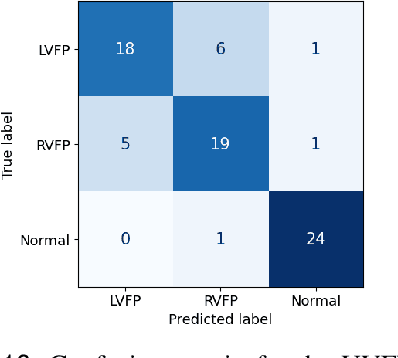
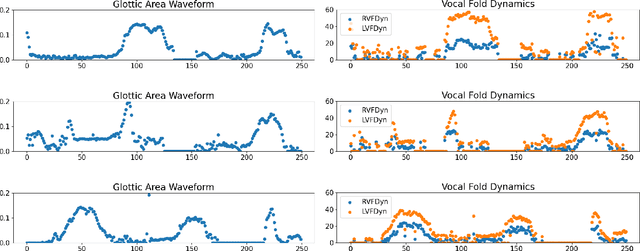
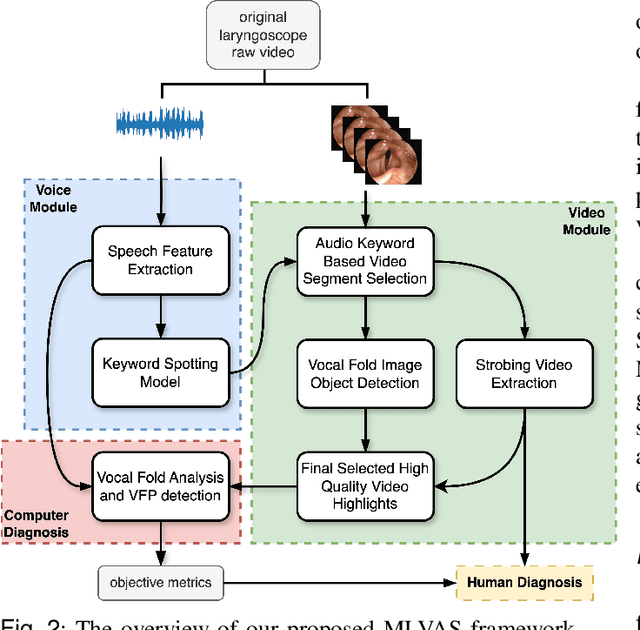
This paper presents the Multimodal Analyzing System for Laryngoscope (MASL), a system that combines audio and video data to automatically extract key segments and metrics from laryngeal videostroboscopic videos for clinical assessment. MASL integrates glottis detection with keyword spotting to analyze patient vocalizations and refine video highlights for better inspection of vocal cord movements. The system includes a strobing video extraction module that identifies frames by analyzing hue, saturation, and value fluctuations. MASL also provides effective metrics for vocal cord paralysis detection, employing a two-stage glottis segmentation process using U-Net followed by diffusion-based refinement to reduce false positives. Instead of glottal area waveforms, MASL estimates anterior glottic angle waveforms (AGAW) from glottis masks, evaluating both left and right vocal cords to detect unilateral vocal cord paralysis (UVFP). By comparing AGAW variances, MASL distinguishes between left and right paralysis. Ablation studies and experiments on public and real-world datasets validate MASL's segmentation module and demonstrate its ability to provide reliable metrics for UVFP diagnosis.
FSOINet: Feature-Space Optimization-Inspired Network for Image Compressive Sensing
Apr 12, 2022
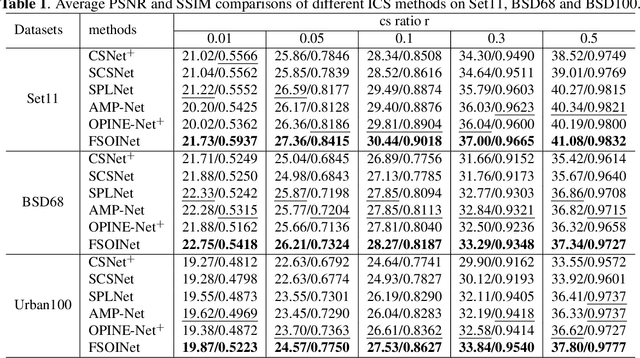
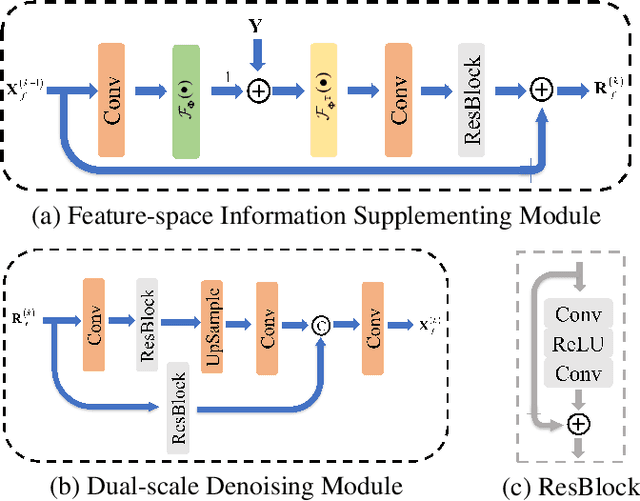
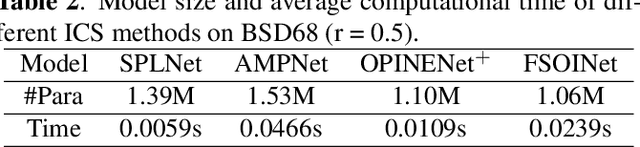
In recent years, deep learning-based image compressive sensing (ICS) methods have achieved brilliant success. Many optimization-inspired networks have been proposed to bring the insights of optimization algorithms into the network structure design and have achieved excellent reconstruction quality with low computational complexity. But they keep the information flow in pixel space as traditional algorithms by updating and transferring the image in pixel space, which does not fully use the information in the image features. In this paper, we propose the idea of achieving information flow phase by phase in feature space and design a Feature-Space Optimization-Inspired Network (dubbed FSOINet) to implement it by mapping both steps of proximal gradient descent algorithm from pixel space to feature space. Moreover, the sampling matrix is learned end-to-end with other network parameters. Experiments show that the proposed FSOINet outperforms the existing state-of-the-art methods by a large margin both quantitatively and qualitatively. The source code is available on https://github.com/cwjjun/FSOINet.