 Add to Chrome
 Add to Firefox
 Add to Edge
Cooperative-Competitive Team Play of Real-World Craft Robots
Feb 24, 2026
Multi-agent deep Reinforcement Learning (RL) has made significant progress in developing intelligent game-playing agents in recent years. However, the efficient training of collective robots using multi-agent RL and the transfer of learned policies to real-world applications remain open research questions. In this work, we first develop a comprehensive robotic system, including simulation, distributed learning framework, and physical robot components. We then propose and evaluate reinforcement learning techniques designed for efficient training of cooperative and competitive policies on this platform. To address the challenges of multi-agent sim-to-real transfer, we introduce Out of Distribution State Initialization (OODSI) to mitigate the impact of the sim-to-real gap. In the experiments, OODSI improves the Sim2Real performance by 20%. We demonstrate the effectiveness of our approach through experiments with a multi-robot car competitive game and a cooperative task in real-world settings.

Emergent collective intelligence from massive-agent cooperation and competition
Jan 05, 2023

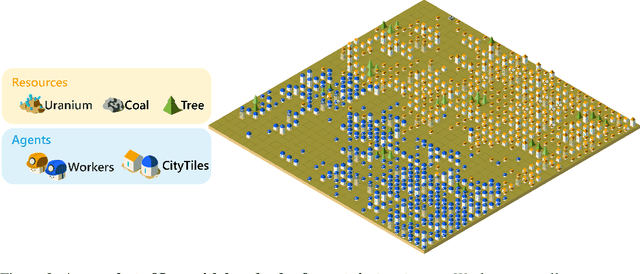
Inspired by organisms evolving through cooperation and competition between different populations on Earth, we study the emergence of artificial collective intelligence through massive-agent reinforcement learning. To this end, We propose a new massive-agent reinforcement learning environment, Lux, where dynamic and massive agents in two teams scramble for limited resources and fight off the darkness. In Lux, we build our agents through the standard reinforcement learning algorithm in curriculum learning phases and leverage centralized control via a pixel-to-pixel policy network. As agents co-evolve through self-play, we observe several stages of intelligence, from the acquisition of atomic skills to the development of group strategies. Since these learned group strategies arise from individual decisions without an explicit coordination mechanism, we claim that artificial collective intelligence emerges from massive-agent cooperation and competition. We further analyze the emergence of various learned strategies through metrics and ablation studies, aiming to provide insights for reinforcement learning implementations in massive-agent environments.