 Add to Chrome
 Add to Firefox
 Add to Edge
DreamUV: Unwrap Artist-like UV by End-to-End Flow Matching
Jun 21, 2026
UV parameterization is a fundamental step in 3D content creation, yet producing production-ready UV layouts remains challenging due to the gap between geometric distortion objectives and the stylistic preferences of professional artists. While classical methods optimize handcrafted energy functions, artist-authored UVs exhibit structural patterns such as straightened seams, axis-aligned islands, and flexible interior deformation, properties that are difficult to explicitly formulate. In this work, we present DreamUV, an end-to-end learning framework that formulates UV unwrapping as a generative Flow Matching problem. Rather than predicting a single optimal parameterization, DreamUV learns a mesh-conditioned transport process that maps noise samples to a distribution of artist-like UV layouts. To reflect real-world authoring practices, we introduce a boundary-aware training strategy that prioritizes seam geometry, and a Model-in-the-Loop Finetuning(MITL) scheme that explicitly accounts for discretization errors during sampling and stabilizes transport dynamics under heterogeneous supervision. We evaluate DreamUV on a large-scale dataset of professionally authored UV layouts. Experiments demonstrate that our method produces significantly straighter boundaries and tighter axis-aligned islands than both classical and learning-based baselines, while maintaining competitive distortion metrics. Qualitative results and a user study with professional artists further confirm that DreamUV generates UV layouts that are not only valid, but aligned with practical production requirements.

SuperVoxelGPT: Adaptive and Ordered 3D Tokenization for Autoregressive Shape Generation
May 28, 2026Autoregressive multimodal large language models (MLLMs) enable 3D generation but struggle to scale to high-resolution shapes due to inadequate 3D tokenizations. Compact set-based representations discard deterministic spatial ordering, leading to ambiguous sequence prediction, while uniform or octree-based voxel grids preserve ordering at the cost of severe redundancy and excessively long sequences. This structural trade-off limits stable and efficient autoregressive 3D generation. We present SuperVoxelGPT, a representation-first framework that resolves this tension through adaptive and deterministically ordered supervoxel tokenization. Given a prompt, we first predict a coarse geometric saliency distribution and construct a shape-adaptive supervoxel partition using saliency-guided centroidal Voronoi tessellation, allocating fine-grained cells to complex regions and larger cells to smooth regions. Conditioned on the text and ordered supervoxel layout, we introduce a SuperVoxelVAE and fine-tune a pretrained MLLM to autoregressively generate supervoxel tokens. Experiments on Trellis-500K show that SuperVoxelGPT reduces token sequence length to 12.8% of uniform voxel tokenization while achieving state-of-the-art generation quality and an average 10$\times$ speedup over prior methods.
ARGS: Auto-Regressive Gaussian Splatting via Parallel Progressive Next-Scale Prediction
Apr 01, 2026Auto-regressive frameworks for next-scale prediction of 2D images have demonstrated strong potential for producing diverse and sophisticated content by progressively refining a coarse input. However, extending this paradigm to 3D object generation remains largely unexplored. In this paper, we introduce auto-regressive Gaussian splatting (ARGS), a framework for making next-scale predictions in parallel for generation according to levels of detail. We propose a Gaussian simplification strategy and reverse the simplification to guide next-scale generation. Benefiting from the use of hierarchical trees, the generation process requires only \(\mathcal{O}(\log n)\) steps, where \(n\) is the number of points. Furthermore, we propose a tree-based transformer to predict the tree structure auto-regressively, allowing leaf nodes to attend to their internal ancestors to enhance structural consistency. Extensive experiments demonstrate that our approach effectively generates multi-scale Gaussian representations with controllable levels of detail, visual fidelity, and a manageable time consumption budget.
Internal State Estimation in Groups via Active Information Gathering
May 15, 2025Accurately estimating human internal states, such as personality traits or behavioral patterns, is critical for enhancing the effectiveness of human-robot interaction, particularly in group settings. These insights are key in applications ranging from social navigation to autism diagnosis. However, prior methods are limited by scalability and passive observation, making real-time estimation in complex, multi-human settings difficult. In this work, we propose a practical method for active human personality estimation in groups, with a focus on applications related to Autism Spectrum Disorder (ASD). Our method combines a personality-conditioned behavior model, based on the Eysenck 3-Factor theory, with an active robot information gathering policy that triggers human behaviors through a receding-horizon planner. The robot's belief about human personality is then updated via Bayesian inference. We demonstrate the effectiveness of our approach through simulations, user studies with typical adults, and preliminary experiments involving participants with ASD. Our results show that our method can scale to tens of humans and reduce personality prediction error by 29.2% and uncertainty by 79.9% in simulation. User studies with typical adults confirm the method's ability to generalize across complex personality distributions. Additionally, we explore its application in autism-related scenarios, demonstrating that the method can identify the difference between neurotypical and autistic behavior, highlighting its potential for diagnosing ASD. The results suggest that our framework could serve as a foundation for future ASD-specific interventions.
SDRS: Shape-Differentiable Robot Simulator
Dec 26, 2024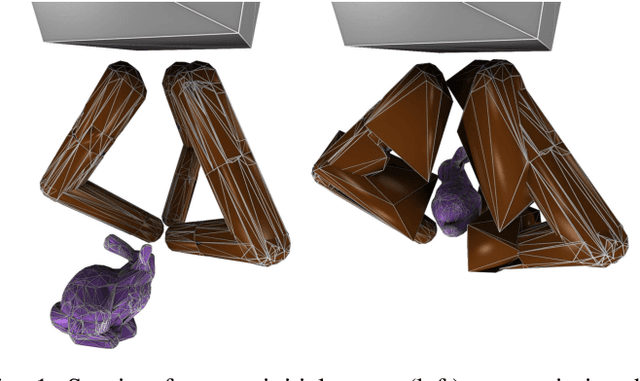

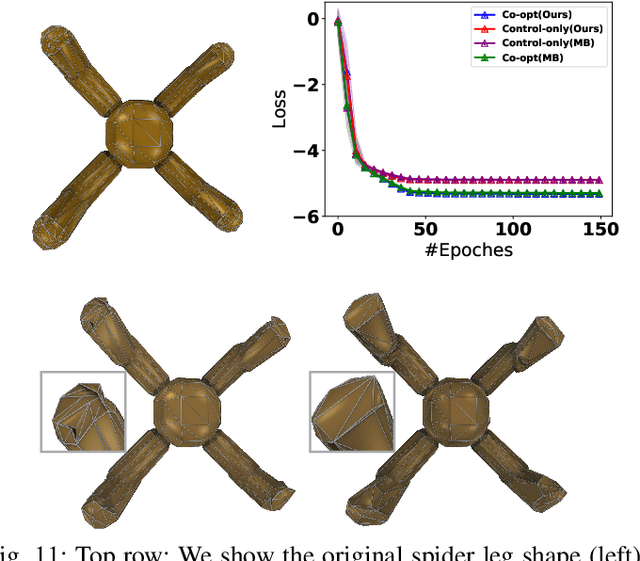
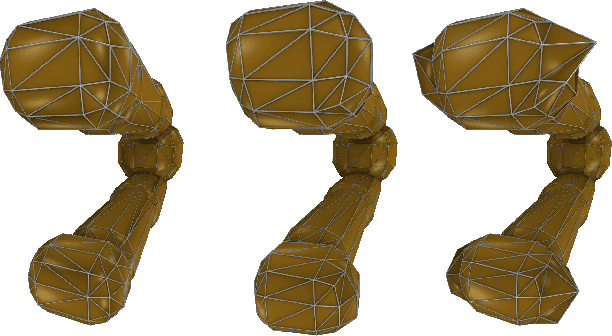
Robot simulators are indispensable tools across many fields, and recent research has significantly improved their functionality by incorporating additional gradient information. However, existing differentiable robot simulators suffer from non-differentiable singularities, when robots undergo substantial shape changes. To address this, we present the Shape-Differentiable Robot Simulator (SDRS), designed to be differentiable under significant robot shape changes. The core innovation of SDRS lies in its representation of robot shapes using a set of convex polyhedrons. This approach allows us to generalize smooth, penalty-based contact mechanics for interactions between any pair of convex polyhedrons. Using the separating hyperplane theorem, SDRS introduces a separating plane for each pair of contacting convex polyhedrons. This separating plane functions as a zero-mass auxiliary entity, with its state determined by the principle of least action. This setup ensures global differentiability, even as robot shapes undergo significant geometric and topological changes. To demonstrate the practical value of SDRS, we provide examples of robot co-design scenarios, where both robot shapes and control movements are optimized simultaneously.
Learning Neural Traffic Rules
Dec 03, 2023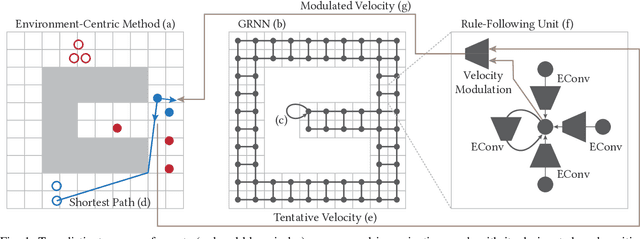
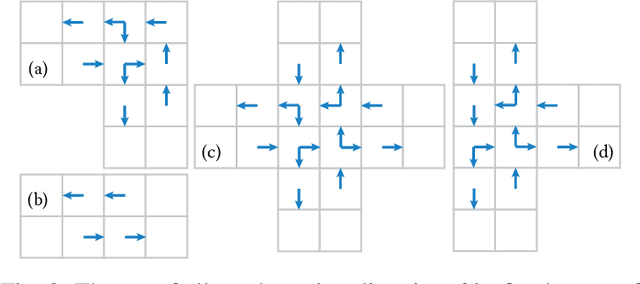
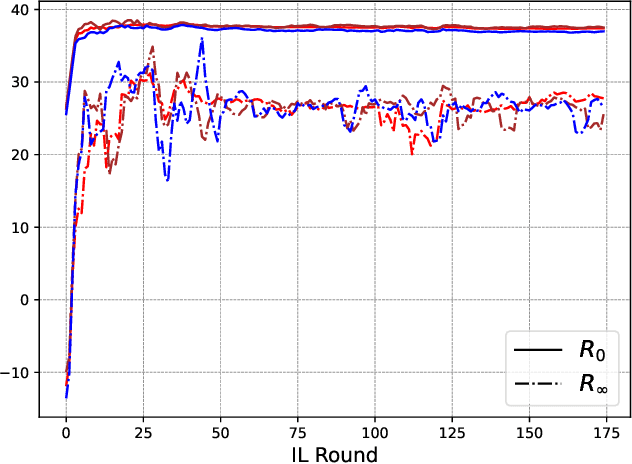
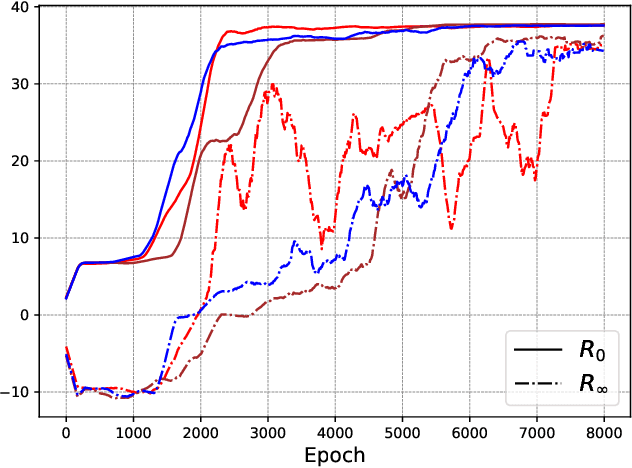
Extensive research has been devoted to the field of multi-agent navigation. Recently, there has been remarkable progress attributed to the emergence of learning-based techniques with substantially elevated intelligence and realism. Nonetheless, prevailing learned models face limitations in terms of scalability and effectiveness, primarily due to their agent-centric nature, i.e., the learned neural policy is individually deployed on each agent. Inspired by the efficiency observed in real-world traffic networks, we present an environment-centric navigation policy. Our method learns a set of traffic rules to coordinate a vast group of unintelligent agents that possess only basic collision-avoidance capabilities. Our method segments the environment into distinct blocks and parameterizes the traffic rule using a Graph Recurrent Neural Network (GRNN) over the block network. Each GRNN node is trained to modulate the velocities of agents as they traverse through. Using either Imitation Learning (IL) or Reinforcement Learning (RL) schemes, we demonstrate the efficacy of our neural traffic rules in resolving agent congestion, closely resembling real-world traffic regulations. Our method handles up to $240$ agents at real-time and generalizes across diverse agent and environment configurations.
Consistent Mesh Diffusion
Dec 01, 2023Given a 3D mesh with a UV parameterization, we introduce a novel approach to generating textures from text prompts. While prior work uses optimization from Text-to-Image Diffusion models to generate textures and geometry, this is slow and requires significant compute resources. Alternatively, there are projection based approaches that use the same Text-to-Image models that paint images onto a mesh, but lack consistency at different viewing angles, we propose a method that uses a single Depth-to-Image diffusion network, and generates a single consistent texture when rendered on the 3D surface by first unifying multiple 2D image's diffusion paths, and hoisting that to 3D with MultiDiffusion~\cite{multidiffusion}. We demonstrate our approach on a dataset containing 30 meshes, taking approximately 5 minutes per mesh. To evaluate the quality of our approach, we use CLIP-score~\cite{clipscore} and Frechet Inception Distance (FID)~\cite{frechet} to evaluate the quality of the rendering, and show our improvement over prior work.
GaussianShader: 3D Gaussian Splatting with Shading Functions for Reflective Surfaces
Nov 29, 2023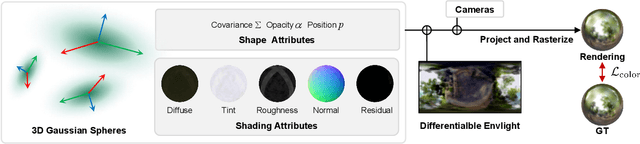
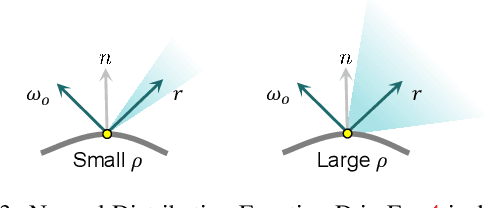
The advent of neural 3D Gaussians has recently brought about a revolution in the field of neural rendering, facilitating the generation of high-quality renderings at real-time speeds. However, the explicit and discrete representation encounters challenges when applied to scenes featuring reflective surfaces. In this paper, we present GaussianShader, a novel method that applies a simplified shading function on 3D Gaussians to enhance the neural rendering in scenes with reflective surfaces while preserving the training and rendering efficiency. The main challenge in applying the shading function lies in the accurate normal estimation on discrete 3D Gaussians. Specifically, we proposed a novel normal estimation framework based on the shortest axis directions of 3D Gaussians with a delicately designed loss to make the consistency between the normals and the geometries of Gaussian spheres. Experiments show that GaussianShader strikes a commendable balance between efficiency and visual quality. Our method surpasses Gaussian Splatting in PSNR on specular object datasets, exhibiting an improvement of 1.57dB. When compared to prior works handling reflective surfaces, such as Ref-NeRF, our optimization time is significantly accelerated (23h vs. 0.58h). Please click on our project website to see more results.
Second-Order Convergent Collision-Constrained Optimization-Based Planner
Nov 03, 2023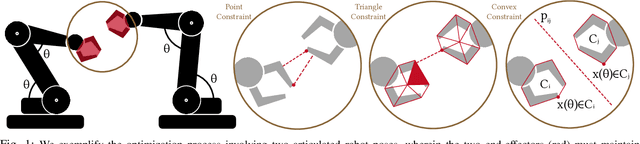
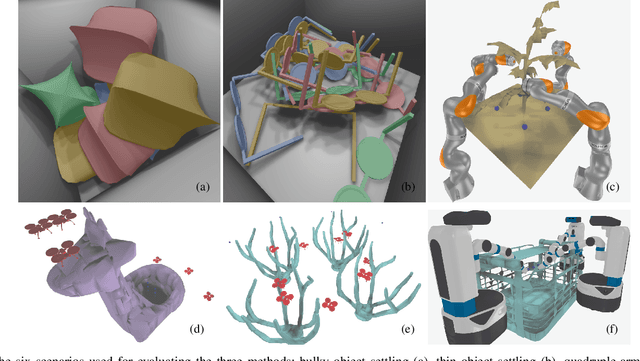
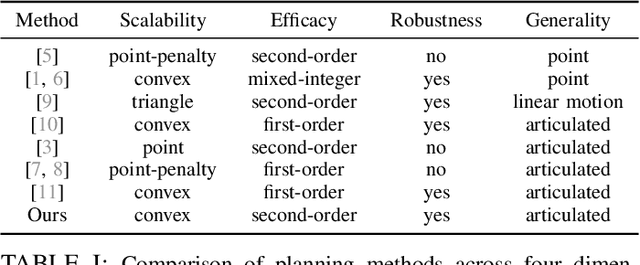
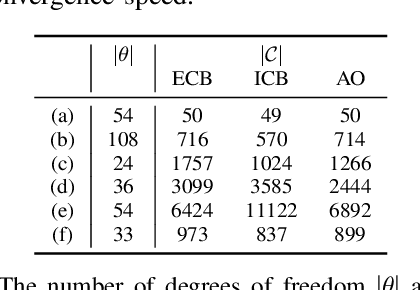
Finding robot poses and trajectories represents a foundational aspect of robot motion planning. Despite decades of research, efficiently and robustly addressing these challenges is still difficult. Existing approaches are often plagued by various limitations, such as intricate geometric approximations, violations of collision constraints, or slow first-order convergence. In this paper, we introduce two novel optimization formulations that offer provable robustness, achieving second-order convergence while requiring only a convex approximation of the robot's links and obstacles. Our first method, known as the Explicit Collision Barrier (ECB) method, employs a barrier function to guarantee separation between convex objects. ECB uses an efficient matrix factorization technique, enabling a second-order Newton's method with an iterative complexity linear in the number of separating planes. Our second method, referred to as the Implicit Collision Barrier (ICB) method, further transforms the separating planes into implicit functions of robot poses. We show such an implicit objective function is twice-differentiable, with derivatives evaluated at a linear complexity. To assess the effectiveness of our approaches, we conduct a comparative study with a first-order baseline algorithm across six testing scenarios. Our results unequivocally justify that our method exhibits significantly faster convergence rates compared to the baseline algorithm.
Learning Reduced-Order Soft Robot Controller
Nov 03, 2023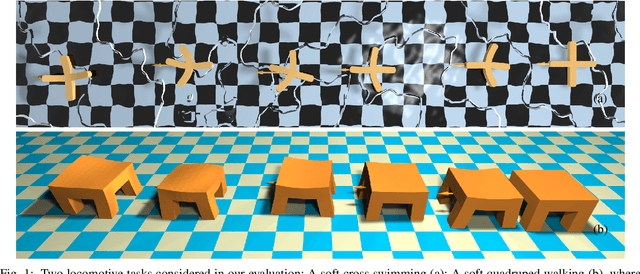

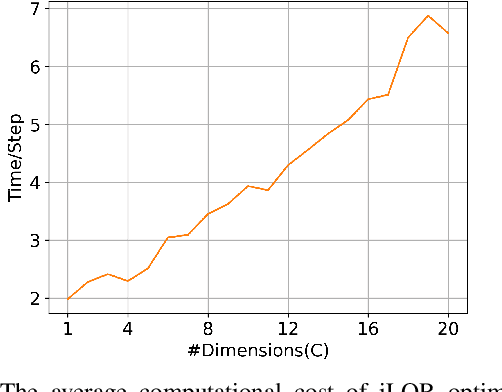
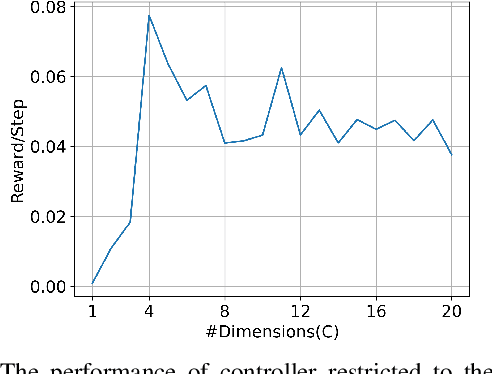
Deformable robots are notoriously difficult to model or control due to its high-dimensional configuration spaces. Direct trajectory optimization suffers from the curse-of-dimensionality and incurs a high computational cost, while learning-based controller optimization methods are sensitive to hyper-parameter tuning. To overcome these limitations, we hypothesize that high fidelity soft robots can be both simulated and controlled by restricting to low-dimensional spaces. Under such assumption, we propose a two-stage algorithm to identify such simulation- and control-spaces. Our method first identifies the so-called simulation-space that captures the salient deformation modes, to which the robot's governing equation is restricted. We then identify the control-space, to which control signals are restricted. We propose a multi-fidelity Riemannian Bayesian bilevel optimization to identify task-specific control spaces. We show that the dimension of control-space can be less than $10$ for a high-DOF soft robot to accomplish walking and swimming tasks, allowing low-dimensional MPC controllers to be applied to soft robots with tractable computational complexity.