 Add to Chrome
 Add to Firefox
 Add to Edge
GroupMemBench: Benchmarking LLM Agent Memory in Multi-Party Conversations
May 14, 2026
Large Language Model (LLM) agents increasingly serve as personal assistants and workplace collaborators, where their utility depends on memory systems that extract, retrieve, and apply information across long-running conversations. However, both existing memory systems and benchmarks are built around the dyadic, single-user setup, even though real deployments routinely span groups and channels with multiple users interacting with the agent and with each other. This mismatch leaves three properties of group memory unmeasured: (i) group dynamics that go beyond concatenated one-on-one chats, (ii) speaker-grounded belief tracking, where the per-user memory modeling is needed, and (iii) audience-adapted language, where Theory-of-Mind shifts produce role-specific vocabulary. We introduce GroupMemBench, a benchmark that exposes all three. A graph-grounded synthesis pipeline produces multi-party conversations with controllable reply structure and conditions each message on per-user personas and target audiences. An adversarial query pipeline then binds every question to a specific asker across six categories, spanning multi-hop reasoning, knowledge update, term ambiguity, user-implicit reasoning, temporal reasoning, and abstention, and iteratively searches challenging, realistic queries that reflect comprehensive memory capability. Benchmarking leading memory systems exposes a sharp collapse: the strongest one reaches only 46.0% average accuracy, with knowledge update at 27.1% and term ambiguity at 37.7%, while a simple BM25 baseline matches or exceeds most agent memory systems. This indicates current memory ingestion erases the structural and lexical features group memory depends on, leaving multi-user memory far from solved.

CT-Conditioned Diffusion Prior with Physics-Constrained Sampling for PET Super-Resolution
Mar 14, 2026PET super-resolution is highly under-constrained because paired multi-resolution scans from the same subject are rarely available, and effective resolution is determined by scanner-specific physics (e.g., PSF, detector geometry, and acquisition settings). This limits supervised end-to-end training and makes purely image-domain generative restoration prone to hallucinated structures when anatomical and physical constraints are weak. We formulate PET super-resolution as posterior inference under heterogeneous system configurations and propose a CT-conditioned diffusion framework with physics-constrained sampling. During training, a conditional diffusion prior is learned from high-quality PET/CT pairs using cross-attention for anatomical guidance, without requiring paired LR--HR PET data. During inference, measurement consistency is enforced through a scanner-aware forward model with explicit PSF effects and gradient-based data-consistency refinement. Under both standard and OOD settings, the proposed method consistently improves experimental metrics and lesion-level clinical relevance indicators over strong baselines, while reducing hallucination artifacts and improving structural fidelity.
A Survey of Datasets for Information Diffusion Tasks
Jul 06, 2024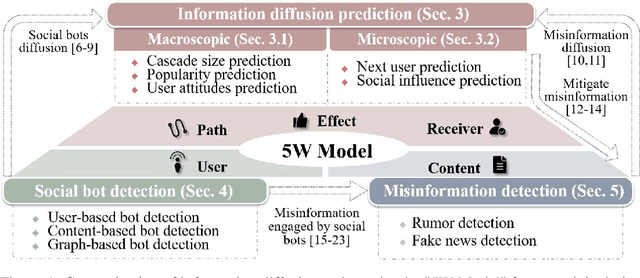
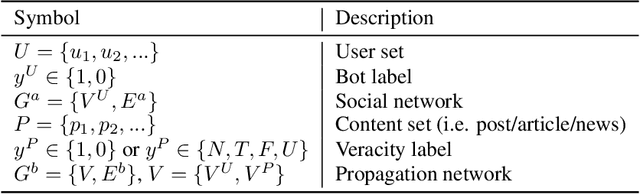
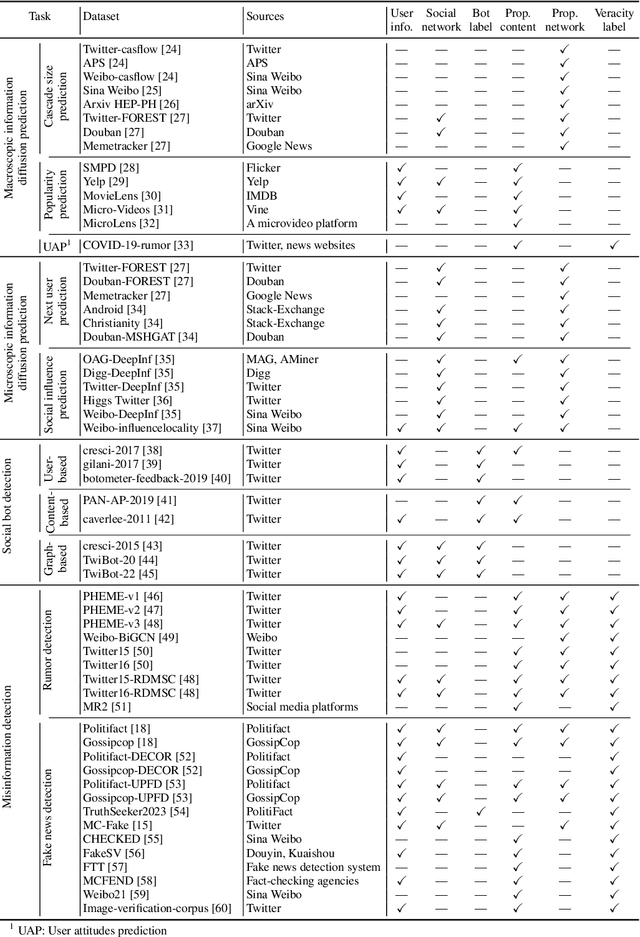
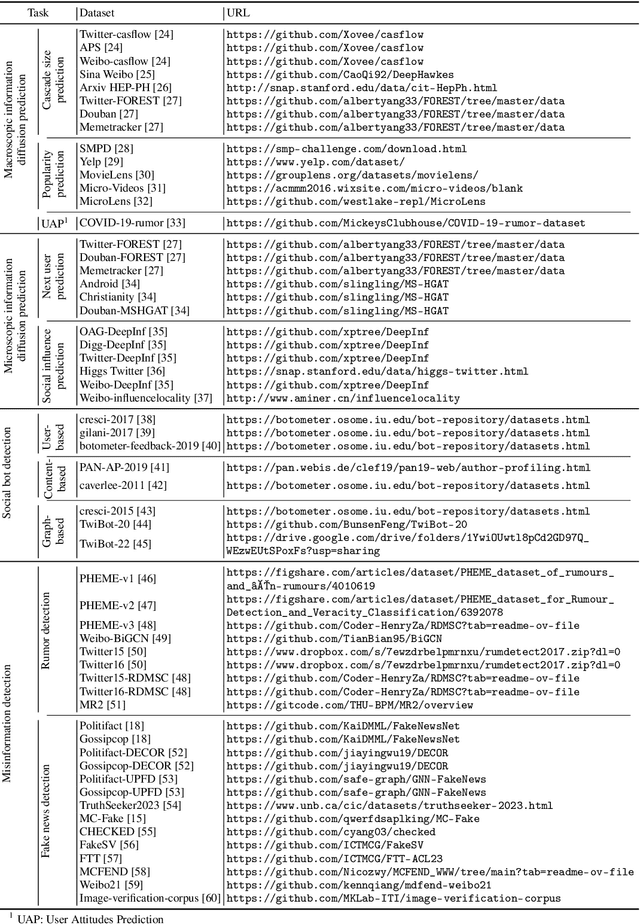
Information diffusion across various new media platforms gradually influences perceptions, decisions, and social behaviors of individual users. In communication studies, the famous Five W's of Communication model (5W Model) has displayed the process of information diffusion clearly. At present, although plenty of studies and corresponding datasets about information diffusion have emerged, a systematic categorization of tasks and an integration of datasets are still lacking. To address this gap, we survey a systematic taxonomy of information diffusion tasks and datasets based on the "5W Model" framework. We first categorize the information diffusion tasks into ten subtasks with definitions and datasets analysis, from three main tasks of information diffusion prediction, social bot detection, and misinformation detection. We also collect the publicly available dataset repository of information diffusion tasks with the available links and compare them based on six attributes affiliated to users and content: user information, social network, bot label, propagation content, propagation network, and veracity label. In addition, we discuss the limitations and future directions of current datasets and research topics to advance the future development of information diffusion. The dataset repository can be accessed at our website https://github.com/fuxiaG/Information-Diffusion-Datasets.