 Add to Chrome
 Add to Firefox
 Add to Edge
Energy-Based Cell Association in Nonuniform Renewable Energy-Powered Cellular Networks: Analysis and Optimization of Carbon Efficiency
Jan 19, 2026
The increasing global push for carbon reduction highlights the importance of integrating renewable energy into the supply chain of cellular networks. However, due to the stochastic nature of renewable energy generation and the uneven load distribution across base stations, the utilization rate of renewable energy remains low. To address these challenges, this paper investigates the trade-off between carbon emissions and downlink throughput in cellular networks, offering insights into optimizing both network performance and sustainability. The renewable energy state of base station batteries and the number of occupied channels are modeled as a quasi-birth-death process. We construct models for the probability of channel blocking, average successful transmission probability for users, downlink throughput, carbon emissions, and carbon efficiency based on stochastic geometry. Based on these analyses, an energy-based cell association scheme is proposed to optimize the carbon efficiency of cellular networks. The results show that, compared to the closest cell association scheme, the energy-based cell association scheme is capable of reducing the carbon emissions of the network by 13.0% and improving the carbon efficiency by 11.3%.

Policy Gradient Algorithms for Age-of-Information Cost Minimization
Dec 12, 2025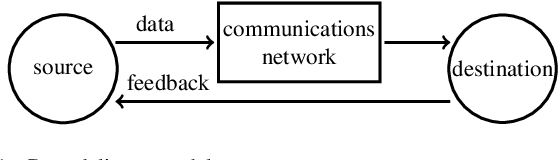
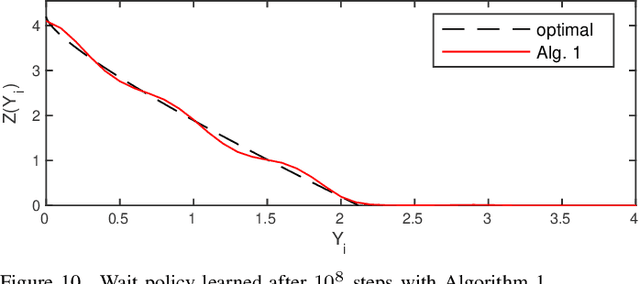
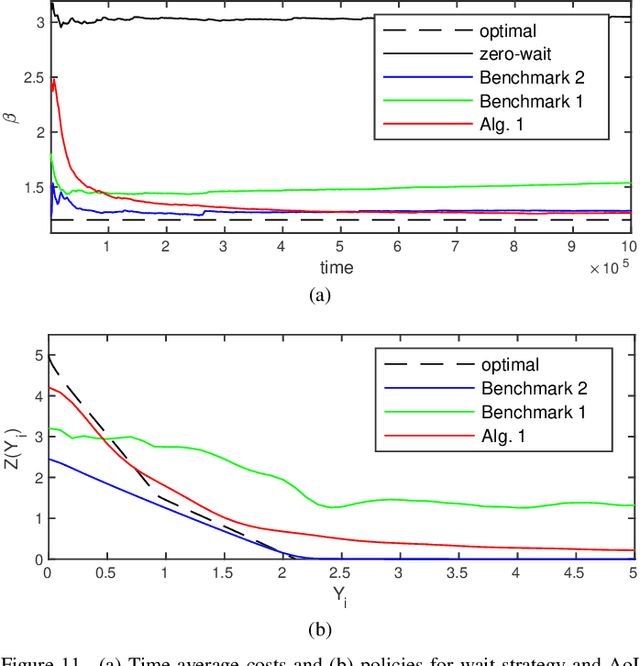
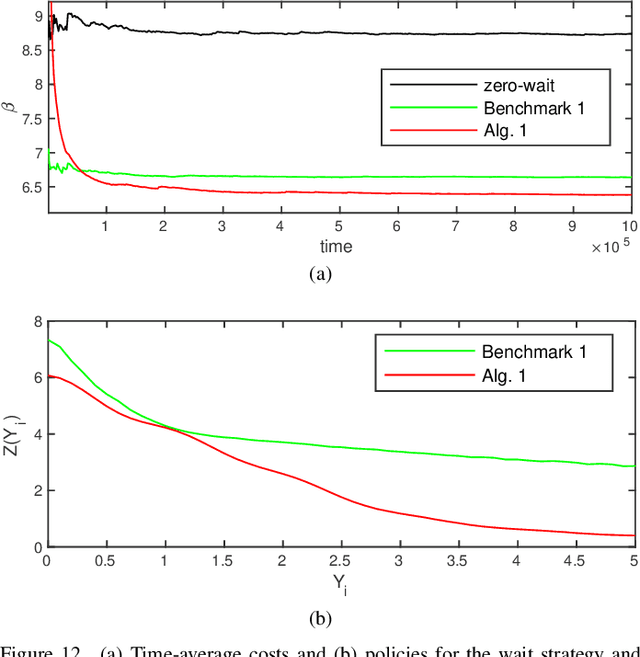
Recent developments in cyber-physical systems have increased the importance of maximizing the freshness of the information about the physical environment. However, optimizing the access policies of Internet of Things devices to maximize the data freshness, measured as a function of the Age-of-Information (AoI) metric, is a challenging task. This work introduces two algorithms to optimize the information update process in cyber-physical systems operating under the generate-at-will model, by finding an online policy without knowing the characteristics of the transmission delay or the age cost function. The optimization seeks to minimize the time-average cost, which integrates the AoI at the receiver and the data transmission cost, making the approach suitable for a broad range of scenarios. Both algorithms employ policy gradient methods within the framework of model-free reinforcement learning (RL) and are specifically designed to handle continuous state and action spaces. Each algorithm minimizes the cost using a distinct strategy for deciding when to send an information update. Moreover, we demonstrate that it is feasible to apply the two strategies simultaneously, leading to an additional reduction in cost. The results demonstrate that the proposed algorithms exhibit good convergence properties and achieve a time-average cost within 3% of the optimal value, when the latter is computable. A comparison with other state-of-the-art methods shows that the proposed algorithms outperform them in one or more of the following aspects: being applicable to a broader range of scenarios, achieving a lower time-average cost, and requiring a computational cost at least one order of magnitude lower.