 Add to Chrome
 Add to Firefox
 Add to Edge
Deep Reinforcement Learning-Enhanced Event-Triggered Data-Driven Predictive Control for a 3D Cable-Driven Soft Robotic Arm
Jun 24, 2026
Soft robots are challenging to control due to their nonlinear and time-varying dynamics. Data-enabled predictive control (DeePC) offers a model-free alternative by directly leveraging measured input-output trajectories to construct a predictive controller. However, its receding-horizon formulation requires solving a constrained optimization problem at every sampling instant, which can be computationally demanding for real-time deployment on resource-limited robotic platforms.To address this limitation, we propose an adaptive reinforcement-learning-based event-triggered DeePC (RL-ET-DeePC) framework for soft robotic control. A model-free RL policy is trained to determine when to invoke the DeePC optimizer based on the current system state representation, thereby reducing unnecessary optimization calls while preserving closed-loop performance.Simulation results show that RL-ET-DeePC reduces optimization frequency by up to 66% compared to periodic DeePC, while maintaining comparable tracking accuracy. Hardware experiments on a three-dimensional cable-driven soft robotic arm demonstrate zero-shot transfer, achieving a 34% reduction in optimization frequency with tracking accuracy comparable to periodic DeePC and more consistent performance than a static threshold-based event-triggered baseline.

BiPneu: Design and Control of a Bipolar-Pressure Pneumatic System for Soft Robots
May 12, 2026Positive-negative pressure regulation is critical to soft robotic actuators, enabling large motion ranges and versatile actuation modes. However, achieving high-performance regulation across both pressure polarities remains challenging due to asymmetric inflation-deflation dynamics, valve nonlinearities, and switching-induced flow disturbances. This paper presents BiPneu, a scalable and cost-efficient multi-channel bipolar-pressure pneumatic system for soft robots that enables wide-range, accurate, and responsive pressure regulation while providing seamless compatibility with high-level software ecosystems. A dual-mode sliding-mode controller (DM-SMC) with hysteresis-supervised mode selection is proposed based on a hybrid electro-pneumatic model. Extensive simulation and experiments demonstrate the superior performance of DM-SMC in tracking step and sinusoidal pressure references compared with both advanced model predictive controllers and well-tuned PID controllers. Experimental results show average absolute errors of 1.44 kPa in multi-step tests and 4.23 kPa in sinusoidal tracking, corresponding to reductions of 11.9% and 35.6% relative to PID control, along with improved control effort, valve switching rate, and transient response. Robustness of DM-SMC is further verified on a bellow actuator with pressure-dependent volume. Finally, BiPneu's capability is demonstrated via two soft robotic examples, quick ball-maneuvering with a soft parallel manipulator and real-time finite element method (FEM)-based teleoperation of a soft bellows actuator.
Dynamic Modeling and Robust Gait Optimization of a Compliant Worm Robot
Apr 13, 2026Worm-inspired robots provide an effective locomotion strategy for constrained environments by combining cyclic body deformation with alternating anchoring. For compliant robots, however, the interaction between deformable anchoring structures and the environment makes predictive modeling and deployable gait optimization challenging. This paper presents an experimentally grounded modeling and optimization framework for a compliant worm robot capable of traversing corrugated pipes. First, a hybrid dynamic locomotion model is derived, in which the robot motion is represented by continuous dynamics within a corrugation groove and discrete switching of anchoring positions between adjacent grooves. A slack-aware actuation model is further introduced to map the commanded gait input to the realized body-length change, and an energy model is developed based on physics and calibrated with empirical power measurement. Based on these models, a multi-objective gait optimization problem is formulated to maximize average speed while minimizing average power. To reduce the fragility of nominal boundary-seeking solutions, a kinematic robustness margin is introduced into the anchoring-transition conditions, leading to a margin-based robust gait optimization framework. Experimental results show that the proposed framework captures the dominant locomotion and energy-consumption behavior of the robot over the tested conditions, and enables robust gait optimization for achieving speed-power trade-off.
Skill-informed Data-driven Haptic Nudges for High-dimensional Human Motor Learning
Mar 13, 2026In this work, we propose a data-driven skill-informed framework to design optimal haptic nudge feedback for high-dimensional novel motor learning tasks. We first model the stochastic dynamics of human motor learning using an Input-Output Hidden Markov Model (IOHMM), which explicitly decouples latent skill evolution from observable kinematic emissions. Leveraging this predictive model, we formulate the haptic nudge feedback design problem as a Partially Observable Markov Decision Process (POMDP). This allows us to derive an optimal nudging policy that minimizes long-term performance cost, implicitly guiding the learner toward robust regions of the skill space. We validated our approach through a human-subject study ($N=30$) using a high-dimensional hand-exoskeleton task. Results demonstrate that participants trained with the POMDP-derived policy exhibited significantly accelerated task performance compared to groups receiving heuristic-based feedback or no feedback. Furthermore, synergy analysis revealed that the POMDP group discovered efficient low-dimensional motor representations more rapidly.
A Novel Modular Cable-Driven Soft Robotic Arm with Multi-Segment Reconfigurability
Mar 04, 2026This paper presents a novel, modular, cable-driven soft robotic arm featuring multi-segment reconfigurability. The proposed architecture enables a stackable system with independent segment control, allowing scalable adaptation to diverse structural and application requirements. The system is fabricated from soft silicone material and incorporates embedded tendon-routing channels with a protective dual-helical tendon structure. Experimental results showed that modular stacking substantially expanded the reachable workspace: relative to the single-segment arm, the three-segment configuration achieved up to a 13-fold increase in planar workspace area and a 38.9-fold increase in workspace volume. Furthermore, this study investigated the effect of silicone stiffness on actuator performance. The results revealed a clear trade-off between compliance and stiffness: softer silicone improved bending flexibility, while stiffer silicone improved structural rigidity and load-bearing stability. These results highlight the potential of stiffness tuning to balance compliance and strength for configuring scalable, reconfigurable soft robotic arms.
Learning-Based Modeling of Soft Actuators Using Euler Spiral-Inspired Curvature
Apr 25, 2025Soft robots, distinguished by their inherent compliance and continuum structures, present unique modeling challenges, especially when subjected to significant external loads such as gravity and payloads. In this study, we introduce an innovative data-driven modeling framework leveraging an Euler spiral-inspired shape representations to accurately describe the complex shapes of soft continuum actuators. Based on this representation, we develop neural network-based forward and inverse models to effectively capture the nonlinear behavior of a fiber-reinforced pneumatic bending actuator. Our forward model accurately predicts the actuator's deformation given inputs of pressure and payload, while the inverse model reliably estimates payloads from observed actuator shapes and known pressure inputs. Comprehensive experimental validation demonstrates the effectiveness and accuracy of our proposed approach. Notably, the augmented Euler spiral-based forward model achieves low average positional prediction errors of 3.38%, 2.19%, and 1.93% of the actuator length at the one-third, two-thirds, and tip positions, respectively. Furthermore, the inverse model demonstrates precision of estimating payloads with an average error as low as 0.72% across the tested range. These results underscore the potential of our method to significantly enhance the accuracy and predictive capabilities of modeling frameworks for soft robotic systems.
Fast Online Adaptive Neural MPC via Meta-Learning
Apr 24, 2025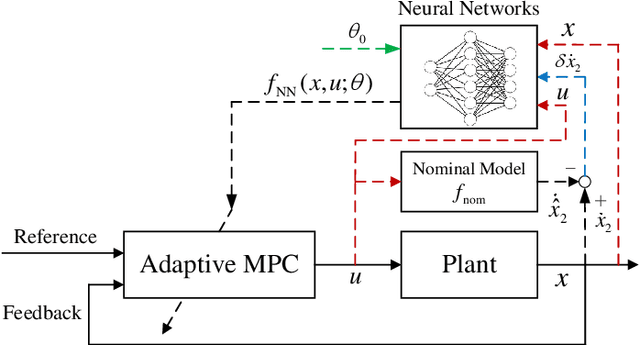
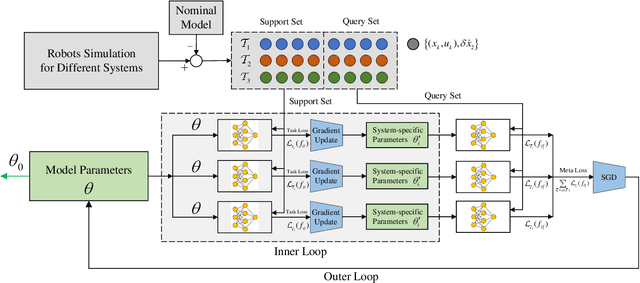
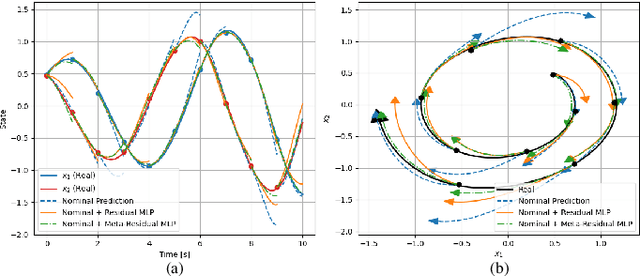
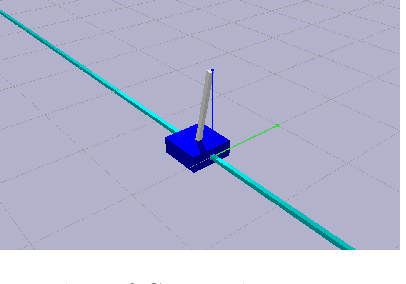
Data-driven model predictive control (MPC) has demonstrated significant potential for improving robot control performance in the presence of model uncertainties. However, existing approaches often require extensive offline data collection and computationally intensive training, limiting their ability to adapt online. To address these challenges, this paper presents a fast online adaptive MPC framework that leverages neural networks integrated with Model-Agnostic Meta-Learning (MAML). Our approach focuses on few-shot adaptation of residual dynamics - capturing the discrepancy between nominal and true system behavior - using minimal online data and gradient steps. By embedding these meta-learned residual models into a computationally efficient L4CasADi-based MPC pipeline, the proposed method enables rapid model correction, enhances predictive accuracy, and improves real-time control performance. We validate the framework through simulation studies on a Van der Pol oscillator, a Cart-Pole system, and a 2D quadrotor. Results show significant gains in adaptation speed and prediction accuracy over both nominal MPC and nominal MPC augmented with a freshly initialized neural network, underscoring the effectiveness of our approach for real-time adaptive robot control.
Back-stepping Experience Replay with Application to Model-free Reinforcement Learning for a Soft Snake Robot
Jan 21, 2024In this paper, we propose a novel technique, Back-stepping Experience Replay (BER), that is compatible with arbitrary off-policy reinforcement learning (RL) algorithms. BER aims to enhance learning efficiency in systems with approximate reversibility, reducing the need for complex reward shaping. The method constructs reversed trajectories using back-stepping transitions to reach random or fixed targets. Interpretable as a bi-directional approach, BER addresses inaccuracies in back-stepping transitions through a distillation of the replay experience during learning. Given the intricate nature of soft robots and their complex interactions with environments, we present an application of BER in a model-free RL approach for the locomotion and navigation of a soft snake robot, which is capable of serpentine motion enabled by anisotropic friction between the body and ground. In addition, a dynamic simulator is developed to assess the effectiveness and efficiency of the BER algorithm, in which the robot demonstrates successful learning (reaching a 100% success rate) and adeptly reaches random targets, achieving an average speed 48% faster than that of the best baseline approach.
Design and Nonlinear Modeling of a Modular Cable Driven Soft Robotic Arm
Jan 12, 2024We propose a novel multi-section cable-driven soft robotic arm inspired by octopus tentacles along with a new modeling approach. Each section of the modular manipulator is made of a soft tubing backbone, a soft silicon arm body, and two rigid endcaps, which connect adjacent sections and decouple the actuation cables of different sections. The soft robotic arm is made with casting after the rigid endcaps are 3D-printed, achieving low-cost and convenient fabrication. To capture the nonlinear effect of cables pushing into the soft silicon arm body, which results from the absence of intermediate rigid cable guides for higher compliance, an analytical static model is developed to capture the relationship between the bending curvature and the cable lengths. The proposed model shows superior prediction performance in experiments over that of a baseline model, especially under large bending conditions. Based on the nonlinear static model, a kinematic model of a multi-section arm is further developed and used to derive a motion planning algorithm. Experiments show that the proposed soft arm has high flexibility and a large workspace, and the tracking errors under the algorithm based on the proposed modeling approach are up to 52$\%$ smaller than those with the algorithm derived from the baseline model. The presented modeling approach is expected to be applicable to a broad range of soft cable-driven actuators and manipulators.
Label-Efficient Learning in Agriculture: A Comprehensive Review
May 24, 2023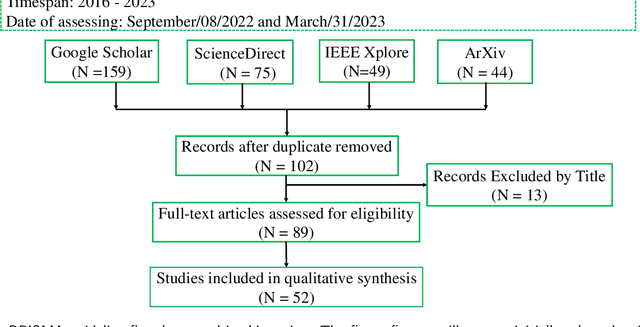
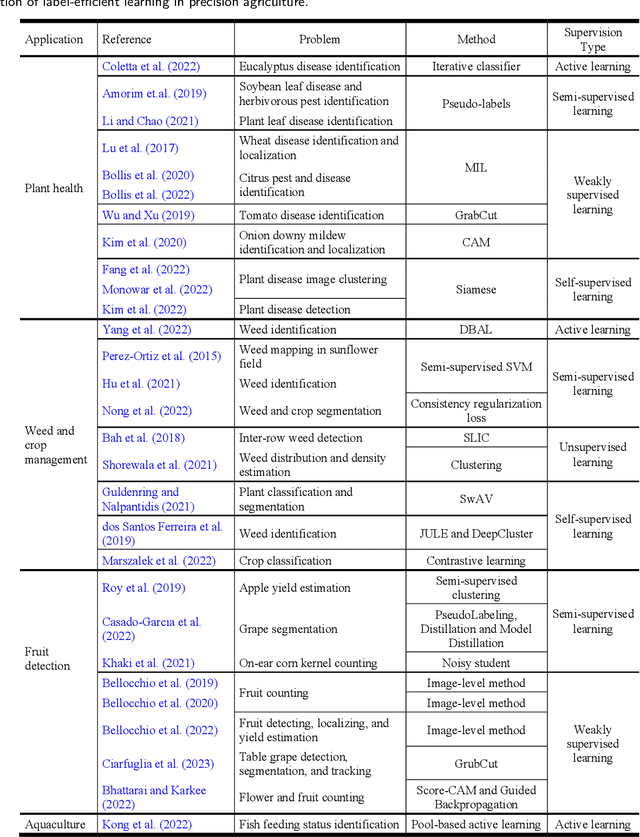
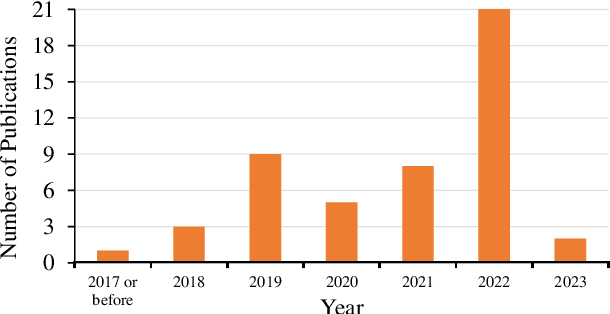
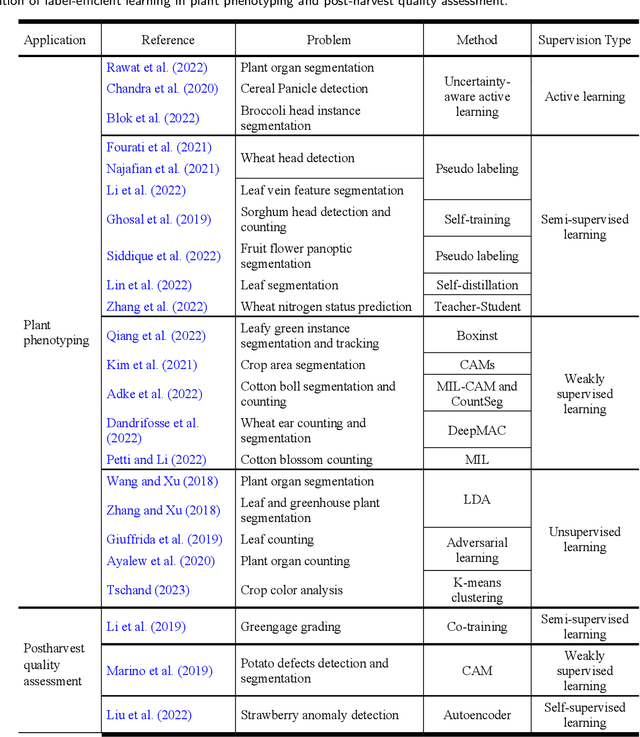
The past decade has witnessed many great successes of machine learning (ML) and deep learning (DL) applications in agricultural systems, including weed control, plant disease diagnosis, agricultural robotics, and precision livestock management. Despite tremendous progresses, one downside of such ML/DL models is that they generally rely on large-scale labeled datasets for training, and the performance of such models is strongly influenced by the size and quality of available labeled data samples. In addition, collecting, processing, and labeling such large-scale datasets is extremely costly and time-consuming, partially due to the rising cost in human labor. Therefore, developing label-efficient ML/DL methods for agricultural applications has received significant interests among researchers and practitioners. In fact, there are more than 50 papers on developing and applying deep-learning-based label-efficient techniques to address various agricultural problems since 2016, which motivates the authors to provide a timely and comprehensive review of recent label-efficient ML/DL methods in agricultural applications. To this end, we first develop a principled taxonomy to organize these methods according to the degree of supervision, including weak supervision (i.e., active learning and semi-/weakly- supervised learning), and no supervision (i.e., un-/self- supervised learning), supplemented by representative state-of-the-art label-efficient ML/DL methods. In addition, a systematic review of various agricultural applications exploiting these label-efficient algorithms, such as precision agriculture, plant phenotyping, and postharvest quality assessment, is presented. Finally, we discuss the current problems and challenges, as well as future research directions. A well-classified paper list can be accessed at https://github.com/DongChen06/Label-efficient-in-Agriculture.