 Add to Chrome
 Add to Firefox
 Add to Edge
PhotoBench: Beyond Visual Matching Towards Personalized Intent-Driven Photo Retrieval
Mar 02, 2026
Personal photo albums are not merely collections of static images but living, ecological archives defined by temporal continuity, social entanglement, and rich metadata, which makes the personalized photo retrieval non-trivial. However, existing retrieval benchmarks rely heavily on context-isolated web snapshots, failing to capture the multi-source reasoning required to resolve authentic, intent-driven user queries. To bridge this gap, we introduce PhotoBench, the first benchmark constructed from authentic, personal albums. It is designed to shift the paradigm from visual matching to personalized multi-source intent-driven reasoning. Based on a rigorous multi-source profiling framework, which integrates visual semantics, spatial-temporal metadata, social identity, and temporal events for each image, we synthesize complex intent-driven queries rooted in users' life trajectories. Extensive evaluation on PhotoBench exposes two critical limitations: the modality gap, where unified embedding models collapse on non-visual constraints, and the source fusion paradox, where agentic systems perform poor tool orchestration. These findings indicate that the next frontier in personal multimodal retrieval lies beyond unified embeddings, necessitating robust agentic reasoning systems capable of precise constraint satisfaction and multi-source fusion. Our PhotoBench is available.

OSCAR: Optimization-Steered Agentic Planning for Composed Image Retrieval
Feb 09, 2026Composed image retrieval (CIR) requires complex reasoning over heterogeneous visual and textual constraints. Existing approaches largely fall into two paradigms: unified embedding retrieval, which suffers from single-model myopia, and heuristic agentic retrieval, which is limited by suboptimal, trial-and-error orchestration. To this end, we propose OSCAR, an optimization-steered agentic planning framework for composed image retrieval. We are the first to reformulate agentic CIR from a heuristic search process into a principled trajectory optimization problem. Instead of relying on heuristic trial-and-error exploration, OSCAR employs a novel offline-online paradigm. In the offline phase, we model CIR via atomic retrieval selection and composition as a two-stage mixed-integer programming problem, mathematically deriving optimal trajectories that maximize ground-truth coverage for training samples via rigorous boolean set operations. These trajectories are then stored in a golden library to serve as in-context demonstrations for online steering of VLM planner at online inference time. Extensive experiments on three public benchmarks and a private industrial benchmark show that OSCAR consistently outperforms SOTA baselines. Notably, it achieves superior performance using only 10% of training data, demonstrating strong generalization of planning logic rather than dataset-specific memorization.
EEdit : Rethinking the Spatial and Temporal Redundancy for Efficient Image Editing
Mar 13, 2025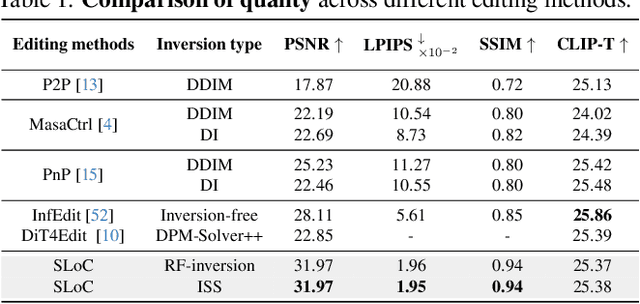
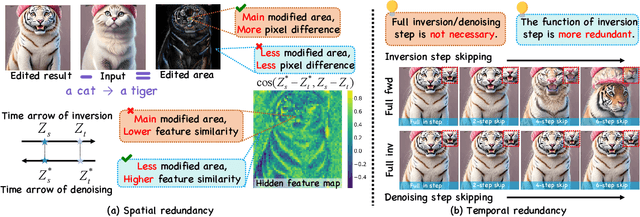
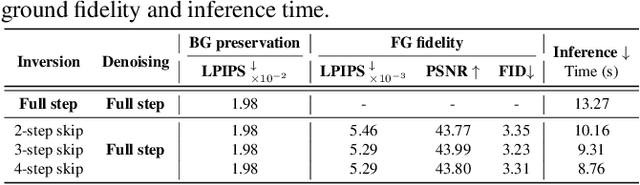
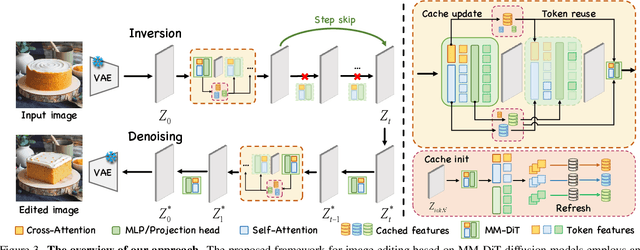
Inversion-based image editing is rapidly gaining momentum while suffering from significant computation overhead, hindering its application in real-time interactive scenarios. In this paper, we rethink that the redundancy in inversion-based image editing exists in both the spatial and temporal dimensions, such as the unnecessary computation in unedited regions and the redundancy in the inversion progress. To tackle these challenges, we propose a practical framework, named EEdit, to achieve efficient image editing. Specifically, we introduce three techniques to solve them one by one. For spatial redundancy, spatial locality caching is introduced to compute the edited region and its neighboring regions while skipping the unedited regions, and token indexing preprocessing is designed to further accelerate the caching. For temporal redundancy, inversion step skipping is proposed to reuse the latent for efficient editing. Our experiments demonstrate an average of 2.46 $\times$ acceleration without performance drop in a wide range of editing tasks including prompt-guided image editing, dragging and image composition. Our codes are available at https://github.com/yuriYanZeXuan/EEdit